Hair has carried spiritual significance across cultures for thousands of years.
Monks shave it. Yogis grow it. Religious figures cover it. Warriors have treated it as a symbol of vitality. In many traditions, changing the hair marks a transition in identity—a death of an old self, entry into religious life, mourning, purification, rebellion, or rebirth.
It is therefore interesting that one of humanity’s most emotionally significant physical changes—hair loss—frequently occurs around the same area associated with the crown chakra.
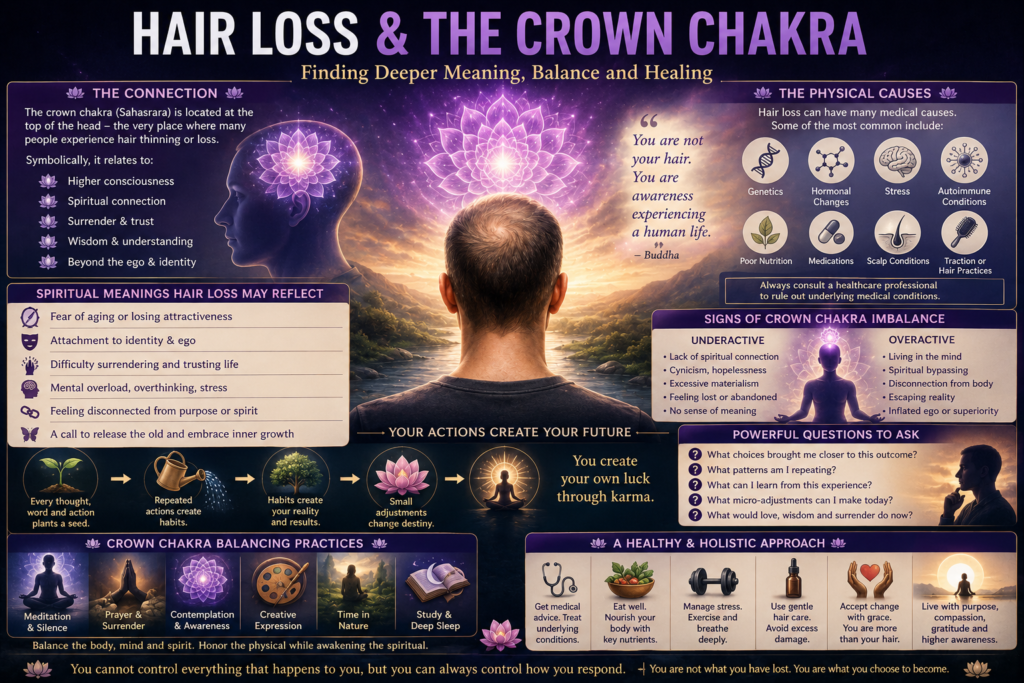
The crown chakra, or Sahasrara, is traditionally visualized at or above the top of the head. In yogic interpretations it is associated with consciousness, transcendence, surrender, spiritual understanding, and connection with something greater than the individual ego.
Could hair thinning around this region therefore represent an imbalance of the crown chakra?
Spiritually, it can be an interesting symbolic interpretation.
Medically, however, an important distinction must be made immediately:
There is currently no established scientific evidence that an imbalanced crown chakra directly causes hair loss.
Hair loss has well-established physical causes—including genetics, hormonal factors, autoimmune disease, illness, medications, nutritional problems, significant stress, and particular hair-care practices. (Mayo Clinic)
The most useful way to explore a crown-chakra connection is therefore not to replace medical explanations, but to ask whether hair loss can sometimes coincide with emotional, psychological, and spiritual conditions that a chakra system would describe as imbalance.
That creates a much more interesting mind-body-spirit discussion.
Why the Location Is Symbolically Interesting
The crown chakra is traditionally associated with the highest point of the human energy system.
It represents questions such as:
Who am I beyond my ego?
Do I trust life?
Do I have a sense of meaning?
Am I connected to something larger than myself?
Can I surrender what I cannot control?
Am I spiritually grounded, or am I trapped entirely inside thought?
Hair loss often becomes noticeable at precisely this part of the body.
In common hereditary pattern hair loss, the crown can be one of the major areas affected. Other conditions can also cause thinning around the centre or crown of the scalp. The American Academy of Dermatology, for example, notes that central centrifugal cicatricial alopecia can begin with hair loss at the centre or crown and that early treatment matters because the condition can eventually cause permanent loss. (AAD)
That physical location does not prove a chakra mechanism.
But symbolically, it creates an intriguing overlap.
The part of the body traditionally associated with spiritual connection is also an area where many people experience a visible loss of something strongly connected with identity.
Hair Is Deeply Connected With Identity
Hair is unusual because it is part of the body but also part of our social identity.
We style it.
Grow it.
Cut it.
Colour it.
Hide it.
Display it.
Associate it with attractiveness, age, sexuality, rebellion, discipline, culture, masculinity, femininity, and personality.
When someone begins losing hair, the experience is therefore rarely perceived as merely biological.
A person may think:
Am I getting old?
Am I becoming less attractive?
Is something wrong with my body?
Am I losing control?
Those questions immediately move hair loss into the psychological realm.
And once questions about identity, control, aging, impermanence, and self-image appear, the symbolism of the crown chakra becomes much more relevant.
Hair loss may not be caused by a crown-chakra imbalance.
But hair loss can certainly challenge the very issues traditionally associated with the crown chakra.
The Crown Chakra Is About Surrender
One of the most difficult spiritual lessons is accepting that we do not control everything.
People can exercise.
Eat well.
Meditate.
Take care of their appearance.
Build careers.
Develop relationships.
And eventually life still introduces change.
Bodies age.
People leave.
Plans fail.
Illness happens.
Beauty changes.
Hair thins.
The ego naturally resists these changes because the ego wants continuity.
It says:
I want to remain exactly as I recognize myself.
The crown chakra represents almost the opposite principle.
It asks us to loosen our grip.
Not to become passive, but to understand that life is larger than our attempts to control it.
From this perspective, hair loss can become an unexpected crown-chakra lesson.
You can investigate it medically.
You can treat it.
You can improve nutrition.
You can reduce damaging hair practices.
You can explore available therapies.
But alongside all that, you may eventually have to confront another question:
Who am I if my appearance changes?
That is a deeply spiritual question.
Stress Creates One Possible Bridge Between the Physical and Spiritual
There is one area where the medical and spiritual interpretations can partially meet: stress.
Certain forms of significant physical or psychological stress can trigger temporary excessive shedding called telogen effluvium. The American Academy of Dermatology and Mayo Clinic both recognize stress-related hair shedding, and Mayo notes that controlling stress may allow hair to regrow in some stress-related cases. (AAD)
This does not mean:
Stress → blocked chakra → baldness.
Human biology is much more complicated.
But consider what chronic stress often feels like spiritually.
Constant thinking.
Difficulty surrendering.
Fear of the future.
Hypervigilance.
Loss of trust.
Feeling disconnected from meaning.
Obsessive attempts to control events.
Mental exhaustion.
In a chakra framework, many of these experiences might be described as disturbances around the upper chakras, particularly the third eye and crown.
Medically, severe or prolonged stress can also affect the body.
The two languages are different.
One describes physiology.
The other describes subjective spiritual experience.
They do not have to be treated as enemies.
An Overactive Crown May Be Just as Significant as a “Blocked” Crown
People often describe chakras too simplistically.
Something goes wrong and they immediately say:
“My chakra must be blocked.”
But spiritual imbalance can occur through excess as well as deficiency.
An underactive crown might symbolically resemble:
- Feeling spiritually disconnected
- Believing life has no meaning
- Excessive materialism
- Cynicism
- Isolation
- Lack of trust
- Feeling abandoned by life or God
An overactive crown might resemble:
- Living almost entirely inside the mind
- Constant abstract thinking
- Spiritual obsession
- Neglecting the physical body
- Trying to transcend ordinary life
- Excessive meditation without grounding
- Using spirituality to escape practical problems
- Believing every physical symptom must have a mystical explanation
That final point is particularly relevant to hair loss.
Paradoxically, someone attempting to heal the crown chakra could become more imbalanced by interpreting a treatable medical condition only through spirituality.
True spiritual awareness should increase discernment rather than eliminate it.
If your roof is leaking, meditation may help you respond calmly.
You still fix the roof.
Hair Loss Can Become a Crisis of Ego
Imagine someone who has always been known for beautiful, thick hair.
Perhaps it has become part of their identity.
People compliment it.
They style themselves around it.
It contributes to how attractive they feel.
Then it begins thinning.
Suddenly, something they unconsciously assumed would remain forever starts disappearing.
The physical problem may be biological.
But the suffering around it can become existential.
Why me?
Why now?
What will people think?
Will I still be attractive?
Am I becoming old?
The Buddhist concept of attachment becomes relevant here.
Suffering often increases when we demand permanence from something inherently impermanent.
That does not mean we should refuse treatment.
It means treatment and acceptance can coexist.
You can attempt to preserve your hair without allowing hair to determine your worth.
That is arguably a healthier crown-chakra response than either panic or denial.
Could Hair Loss Be a Spiritual Message?
There is no scientific method for demonstrating that the universe sends messages through hair loss.
But personal spirituality frequently involves using life events as material for reflection.
Instead of saying:
“My hair is falling out because my crown chakra is blocked.”
A more useful spiritual question may be:
“What is this experience showing me about myself?”
Perhaps it exposes fear of aging.
Perhaps you realize how much identity was attached to appearance.
Perhaps stress has become overwhelming.
Perhaps you have been neglecting the body while focusing excessively on work or spiritual pursuits.
Perhaps the experience forces you to develop acceptance.
Perhaps nothing profound is happening at all—you simply inherited androgenetic alopecia.
Even then, your response to the situation can become spiritual practice.
A spiritual lesson does not require a supernatural cause.
Hair Loss at the Crown Should Not Automatically Be Called a Chakra Problem
This is particularly important because different patterns of hair loss can point toward different medical conditions.
Hereditary pattern baldness is extremely common. Hair loss may also arise from hormonal changes, thyroid problems, autoimmune alopecia areata, scalp infections, medications, significant weight loss, poor nutrition, stress, and other causes. (Mayo Clinic)
Tight hairstyles can also create traction alopecia, and repeated pulling can eventually cause permanent loss. (AAD)
Alopecia areata occurs when the immune system attacks hair follicles and often produces characteristic patches of hair loss. (AAD)
So if someone suddenly notices hair disappearing around the crown, the first assumption should not be:
“My spiritual energy is blocked.”
It should be:
“What is happening to my scalp and follicles?”
Then the spiritual investigation can occur alongside the physical one.
Sudden Hair Loss Deserves Attention
Gradual hereditary thinning and sudden unexplained loss are not necessarily the same situation.
If hair loss is sudden, patchy, substantially heavier than usual, or accompanied by other scalp or health changes, medical evaluation is sensible. Sudden hair loss can sometimes indicate an underlying condition that deserves treatment. (Mayo Clinic)
Spiritual practices should therefore complement appropriate medical investigation rather than postpone it.
This is especially important because some forms of hair loss respond better when identified early. (AAD)
The Crown Chakra and the Fear of Aging
Hair loss is often one of the first unmistakable signs that the body is changing.
A person can ignore many aspects of aging.
Hair can make the process visible in the mirror.
This confrontation with aging connects beautifully with crown-chakra philosophy because the crown concerns the movement beyond identification with the temporary physical self.
The question becomes:
Am I my hair?
Obviously not.
Am I my face?
My body?
My profession?
My possessions?
My social reputation?
My age?
The spiritual traditions associated with transcendence repeatedly ask us to investigate what remains when temporary identities are stripped away.
Hair loss can unexpectedly provoke that investigation.
That does not make baldness spiritually superior.
Nor does keeping one’s hair indicate spiritual attachment.
The deeper issue is whether your internal stability depends completely upon maintaining a particular external form.
Buddhist Monks Voluntarily Remove Their Hair
The symbolism becomes even more interesting when we consider Buddhist monastic traditions.
Monastics traditionally shave their heads as part of renunciation.
The gesture strips away an important form of personal decoration and social identity.
A monk does intentionally what many people experiencing hair loss desperately fear happening naturally.
The message is not:
Hair is bad.
It is:
Your identity is deeper than your appearance.
For someone losing hair involuntarily, contemplating this symbolism can transform the psychological experience.
Instead of seeing only loss, the person may ask:
What identity am I defending?
Can I care about appearance without worshipping it?
Can I remain confident when the body changes?
Can I distinguish self-care from attachment?
Those questions move directly into crown-chakra territory.
Shiva, Hair, and Spiritual Power
Hindu symbolism presents another fascinating contrast.
Shiva is frequently portrayed with enormous matted locks—jata—representing ascetic power, wildness, yogic discipline, and mastery over ordinary social conventions.
The sacred river Ganga is famously depicted descending through Shiva’s hair before reaching Earth.
Here hair represents spiritual force rather than vanity.
Buddhist monks symbolize renunciation by removing hair.
Shiva symbolizes yogic transcendence through wild hair.
Different spiritual traditions therefore demonstrate an important point:
There is no universally sacred amount of hair.
A shaved head can represent awakening.
Long hair can represent awakening.
Baldness can belong to an enlightened person.
Thick hair can belong to an enlightened person.
Spirituality does not reside inside the follicle.
What matters is consciousness.
Why Crown-Chakra Work May Still Help Someone Experiencing Hair Loss
Even if crown meditation does not regrow hair, it may help with the emotional and spiritual dimensions surrounding the experience.
Crown-oriented practices typically emphasize:
- Meditation
- Silence
- Surrender
- Prayer
- Contemplation
- Nonattachment
- Trust
- Awareness beyond ego
- Connection with the divine or universal consciousness
These practices may help someone stop obsessively checking the mirror, catastrophizing every shed hair, or defining personal value entirely through appearance.
That itself can be meaningful healing.
Healing does not always mean returning the body to its previous condition.
Sometimes healing means changing the relationship with what is happening.
Meditation
Sit quietly and bring awareness to the top of the head.
You do not have to imagine that mysterious energy is physically repairing follicles.
Instead, visualize a thousand-petaled lotus opening above the crown.
Allow the breath to slow.
Imagine unnecessary tension leaving the scalp, forehead, jaw, neck, and shoulders.
Then contemplate:
“My body changes, but awareness remains.”
This shifts crown work away from magical thinking and toward spiritual insight.
Practise Surrender Without Giving Up
There is an important difference between surrender and resignation.
Resignation says:
“Nothing can be done.”
Surrender says:
“I will do what I reasonably can, and I will stop mentally fighting what I cannot control.”
You can book a medical assessment.
Research treatment options.
Take care of your scalp.
Improve lifestyle factors where appropriate.
And simultaneously say:
Whatever happens to my hair, I remain myself.
That is a powerful crown-chakra practice.
Reduce Chronic Mental Overload
If your life consists of constant work, notifications, arguments, financial worries, social media, news, and obsessive planning, creating periods of silence may be useful whether or not you believe in chakras.
Walk without headphones.
Meditate.
Spend time in nature.
Reduce unnecessary outrage content.
Sleep adequately.
Allow periods in which the nervous system is not constantly processing information.
If significant stress is contributing to temporary shedding, addressing that stress may also have physical relevance. (Mayo Clinic)
Ground the Lower Chakras Too
Ironically, crown-chakra problems should not always be addressed by doing more crown work.
Someone who feels spiritually scattered may need grounding.
Exercise.
Eat properly.
Sleep.
Spend time outdoors.
Clean your home.
Deal with financial responsibilities.
Build relationships.
Work with your hands.
Reconnect with the physical world.
A healthy spiritual life should connect heaven and earth.
The purpose of the crown is not to escape the body.
It is to place the body within a larger understanding of existence.
Stop Measuring Spirituality Through Physical Symptoms
One trap in energy work is believing that every physical improvement means spiritual success and every physical problem means spiritual failure.
That can become cruel.
A person may meditate deeply and still develop cancer.
A compassionate person may have alopecia.
A spiritually confused person may have magnificent hair.
Human physiology does not operate as a visible morality meter.
Hair loss should therefore never be interpreted as proof that someone is spiritually blocked, karmically inferior, disconnected from God, or energetically contaminated.
The chakra model is most useful as a tool for self-reflection, not judgment.
Combining the Medical and Spiritual Approaches
A balanced approach might look like this:
Physical level:
Determine the kind of hair loss and investigate possible biological causes.
Lifestyle level:
Examine nutrition, sleep, stress, hair practices, general health, and anything else relevant to the individual situation.
Psychological level:
Notice anxiety, self-esteem changes, obsessive checking, shame, or fear of aging.
Spiritual level:
Explore attachment, identity, surrender, impermanence, trust, and your relationship with something larger than appearance.
The four approaches do not need to compete.
The dermatologist examines the follicle.
The psychologist examines emotional distress.
The spiritual practitioner examines meaning.
Each is asking a different question.
Perhaps the Real Crown-Chakra Imbalance Is the Fear
There is an interesting reversal here.
Maybe hair loss itself is not the crown-chakra imbalance.
Perhaps the imbalance is the belief:
“If I lose my hair, I lose myself.”
That is exactly the kind of identification that crown-oriented spirituality attempts to transcend.
The crown reminds us that consciousness is larger than appearance.
Hair can be beautiful.
Caring about it is normal.
Trying to preserve it is reasonable.
But it does not contain your soul.
The spiritual challenge is to hold both truths simultaneously:
I can value my hair without making my identity dependent upon it.
That may be the healthiest possible relationship between hair loss and the crown chakra.
Conclusion
There is no established medical evidence that a blocked or imbalanced crown chakra directly causes hair loss.
Hair loss can result from hereditary pattern baldness, autoimmune conditions, stress-related shedding, hormonal or medical problems, medications, nutritional issues, damaging hairstyles, and numerous other physical causes. (Mayo Clinic)
But that does not make the crown-chakra perspective meaningless.
Hair loss occurs in a part of the body that spiritual traditions associate with transcendence, identity beyond ego, surrender, consciousness, and connection to something greater.
And hair loss itself can confront us with exactly those issues.
It can challenge vanity.
Expose fear of aging.
Reveal attachment.
Force acceptance of impermanence.
Encourage better stress management.
Ask whether our confidence resides within ourselves or only within our reflection.
The physical cause may lie in the follicle.
The spiritual lesson may lie somewhere much deeper.
Perhaps the most balanced response is therefore neither:
“This is purely physical and has no spiritual meaning.”
nor:
“My crown chakra caused my hair to fall out.”
It is:
“I will take care of my body seriously while also listening to what this experience is teaching my consciousness.”
That approach respects both science and spirituality.
And perhaps that balance itself is a sign of a healthier crown chakra.