Motorcycling is often described as freedom, adrenaline, danger, focus, rebellion, and connection with the road.
From a chakra perspective, however, riding a motorcycle can be understood as something more interesting: a full-body energetic experience that activates several chakras at once.
The vibrations of the machine, the need for balance, the sensation of acceleration, the awareness of danger, the wind against the body, and the intense concentration required to ride all engage different psychological and energetic qualities.
There is no scientific evidence that riding a motorcycle literally activates chakras as measurable energy centres. Chakras belong to Indian yogic and spiritual traditions rather than modern anatomy.
But as a symbolic framework, motorcycling maps surprisingly well onto the chakra system.
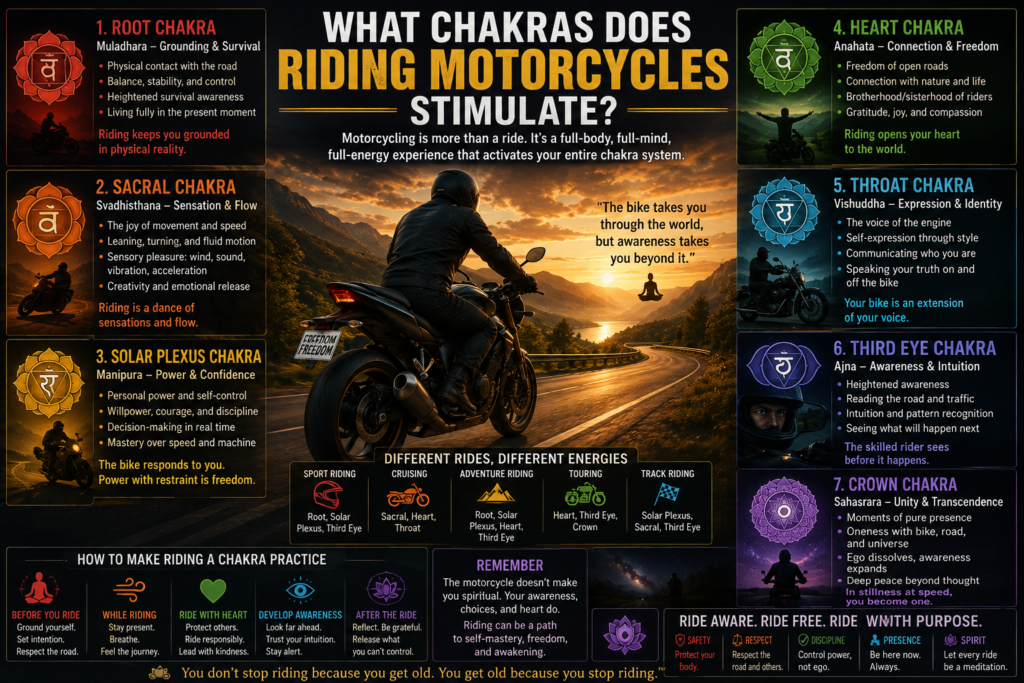
Different styles of riding may stimulate different chakras, but the strongest relationships are usually with the:
- Root chakra
- Sacral chakra
- Solar plexus chakra
- Heart chakra
- Throat chakra
- Third-eye chakra
And under certain conditions, even the crown chakra.
Motorcycling may therefore be one of the most interesting modern activities for experiencing the entire energy system simultaneously.
The Root Chakra: Survival, Grounding, and Physical Reality
The root chakra, or Muladhara, is the chakra most obviously connected with motorcycling.
It is traditionally associated with:
- Survival
- Safety
- Stability
- Grounding
- Physical awareness
- Instinct
- Courage
- The material world
When riding a motorcycle, survival awareness is constantly present.
Unlike sitting inside a car surrounded by a metal frame, a rider is physically exposed.
Road surface matters.
Weather matters.
Balance matters.
Speed matters.
Traffic matters.
A motorcycle demands continual awareness of physical reality.
You cannot completely disappear into thought while riding safely.
Your consciousness is repeatedly pulled back into:
Where am I?
What is around me?
What is the road doing?
Where is my body positioned?
This is extremely root-chakra-oriented.
The Vibration of the Motorcycle May Feel Root-Chakra Stimulating
Motorcycles physically vibrate through the rider’s body.
The feet rest directly on pegs connected to the frame.
The legs grip the motorcycle.
The pelvis and lower body feel the engine and road.
From a chakra perspective, this naturally draws attention toward the lower body and grounding centres.
This may partially explain why riding can feel so physically satisfying.
You are not simply observing movement.
You are sitting directly on top of the machine producing it.
The rider feels connected with the mechanical system underneath them.
Spiritually, this can create an intense sense of being inside the physical world rather than merely thinking about it.
Root Chakra and Fear
The root chakra also deals with fear.
Motorcycles naturally introduce controlled risk.
Even experienced riders understand that falling is possible.
The important psychological transformation happens when fear becomes awareness rather than panic.
A beginning rider may feel:
“I could fall.”
An experienced rider eventually transforms that into:
“I understand the risk, so I remain alert.”
That is a healthy root chakra.
The goal is not to eliminate fear.
Fear exists for a reason.
The goal is to prevent fear from controlling the mind.
Sacral Chakra: Motion, Sensation, and Pleasure
The sacral chakra, or Svadhisthana, is associated with:
- Pleasure
- Sensation
- Movement
- Sexual energy
- Creativity
- Flow
- Emotional expression
- Enjoyment of life
Motorcycling strongly stimulates this chakra through sensory experience.
Acceleration.
Cornering.
Engine sound.
Wind.
Temperature.
Movement.
Road rhythm.
The sensation of leaning through a curve is especially sacral in character.
The rider is not travelling through the road in a rigid straight line.
The motorcycle and body move together.
This produces something similar to dance.
Motorcycling as Mechanical Dance
A skilled rider does not fight the motorcycle.
They flow with it.
Weight shifts.
Pressure changes.
The body leans.
The motorcycle responds.
Throttle, clutch, braking, steering, and posture combine into one continuous movement.
This resembles many activities associated with sacral energy:
Dance.
Swimming.
Martial arts.
Sexual movement.
Surfing.
Skiing.
Yoga.
The person becomes less rigid and more responsive.
The sacral chakra represents this ability to move with life rather than against it.
A rider who is excessively tense often rides worse.
The body has to relax enough to respond fluidly.
The Pleasure of Acceleration
Acceleration is one of the most obvious sensory pleasures of motorcycling.
When the throttle opens and the motorcycle surges forward, the body receives a powerful physical stimulus.
That sensation can feel exciting, liberating, even euphoric.
This belongs partly to the sacral chakra because the sacral centre concerns pleasure and sensation.
But the same experience simultaneously activates the solar plexus.
That combination is important.
Sacral says:
This feels good.
Solar plexus says:
I control this power.
Solar Plexus Chakra: Power, Confidence, and Control
The solar plexus chakra, or Manipura, may be the strongest chakra associated with performance riding.
It traditionally represents:
- Personal power
- Confidence
- Willpower
- Courage
- Discipline
- Self-control
- Decision-making
- Assertiveness
A motorcycle places enormous mechanical power directly under the rider’s control.
Your right hand controls acceleration.
Your hands and feet control braking and shifting.
Your body controls balance and direction.
Small movements produce substantial consequences.
This creates an intimate relationship with personal power.
The Motorcycle Does What You Tell It
Motorcycles respond quickly.
Twist the throttle aggressively and acceleration changes immediately.
Brake too hard and weight transfers dramatically.
Shift incorrectly and the machine responds.
Lean too far or enter a corner too fast and physics provides immediate feedback.
This makes motorcycling highly solar-plexus oriented.
The rider learns:
My decisions matter.
The machine constantly reflects the quality of those decisions.
That can build confidence.
But it can also expose ego.
The Solar Plexus Can Become Overactive
Motorcycling can stimulate healthy confidence.
It can also stimulate:
- Aggression
- Competitiveness
- Dominance
- Recklessness
- Showing off
- Speed addiction
- Ego identification
This would represent an overactive solar plexus.
A rider begins believing:
“I need to prove that I am brave.”
“I need to be faster.”
“I need people to notice me.”
“I cannot let another rider pass me.”
This turns power into ego.
A healthy solar plexus says:
I have power, therefore I must control it.
An unhealthy solar plexus says:
I have power, therefore I must display it.
Motorcycling can teach either lesson.
Riding Can Train Self-Mastery
One of the most spiritually valuable aspects of motorcycling is learning that having power does not mean using all of it.
Your motorcycle may be capable of travelling much faster than the situation allows.
Maturity means controlling desire.
That makes riding surprisingly similar to martial arts.
A skilled martial artist possesses force but does not attack unnecessarily.
A skilled motorcyclist possesses speed but does not constantly use maximum speed.
True power includes restraint.
This is classic solar-plexus development.
Heart Chakra: Freedom and Connection With the World
The heart chakra, or Anahata, is associated with:
- Love
- Openness
- Connection
- Compassion
- Emotional freedom
- Gratitude
- Joy
Motorcycling may not immediately seem heart-centred.
But many riders describe the experience emotionally.
They talk about feeling alive.
Connected.
Free.
Present.
Grateful.
This can become a genuine heart-opening experience.
Riding Removes the Barrier Between You and the Environment
Inside a car, the world exists outside the windows.
On a motorcycle, you are physically immersed in it.
You smell forests.
Feel temperature changes.
Notice humidity.
Feel wind.
Experience sunlight directly.
Smell rain before it arrives.
Notice the air change near lakes or fields.
The environment is no longer scenery behind glass.
You are moving through it.
That can create a strong feeling of connection with nature.
This is one way riding can stimulate the heart chakra.
Motorcycle Community Can Also Stimulate the Heart
Riders often acknowledge one another.
A wave.
A nod.
Helping someone with a mechanical problem.
Stopping when another rider appears stranded.
Group rides can create a surprisingly strong sense of community.
The shared understanding is:
You know what this feels like too.
This creates connection around experience rather than biography.
That can be very heart-centred.
The Heart Chakra Can Balance the Solar Plexus
This is particularly important for motorcycle culture.
Motorcycling easily stimulates power and ego.
The heart balances that with responsibility.
Solar plexus asks:
What can I do?
Heart asks:
How will what I do affect everyone around me?
A heart-centred rider does not only consider personal excitement.
They consider:
Passengers.
Pedestrians.
Other riders.
Drivers.
Families.
The people who care about them.
This changes the meaning of riding.
Freedom becomes responsibility.
Throat Chakra: Sound, Expression, and Identity
The throat chakra, or Vishuddha, represents:
- Expression
- Communication
- Voice
- Authenticity
- Identity
- Creative self-expression
Motorcycles are extremely expressive objects.
Different bikes communicate different identities.
A cruiser.
Sportbike.
Cafe racer.
Adventure bike.
Classic motorcycle.
Scooter.
Custom machine.
Even before someone speaks, their motorcycle may communicate something about taste, lifestyle, aesthetics, and personality.
This makes motorcycling surprisingly throat-chakra-oriented.
The Exhaust Note as Voice
The motorcycle itself has a voice.
Engine note is central to motorcycle identity.
A single-cylinder thumper sounds different from a parallel twin.
A V-twin sounds different from an inline-four.
Some riders modify exhaust systems partly because they want the motorcycle to express more personality.
Symbolically, the engine becomes a kind of external throat chakra.
The motorcycle announces itself through sound.
However, just like human communication, healthy expression should consider others.
An expressive exhaust and deliberately disturbing an entire neighbourhood are not the same thing.
The chakra lesson remains balance.
Clothing and Motorcycles as Self-Expression
Helmets.
Jackets.
Patches.
Colours.
Motorcycle design.
Custom paint.
Mechanical modifications.
These become forms of identity expression.
Motorcycle culture frequently allows people to express parts of themselves that may be suppressed in ordinary life.
Someone who appears conventional at work may become visually expressive on a motorcycle.
That can create psychological freedom.
Third-Eye Chakra: Awareness and Prediction
The third-eye chakra, or Ajna, may be one of the most important chakras for skilled riding.
It represents:
- Awareness
- Intuition
- Pattern recognition
- Insight
- Concentration
- Perception
- Anticipation
Experienced riders constantly predict what will happen before it happens.
That car may change lanes.
That pedestrian might step out.
The road surface looks slippery.
That driver has not noticed me.
That corner tightens.
The traffic light may change.
This is essentially advanced pattern recognition.
The rider begins perceiving intentions through subtle signals.
Riding Develops Situational Awareness
A good rider does not simply look at what is happening.
They look for what is about to happen.
Where are the car’s wheels pointing?
Where is the driver’s head turned?
Is there gravel near the intersection?
Where is the escape route?
Is the vehicle approaching too quickly from behind?
This resembles what many spiritual traditions call heightened awareness.
The third eye is not necessarily about supernatural visions.
It can also represent the capacity to perceive deeper patterns before they become obvious.
Motorcycling trains exactly that ability.
Intuition Becomes Fast Pattern Recognition
Experienced riders sometimes say:
“I just had a feeling that car was going to move.”
This can feel like intuition.
Often, the brain has detected multiple subtle clues without consciously verbalizing them.
Body position.
Vehicle movement.
Road positioning.
Driver behaviour.
The result reaches consciousness as a feeling.
In spiritual language, one might describe this as third-eye sensitivity.
In psychological language, it can be described as experienced pattern recognition.
Either way, riding develops it.
Riding Can Produce a Meditative State
This is one of the most interesting parts of motorcycling.
When riding intensely but safely, the mind may become unusually quiet.
There is no room for:
Yesterday’s argument.
Tomorrow’s work problem.
Social media.
Random anxiety.
Internal dialogue.
Attention becomes absorbed in the present.
Throttle.
Road.
Balance.
Traffic.
Breathing.
Body.
This resembles flow state.
And flow state strongly resembles certain meditative experiences.
The Crown Chakra: Transcendence and the Rider–Machine Experience
The crown chakra, or Sahasrara, is associated with:
- Transcendence
- Unity
- Consciousness
- Spiritual connection
- Ego dissolution
- Meaning
- Oneness
Motorcycling does not automatically activate the crown chakra.
But under certain conditions, riding can become almost spiritual.
A long ride through mountains.
Empty countryside.
Sunset.
No traffic.
Perfect rhythm.
The motorcycle feels like an extension of the body.
Thinking disappears.
There is simply:
Road.
Machine.
Body.
Awareness.
Some riders describe this as one of the closest experiences they have to meditation.
When Rider and Motorcycle Become One
Beginners experience the motorcycle as something separate.
They consciously think:
Clutch.
Throttle.
Brake.
Shift.
Lean.
Experienced riders gradually stop thinking about these individual actions.
The motorcycle becomes incorporated into body awareness.
Psychologically, the boundaries of the self seem to expand.
The rider does not merely sit on the motorcycle.
They begin feeling through it.
The tires become almost like additional sensory organs.
That experience can resemble the crown chakra’s theme of dissolving boundaries between self and environment.
Motorcycling and Zen
Motorcycling has a surprisingly Zen quality.
Zen practice emphasizes direct experience.
Not endless conceptual thinking.
When riding, excessive thinking can actually interfere with performance.
You need awareness without mental noise.
A rider enters a corner.
There is no philosophical discussion about cornering.
There is simply cornering.
This resembles the Zen principle of complete presence in action.
Wash the bowl.
Sweep the floor.
Drink tea.
Ride the motorcycle.
When the mind is completely present, even an ordinary activity can become meditation.
Which Chakra Does Motorcycling Stimulate the Most?
For most riders, the strongest combination is probably:
1. Root Chakra
Because riding directly involves survival, balance, grounding, and physical awareness.
2. Solar Plexus Chakra
Because riding involves power, control, confidence, discipline, and courage.
3. Sacral Chakra
Because riding provides movement, pleasure, flow, sensation, and excitement.
These three lower chakras form the energetic foundation of motorcycling.
The upper chakras become increasingly involved as the rider develops awareness, emotional connection, self-expression, and meditative presence.
Different Riding Styles May Stimulate Different Chakras
Sport Riding
Strongly stimulates:
- Root
- Solar plexus
- Sacral
- Third eye
It involves danger awareness, performance, acceleration, body movement, and rapid decision-making.
Cruising
May stimulate:
- Root
- Sacral
- Heart
- Throat
The focus becomes physical rhythm, pleasure, identity, freedom, and emotional enjoyment.
Adventure Riding
May strongly stimulate:
- Root
- Solar plexus
- Heart
- Third eye
Terrain, navigation, endurance, uncertainty, and connection with nature become central.
Touring
May stimulate:
- Heart
- Third eye
- Crown
Long-distance travel can become reflective and meditative.
Track Riding
Strongly stimulates:
- Solar plexus
- Sacral
- Third eye
The rider explores controlled performance, skill, speed, and concentration in a relatively structured environment.
Motorcycles Can Also Reveal Chakra Imbalances
The way someone rides may reveal psychological tendencies.
An excessively fearful rider may need stronger grounding.
A reckless rider may have an overactive solar plexus or underdeveloped root awareness.
Someone obsessed with speed may be overusing stimulation through the sacral chakra.
Someone riding primarily to impress others may be expressing solar plexus and throat imbalance.
Someone completely disconnected from danger may have confused spiritual freedom with lack of responsibility.
Motorcycling does not automatically make someone spiritually balanced.
Like any powerful activity, it amplifies what is already present.
Riding Can Become a Chakra Practice
A rider could consciously turn motorcycling into an energetic mindfulness practice.
Before riding:
Ground yourself.
Feel your feet.
Notice your breathing.
Check the motorcycle carefully.
While riding:
Root
Feel the road and your physical stability.
Sacral
Relax into movement.
Solar Plexus
Control power rather than being controlled by it.
Heart
Respect everyone sharing the road.
Throat
Let the motorcycle express you without needing attention.
Third Eye
Observe patterns and anticipate danger.
Crown
Allow periods of complete presence where rider, machine, and environment feel unified.
This turns riding from simple transportation into a form of moving meditation.
The Motorcycle as a Modern Spiritual Tool
A motorcycle is obviously a machine.
It runs on engineering, fuel or electricity, friction, combustion, electronics, and physics.
But human beings have always used physical activities as vehicles for spiritual development.
Archery became Zen practice.
Swordsmanship became spiritual discipline.
Tea preparation became meditation.
Walking became pilgrimage.
Martial arts became paths of self-mastery.
Motorcycling can work similarly.
The machine itself does not create spirituality.
The consciousness brought to the activity does.
Conclusion
From a chakra perspective, motorcycle riding stimulates several energy centres simultaneously.
The root chakra is activated through survival awareness, grounding, balance, and physical connection with the road.
The sacral chakra is stimulated through motion, pleasure, leaning, acceleration, flow, and sensory experience.
The solar plexus chakra is strongly engaged through power, confidence, discipline, decision-making, and control of the machine.
The heart chakra can open through freedom, gratitude, community, and direct connection with nature.
The throat chakra appears through the motorcycle’s sound, style, individuality, and personal expression.
The third-eye chakra is exercised through situational awareness, intuition, pattern recognition, and anticipation.
And during deeply focused rides, the crown chakra may emerge through flow state, silence, transcendence, and the feeling that rider, motorcycle, road, and environment have temporarily become one experience.
Motorcycling therefore does not stimulate only one chakra.
At its best, it becomes a full energetic system.
The lower chakras keep the rider grounded, alive, and powerful.
The upper chakras transform that power into awareness, responsibility, connection, and presence.
Perhaps that is why riding can feel so much more profound than simply travelling from one location to another.
A motorcycle does not just move the body.
For some riders, it moves consciousness.