
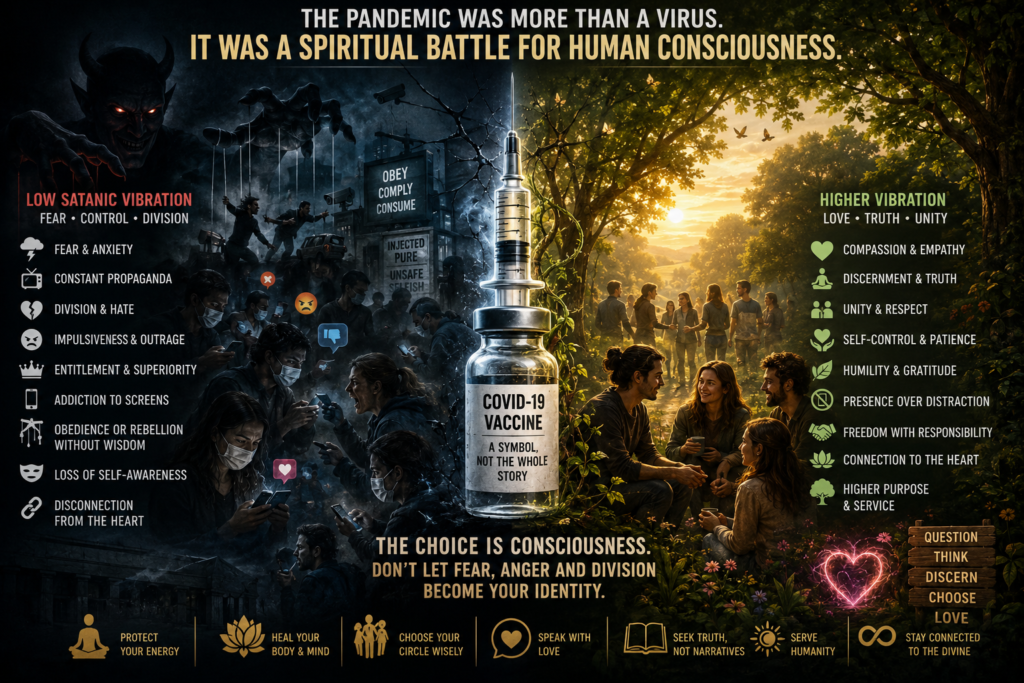
The COVID era did more than introduce a virus and a worldwide vaccination campaign. It transformed the emotional atmosphere of society.
People became more reactive, suspicious, impulsive, entitled, judgmental, and politically hostile. Families divided. Friendships ended. Strangers began treating one another as moral enemies. People who once seemed relatively calm became consumed by outrage, fear, resentment, and the need to control others.
From a spiritual perspective, these behaviours can be described as manifestations of a low vibration: consciousness dominated by fear, anger, compulsion, pride, division, and unconscious reaction.
Some people believe the COVID vaccines themselves contributed to this change. They may feel that something entered humanity physically and spiritually, lowering consciousness and making people easier to manipulate.
However, it is important to distinguish between a spiritual interpretation and a medical claim.
There is no established scientific evidence that COVID vaccination causes lasting impulsiveness, entitlement, anger, moral corruption, or a “Satanic vibration.” Major vaccine-safety monitoring describes recognized reactions such as injection-site pain, fatigue, headache, fever, chills, muscle pain and, rarely, more serious adverse events. Chronic personality changes such as widespread aggression or entitlement are not established vaccine effects. (CDC)
The more defensible spiritual argument is not that a substance mechanically turned people evil. It is that the entire COVID system created conditions in which lower emotional states could flourish.
The vaccine became part of that system, but it was not necessarily the chemical cause of the spiritual condition.
The Pandemic Placed Humanity Into a State of Fear
Fear was the dominant emotional frequency of the pandemic.
People feared infection, death, unemployment, isolation, strangers, hospitals, government restrictions, social rejection, and an uncertain future. Every cough became suspicious. Every person became a potential carrier. Ordinary human closeness was temporarily reframed as danger.
Fear is one of the easiest states through which people can be controlled.
A frightened person does not think with the same patience and clarity as a calm person. Fear narrows attention. It encourages immediate reaction, tribal loyalty, suspicion, and the desire to find someone to blame.
In the first year of the pandemic, the World Health Organization reported a major global increase in anxiety and depression. This does not prove a supernatural explanation, but it demonstrates that the emotional disturbance was real and widespread. (World Health Organization)
From a spiritual perspective, fear disconnects people from the heart.
Instead of asking, “How can I understand and support another person?” the fearful mind asks:
“Is this person dangerous?”
“Is this person obeying?”
“Is this person on my side?”
“Can this person threaten my security?”
This shift prepared society for division.
The Vaccine Became a Symbol of Obedience and Resistance
The COVID vaccine was not experienced merely as a medical product. It became an emotional and political symbol.
For some people, vaccination represented responsibility, protection, community, science, and the hope of returning to normal life.
For others, it represented pressure, institutional power, loss of bodily autonomy, employment threats, travel restrictions, social exclusion, and distrust of authorities.
Because it carried so much symbolic weight, the vaccine debate activated emotions far beyond medicine.
People were no longer merely discussing health risks. They were defending their identity, intelligence, morality, freedom, and membership within society.
This is one reason the topic continues to generate anger years later.
The injection itself may not have chemically created the anger. Instead, the surrounding struggle left a psychological and spiritual imprint.
People felt judged.
People felt controlled.
People felt abandoned.
People felt that their suffering was dismissed.
People on every side believed that the opposing group was endangering society.
That emotional residue did not automatically disappear when restrictions ended.
Coercion Can Create Long-Term Resentment
Even when a medical intervention has legitimate benefits, pressure surrounding it can produce resentment.
Some people felt they could not freely choose because their employment, education, travel, relationships, or participation in society depended upon their vaccination status.
Others felt that people refusing vaccination were placing vulnerable individuals at risk and prolonging the crisis.
Both groups experienced the other as a threat.
This created a spiritual environment based on compulsion rather than mutual understanding.
A person who feels forced may carry anger long after the original situation ends. A person who believes others endangered them may continue carrying moral outrage. Both forms of resentment can become part of the personality when they are repeatedly rehearsed.
The spiritual danger is not simply the original disagreement.
It is the continuing attachment to anger.
When resentment becomes an identity, the person may feel that releasing it would mean admitting defeat. Anger then becomes a source of purpose, belonging, and self-righteousness.
This is one way a temporary crisis can create a lasting low vibration.
Outrage Became a Daily Habit
During the pandemic, millions of people spent more time online.
They watched infection statistics, arguments, government announcements, conspiracy claims, political commentary, personal testimonies, public shaming, and videos of people confronting one another.
Social-media platforms did not create every conflict, but they made conflict continuous.
Research during and following the pandemic found associations between heavier or problematic social-media use and increased stress, anxiety, depression, and other psychiatric symptoms. Social media also became a major channel through which pandemic fears and attitudes were amplified. (PubMed)
Outrage is stimulating.
It provides adrenaline, certainty, purpose, and the feeling of moral superiority. It gives people an enemy and a simple explanation for complicated suffering.
Eventually, some people stopped merely experiencing anger and began consuming it.
They woke up looking for something offensive.
They shared material designed to provoke their allies.
They interpreted disagreement as evidence of evil.
They experienced calmness as weakness and compromise as betrayal.
In spiritual language, they began feeding the very energy they claimed to oppose.
Satanic Influence Does Not Require a Magical Substance
When people imagine Satanic control, they may picture a mysterious chemical or supernatural force entering the body and directly changing the personality.
But spiritual corruption is often described more subtly.
Satanic influence, understood symbolically or literally, works through deception, fear, division, pride, temptation, resentment, and the distortion of good intentions.
A person does not need to receive a special substance to enter a low vibration.
They may enter it by constantly feeding hatred.
They may enter it by treating every opponent as less than human.
They may enter it by surrendering their judgment to a political tribe.
They may enter it by becoming addicted to outrage.
They may enter it by believing that cruelty is justified because they are on the “correct” side.
The most effective spiritual manipulation would not necessarily make people believe they are serving evil.
It would convince them that their anger is righteousness.
Entitlement Grew From Prolonged Crisis
The pandemic disrupted normal social expectations.
People became accustomed to emergency thinking. Governments, workplaces, businesses, and individuals repeatedly demanded that others change their behaviour.
Some demands were reasonable attempts to manage a public-health crisis. Others may have felt inconsistent, excessive, poorly communicated, or unfair.
Over time, the language of emergency can influence everyday behaviour.
People begin believing that their fear should control everyone else.
They expect institutions to remove all discomfort.
They demand immediate accommodation.
They treat personal disagreement as harm.
They feel entitled to know other people’s medical decisions, political beliefs, travel history, or private risk calculations.
This entitlement appeared on multiple sides.
Some people believed everyone should obey institutional guidance without question.
Others believed every restriction was illegitimate and that their personal preferences should override any communal responsibility.
Both extremes placed the ego at the centre.
The spiritually mature position requires discernment: respecting individual dignity while recognizing that personal choices can sometimes affect others.
Impulsiveness Came From a Dysregulated Nervous System
People who remain under prolonged stress often become more reactive.
Sleep may deteriorate. Patience may shorten. Small frustrations may feel threatening. People may seek immediate comfort through food, substances, shopping, pornography, arguments, gambling, social media, or reckless behaviour.
This does not mean everyone experiencing stress behaves destructively. It means prolonged uncertainty can weaken emotional regulation.
The pandemic disrupted routines, relationships, employment, exercise, community gatherings, religious practice, dating, education, and ordinary human contact.
Many people lost the structures that had quietly regulated their emotions.
When those structures disappeared, their hidden anger, loneliness, addictions, and unresolved wounds became more visible.
The vaccine rollout occurred during this emotionally unstable period. This timing can create the impression that vaccination caused everything that followed.
But timing alone does not demonstrate causation.
COVID Infection Itself Can Affect Mental Health
Another complication is that COVID infection—not merely the social response—can produce neurological and psychiatric symptoms in some people.
Studies and clinical reviews have reported anxiety, depression, sleep disturbances, cognitive difficulties, agitation, irritability, and other neuropsychiatric symptoms during or following infection, particularly in some cases of long COVID. (PubMed Central (PMC))
This matters because someone may observe a personality or emotional change after the COVID period and automatically attribute it to vaccination.
But the person may also have experienced infection, isolation, grief, financial stress, disrupted sleep, social-media overload, medication changes, relationship breakdown, or another health problem.
Human behaviour rarely has only one cause.
Sudden or severe personality changes should be medically evaluated rather than automatically interpreted as spiritual corruption or vaccine injury.
Why the Vaccine Theory Feels Spiritually Convincing
The theory persists partly because the vaccine represented an unusual intersection of the body, authority, fear, technology, and social control.
It involved governments directing citizens toward an intervention.
It involved corporations producing new products rapidly.
It involved digital records and access rules.
It involved intense media messaging.
It involved restrictions affecting travel, employment, and social participation.
For spiritually sensitive people, this could feel like more than medicine. It could feel like a ritual of submission to a technological system.
That feeling should not simply be mocked.
Symbols affect consciousness.
Even when a substance does not chemically alter someone’s morality, the experience surrounding it may still leave feelings of violation, fear, humiliation, conformity, betrayal, or distrust.
A person who experienced vaccination as coercive may carry a different psychological imprint than someone who freely chose it and experienced it as protection.
The spiritual effect may therefore come less from the biological material and more from the meaning attached to the event.
The Real Low-Vibration System
A more credible spiritual interpretation is that the pandemic became a vast machine for generating lower emotional energy.
Fear generated obedience.
Isolation generated loneliness.
Loneliness increased dependence on screens.
Screens delivered outrage.
Outrage created division.
Division created entitlement and dehumanization.
Economic stress created desperation.
Uncertainty created impulsiveness.
Political identity replaced independent judgment.
The vaccine battle became one component of this machine, but it was not the entire machine.
Focusing exclusively on the injection may prevent people from recognizing the broader forces still influencing them.
A person may blame the vaccine while continuing to consume six hours of outrage content each day.
Another may defend the vaccine while continuing to treat unvaccinated people with contempt.
Both may remain trapped in the same low vibration.
What Would “Satanic Vibration” Actually Mean?
The word “Satanic” should not simply be used to describe everything frightening, unpopular, or technologically unfamiliar.
Spiritually, a Satanic vibration can be understood as a pattern that separates people from truth, compassion, self-control, humility, and awareness.
Its characteristics include:
- Fear replacing discernment
- Rage replacing reason
- Pride replacing humility
- Compulsion replacing freedom
- Tribalism replacing individual conscience
- Dehumanization replacing compassion
- Constant stimulation replacing inner stillness
- Obedience or rebellion without wisdom
- The desire to dominate others
- The inability to admit uncertainty
Under this definition, vaccinated and unvaccinated people can both fall into a low vibration.
The determining factor is not merely what entered the arm.
It is what occupies the heart and mind.
How to Break the Pandemic’s Spiritual Aftermath
Escaping this state does not require pretending that nothing harmful occurred.
People can question policies, discuss adverse experiences, criticize institutions, and demand transparency without becoming consumed by hatred.
Likewise, people can believe vaccination was beneficial without humiliating those who made different choices.
Stop Feeding Outrage
Reduce exposure to content designed primarily to provoke anger.
Ask whether a post is informing you or merely activating you.
Not every controversy deserves your nervous system.
Restore the Body
Sleep, exercise, sunlight, nutritious food, breathing exercises, time in nature, and reduced substance dependence can help restore emotional regulation.
Spiritual work becomes harder when the nervous system remains exhausted.
Reopen the Heart Chakra
Heart-centred practice may include compassion meditation, prayer, gratitude, forgiveness, honest conversation, service, and physical presence with trustworthy people.
Opening the heart does not mean abandoning boundaries.
It means refusing to let resentment become your permanent identity.
Question Both Authority and Rebellion
Blind obedience is dangerous.
Blind opposition can be equally manipulable.
A person who automatically rejects everything an institution says is not necessarily freer than someone who automatically accepts it.
Discernment requires examining each claim separately.
Allow People to Tell Their Stories
Some people believe vaccination protected them or their families.
Some believe they were harmed.
Some regret receiving it.
Some regret refusing it.
Some experienced coercion.
Some experienced severe COVID and wished protection had been available sooner.
Human experiences do not fit neatly into one political narrative.
Listening does not require immediate agreement.
Seek Medical Evaluation for Persistent Symptoms
People experiencing persistent physical, cognitive, or emotional symptoms after vaccination or infection deserve serious medical attention.
They should not automatically be dismissed, but neither should a single explanation be assumed without investigation.
Acknowledging uncertainty is more honest than forcing every experience into either “the vaccines are completely harmless” or “the vaccines spiritually corrupted humanity.”
The Greatest Victory Would Be Permanent Division
If there were a Satanic intelligence attempting to control humanity, its greatest achievement would not merely be persuading people to accept or reject a vaccine.
Its greater victory would be turning the decision into a permanent civil war.
It would convince vaccinated people that the unvaccinated are ignorant and morally inferior.
It would convince unvaccinated people that everyone who received a dose has become spiritually contaminated or less human.
It would keep both sides emotionally attached to the crisis long after the emergency ended.
It would transform grief into ideology, uncertainty into hatred, and legitimate questions into tribal warfare.
Most importantly, it would prevent reconciliation.
Conclusion
The COVID era did appear to leave many people in a lower emotional state characterized by impulsiveness, outrage, entitlement, fear, and anger.
But it is not accurate to state as established fact that the vaccines chemically created those personality traits or placed humanity into a Satanic vibration.
The larger pandemic environment offers a more convincing explanation.
Fear, isolation, coercion, institutional distrust, infection, economic disruption, social-media addiction, political tribalism, and chronic nervous-system stress combined to produce an emotionally volatile society.
The vaccine became one of the central symbols within that struggle.
Spiritually, the important question is not only what was injected into the body.
It is what people allowed to remain within their consciousness afterward.
Did fear remain?
Did resentment remain?
Did the need to control others remain?
Did outrage become an addiction?
Did political identity replace compassion?
The most powerful way to resist a low vibration is not to obsessively condemn one group. It is to recover awareness, self-control, discernment, courage, compassion, and the ability to see humanity in people who made different choices.
The pandemic may have opened the door to fear and division.
Humanity does not have to keep living inside that room.