
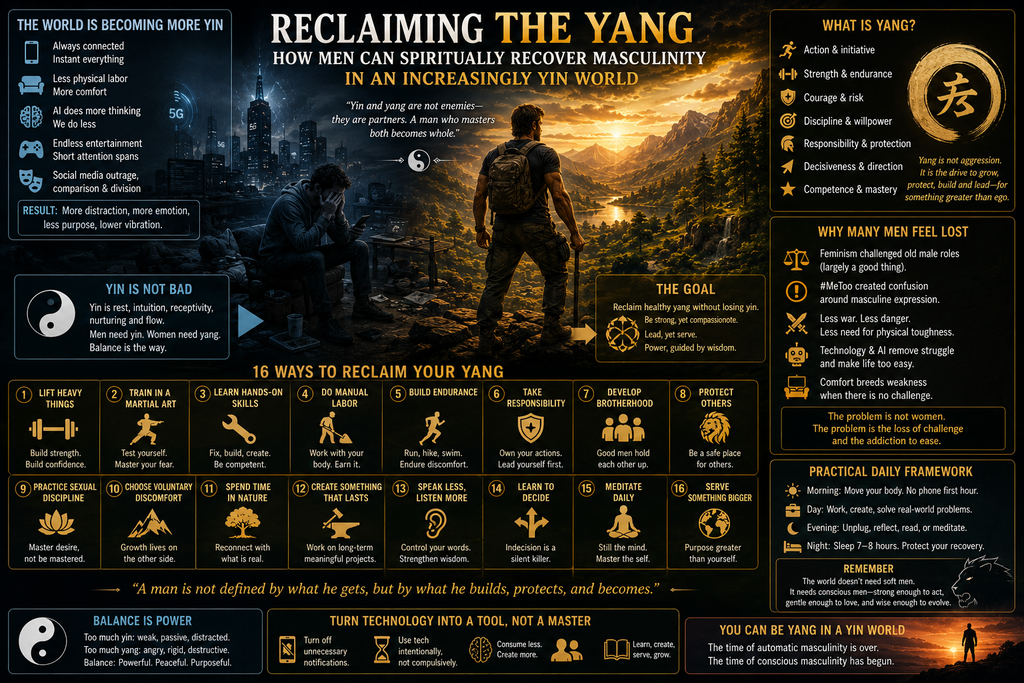
Something unusual is happening to masculinity.
For most of human history, being male almost automatically exposed a person to physically demanding conditions.
Men hunted.
Farmed.
Built.
Carried.
Repaired.
Fought.
Protected territory.
Worked with animals.
Sailed.
Climbed.
Constructed homes.
Operated machinery.
Went underground into mines.
Spent long periods outside.
And, unfortunately, large numbers of men also went to war.
None of this means the past was better. Much of it was brutal, dangerous, unfair, and physically destructive.
But those conditions continually exercised qualities traditionally associated with yang energy:
Action.
Courage.
Strength.
Risk.
Competition.
Decisiveness.
Physical competence.
Endurance.
Responsibility.
Protection.
The modern world increasingly removes the necessity for many of these things.
Machines perform physical labour.
Software handles calculations.
Navigation systems tell us where to go.
Food arrives at the door.
Dating begins through screens.
Entertainment requires almost no effort.
Remote work eliminates the commute.
Artificial intelligence increasingly performs cognitive tasks that once required sustained effort.
The International Labour Organization describes AI as transforming work by automating or augmenting human tasks, and its latest 2026 work emphasizes growing importance for adaptability, resilience and human agency as occupational skill requirements shift.
Human civilization has become extraordinarily efficient at eliminating friction.
That is largely an achievement.
But spiritually, there may be a price.
A man can now construct an entire life in which he rarely has to lift something heavy, repair anything, confront physical danger, endure discomfort, make difficult decisions under pressure, navigate without assistance, or test himself against another man.
In Taoist language, we might say that modern life contains increasingly yin conditions:
Passive.
Comfortable.
Indoor.
Digital.
Receptive.
Safe.
Sedentary.
Soft.
Virtual.
Convenient.
This does not mean yin is bad or that femininity is inferior. Classical yin-yang thought treats yin and yang as complementary forces whose interaction creates balance. Although yin has historically been associated with feminine qualities and yang with masculine qualities, neither belongs exclusively to one sex, and Chinese philosophy fundamentally treats them as relational rather than as two substances at war with each other.
Women need yang.
Men need yin.
But a man who spends almost his entire existence inside yin conditions may begin feeling that something inside him has gone dormant.
The solution is not attacking women.
It is not reversing feminism.
It is not becoming aggressive.
It is not pretending to be an ancient warrior.
The solution is much simpler:
A modern man can deliberately cultivate the yang qualities that modern civilization no longer forces him to develop automatically.
Yin and Yang Are Not Simply Woman and Man
This distinction is important.
Modern popular culture often reduces the system to:
Yin = feminine.
Yang = masculine.
Traditionally, it is considerably deeper.
Yin is associated with tendencies such as:
Stillness.
Receptivity.
Darkness.
Coolness.
Interior space.
Yielding.
Rest.
Containment.
Yang is associated with:
Movement.
Expansion.
Heat.
Light.
Exterior action.
Assertion.
Direction.
Activity.
Traditional Chinese thought associates these symbolically with feminine and masculine qualities, but everything contains both.
A man sleeping is in a more yin state.
A woman sprinting uphill is expressing yang.
Meditation can contain yin stillness and extraordinary yang discipline simultaneously.
Leadership requires yang decisiveness but also yin listening.
A healthy human being needs both.
The problem therefore isn’t:
“The world has become feminine, and feminine things are bad.”
The spiritually interesting question is:
“Has modern civilization removed so much necessary friction that men can now reach adulthood without sufficiently developing their yang?”
That is a much more useful question.
Masculinity Used to Be Tested by Circumstance
For much of history, a man did not need to deliberately schedule opportunities to test himself.
Life supplied them.
A farm needed repairing.
Wood needed cutting.
A roof leaked.
Animals needed managing.
Winter approached.
A machine broke.
Someone had to build something.
Physical work could not be outsourced through an app.
This had obvious disadvantages.
People suffered terrible workplace injuries.
Bodies wore out.
Dangerous work killed people.
Modern technology has rightly eliminated much unnecessary suffering.
But the same process removed a kind of involuntary initiation.
Modern men sometimes have to manufacture the challenge that previous men encountered automatically.
This is why activities such as martial arts, weightlifting, wilderness travel and mechanical work can feel spiritually satisfying even when the person does not economically need them.
The activity wakes up something that ordinary life rarely demands.
Men No Longer Need to Be Warriors—and That Is Good
One should be careful about romanticizing war.
War is not a masculinity-development program.
It traumatizes, maims and kills people.
The fact that many modern men can live entire lives without being forced onto a battlefield represents enormous progress.
But historically, warfare was one of the environments in which masculine virtues and masculine shadows were both concentrated.
Courage.
Brotherhood.
Sacrifice.
Endurance.
Leadership.
But also:
Cruelty.
Domination.
Tribalism.
Violence.
Dehumanization.
The spiritual task of the modern man is therefore fascinating.
Can he preserve the virtues of the warrior without needing the war?
Can he develop courage without brutality?
Strength without domination?
Discipline without authoritarianism?
Brotherhood without tribal hatred?
Aggression without cruelty?
That is arguably a more evolved masculinity than simply recreating the past.
Feminism Changed the Masculine Role
Feminism profoundly changed relations between men and women.
Women gained greater independence in education, employment, finances, sexuality, politics and family life.
That means men are no longer automatically guaranteed a social role simply because they are men.
A woman may not need a man:
To earn money.
To own property.
To access financial institutions.
To perform many household tasks.
To create social status.
To physically survive.
That can feel destabilizing because the old masculine bargain was relatively straightforward:
Become useful enough and society will give you a role.
Today’s man often needs to answer a harder question:
Who are you when masculinity is no longer simply a job assigned at birth?
This can actually become a spiritual opportunity.
A man now has to choose what kind of man he wants to become.
#MeToo Changed the Rules of Masculine Expression
The #MeToo movement produced another major cultural adjustment.
Behaviour once overlooked or quietly tolerated—sexual harassment, coercion, abuse of workplace authority and unwanted sexual behaviour—became much more publicly scrutinized.
That was an important correction.
But social corrections also create periods of uncertainty.
Pew found in 2022 that 46% of Americans believed the increased focus on sexual harassment and assault had made it harder for men to know how to interact with women at work, compared with 21% who said it had made things easier. At the same time, most respondents believed people reporting harassment were more likely to be believed than before.
So there is something real beneath the feeling that men became more cautious.
But the conclusion should not be:
“Men can no longer be masculine.”
The better conclusion is:
Modern masculinity needs greater precision.
Confidence is not harassment.
Flirting is not entitlement.
Leadership is not domination.
Assertiveness is not coercion.
Sexuality is not disregard for boundaries.
Strength is not cruelty.
The spiritually mature masculine learns the difference.
Masculinity Is Not Actually Universally Rejected
It is also easy to exaggerate the cultural backlash against masculinity.
A major 2024 Pew survey found that more Americans said masculine or “manly” men are viewed positively than negatively—43% versus 25%. The same research found significant public uncertainty about changing gender expectations and how men are adapting to them.
The situation is therefore more complicated than:
“Society hates masculine men.”
What has become less acceptable are particular expressions of masculinity.
Uncontrolled aggression.
Sexual entitlement.
Bullying.
Dominance for its own sake.
Emotional irresponsibility.
But traits such as confidence, courage, competence, protection, discipline and decisiveness remain useful.
Perhaps modern men do not need less masculinity.
They need masculinity with better consciousness behind it.
The Problem May Be Uninitiated Masculinity
Older cultures frequently had rites of passage.
A boy went through something difficult and emerged with a new status.
Modern adolescence can continue almost indefinitely.
A person can be thirty and still live psychologically like a teenager:
Games.
Pornography.
Food delivery.
Social media.
Entertainment.
Avoiding responsibility.
Avoiding discomfort.
Avoiding commitment.
Avoiding difficult conversations.
Avoiding risk.
Technology can make this lifestyle extraordinarily comfortable.
Nobody deliberately designed an anti-masculine conspiracy.
Technology simply became excellent at making difficult things easier.
But masculinity develops partly through encountering resistance.
A muscle grows because resistance exists.
Character often works similarly.
AI Creates an Even Stranger Masculine Problem
Artificial intelligence is pushing this process further.
You no longer necessarily have to:
Write everything.
Calculate everything.
Research everything.
Design everything.
Remember everything.
Program everything.
Solve everything independently.
AI can help.
That is enormously powerful.
But the spiritual danger is obvious:
If technology continually removes difficulty, where does the human being develop competence?
The ILO’s research suggests AI will often transform and augment jobs rather than simply eliminate human work, but it is clearly changing the balance of tasks people perform.
The masculine response should not be rejecting AI.
It should be:
Use the tool without allowing the tool to eliminate your capacity.
Let AI calculate something.
But understand the principle.
Let GPS navigate.
But develop a sense of direction.
Let YouTube show you how to repair something.
Then physically repair it.
Technology should multiply capability rather than replace identity.
The Yang Principle Is Agency
If masculinity had to be reduced to one spiritual principle, perhaps it would be:
Agency.
I can act.
I can choose.
I can intervene.
I can carry.
I can endure.
I can build.
I can protect.
I can decide.
I can take responsibility for consequences.
Yang moves outward.
It changes conditions.
Yin receives reality.
Yang shapes reality.
Both are necessary.
But someone whose life becomes overwhelmingly passive may eventually experience helplessness.
Video games simulate agency.
Social media simulates social power.
Pornography simulates sexual abundance.
Online arguments simulate combat.
Watching sports simulates competition.
The digital world provides representations of masculine experience.
But simulation is not always embodiment.
At some point, the man needs to do something.
Healthy Yang vs. Shadow Yang
This distinction should anchor the entire conversation.
Healthy Yang
Strength.
Confidence.
Initiative.
Courage.
Discipline.
Responsibility.
Protection.
Leadership.
Boundary-setting.
Competence.
Endurance.
Purpose.
Shadow Yang
Domination.
Cruelty.
Violence.
Narcissism.
Sexual coercion.
Bullying.
Recklessness.
Arrogance.
Anger without control.
Needless risk.
Treating vulnerability as weakness.
The goal is not simply “more yang.”
A fire can warm a house.
Too much fire burns it down.
The task is conscious yang.
1. Lift Heavy Things
Strength training may be one of the simplest modern masculine practices.
The iron does not care:
Who you know.
How confident you claim to be.
How many followers you have.
What your social status is.
Either you can move the weight or you cannot.
Then you train.
A few months later, something that once felt impossible moves.
This creates an extremely clean relationship between:
Effort.
Discomfort.
Adaptation.
Result.
Strength training teaches a basic yang lesson:
Resistance does not necessarily mean stop. Resistance may be exactly what produces growth.
You do not need to become a bodybuilder.
The spiritual purpose is embodiment.
Feel yourself occupying physical reality.
2. Learn a Martial Art
Martial arts are especially valuable because they preserve some lessons of the warrior without requiring real warfare.
Boxing.
Muay Thai.
Wrestling.
Brazilian jiu-jitsu.
Judo.
Karate.
Taekwondo.
Kendo.
Traditional martial arts.
The particular system matters less than genuine training.
Someone attempts something against you.
You respond.
Pressure becomes real.
Fatigue becomes real.
Fear becomes real.
Ego becomes visible.
This teaches an important masculine paradox:
The more capable you become of violence, the less psychological need you may have to prove it unnecessarily.
A trained fighter does not need every disagreement to become a dominance contest.
That is mature yang.
Power under control.
3. Learn to Fix Physical Things
Modern masculinity can become dangerously abstract.
Emails.
Spreadsheets.
Apps.
Meetings.
Digital assets.
Virtual experiences.
There is value in deliberately returning to matter.
Change your own oil.
Learn basic plumbing.
Repair a bicycle.
Replace a broken electrical fixture safely.
Learn woodworking.
Understand an engine.
Fix drywall.
Build furniture.
Maintain tools.
Learn how household systems actually work.
Mechanical work creates a relationship between thought and matter.
Something is broken.
Diagnose it.
Touch it.
Disassemble it.
Understand it.
Repair it.
Test it.
The result exists physically.
The masculine psyche often finds this deeply satisfying because it converts agency into visible order.
4. Perform Manual Labour Even When You Don’t Have To
There is spiritual value in occasionally doing something the inefficient way.
Dig.
Carry.
Move furniture.
Garden.
Split wood where appropriate.
Paint a room.
Clean something difficult.
Work on a car.
Build something.
Modern convenience teaches:
Avoid unnecessary effort.
Spiritual development sometimes requires the opposite:
Choose useful effort precisely because it develops you.
This does not mean damaging your body unnecessarily.
The goal is not suffering for its own sake.
It is remembering that your body is capable of affecting the physical world.
5. Develop Endurance
Yang is not simply explosive force.
It is also sustained direction.
Run.
Hike.
Cycle.
Swim.
Train for distance.
Carry a backpack.
Climb.
Do physically challenging outdoor activities within your abilities.
Endurance teaches:
I am uncomfortable, but I do not immediately need relief.
That lesson transfers everywhere.
Financial pressure.
Career difficulty.
Relationship uncertainty.
Long projects.
A man who has practised staying calm while exhausted possesses evidence that discomfort does not automatically control him.
6. Spend Time in Nature Without Making It Content
Go somewhere without needing to photograph every moment.
Walk.
Camp.
Fish.
Hike.
Sit beside water.
Learn basic navigation.
Learn weather.
Observe terrain.
Nature creates useful humility.
The physical world does not negotiate with ego.
Rain falls.
The hill remains steep.
The temperature changes.
You adjust.
This awakens yang through action while simultaneously developing yin receptivity.
That is balance.
7. Take Responsibility Before You Seek Authority
Some men want leadership because leadership looks powerful.
Real masculine leadership begins somewhere less glamorous:
Responsibility.
If something goes wrong under your watch, you own your contribution.
If you make a promise, follow through.
If people depend on you, become dependable.
If you make the decision, accept the consequences.
Authority without responsibility is immature yang.
Responsibility before authority is mature yang.
A man should be able to say:
“That was my decision. It did not work. I will correct it.”
Few statements are more masculine than that.
8. Become Protective Without Becoming Controlling
The protector archetype remains deeply masculine.
But modern men must understand it carefully.
Protection does not mean:
Owning women.
Controlling partners.
Deciding what everyone else may do.
Treating people as incapable.
Healthy protection means:
You notice danger.
You prepare.
You intervene when necessary.
You defend someone being bullied.
You remain calm during emergencies.
You learn first aid.
You know basic safety.
You make your environment more secure.
You help people become stronger rather than making them dependent upon you.
Protection says:
“Your freedom is safer because I am here.”
Control says:
“Your freedom disappears because I am here.”
Those are opposites.
9. Practise Sexual Discipline
Masculine sexuality becomes weak when desire automatically controls behaviour.
Pornography.
Compulsive swiping.
Chasing validation.
Needing constant sexual attention.
Allowing attraction to override judgment.
This is not powerful yang.
It is being controlled by appetite.
The spiritually masculine position is:
I can experience desire without immediately obeying it.
That may include:
Reducing pornography.
Being deliberate about dating.
Not pursuing every attractive person.
Maintaining standards.
Respecting consent.
Avoiding desperation.
Allowing sexual energy to become motivation rather than compulsion.
Tantric traditions understood sexual energy as power.
Power becomes useful when directed.
10. Choose Voluntary Discomfort
Modern life continually asks:
How can this become easier?
Occasionally ask:
What useful difficult thing am I avoiding?
Wake earlier.
Train when you do not feel motivated.
Take the stairs.
Fast appropriately if healthy for you.
Have the difficult conversation.
Finish the unpleasant task first.
Walk instead of driving a short distance.
Put the phone away.
Spend time alone.
Do the thing you keep postponing.
Voluntary discomfort teaches the nervous system:
I do not have to obey every request for immediate comfort.
That is enormously yang.
11. Build Something That Takes Years
Modern technology creates short reward loops.
Post.
Like.
Swipe.
Buy.
Receive.
Masculine development often requires long horizons.
Build a business.
Restore a vehicle.
Learn a language.
Master an instrument.
Develop a martial art.
Write a book.
Create a garden.
Become excellent in a technical field.
Build a body.
Build financial independence.
Become genuinely skilled at something.
Long projects create identity through accumulated action.
They teach another yang principle:
Direction matters more than momentary mood.
12. Develop Brotherhood
Men need other men.
Not merely drinking buddies.
Not only gaming friends.
Not people with whom the only connection is complaining about women.
Brotherhood traditionally developed through shared difficulty.
Train together.
Build together.
Travel together.
Compete.
Help one another.
Teach skills.
Tell each other uncomfortable truths.
Celebrate accomplishment without envy.
A healthy group of men can regulate masculine energy.
One man’s recklessness is corrected by another man’s judgment.
One man’s weakness is supported by another man’s strength.
One man’s arrogance is challenged.
The masculine becomes social rather than merely individual.
13. Stop Performing Masculinity for Other Men
A surprising amount of unhealthy masculinity is performed for male approval.
Who earns more?
Who slept with more women?
Who has the better car?
Who can drink more?
Who is tougher?
Who is dominant?
Who backs down first?
This is still dependency.
The man claims independence while allowing the tribe to define his worth.
Spiritual masculinity eventually asks:
Who am I when nobody is watching?
Can you leave a stupid fight?
Can you admit fear?
Can you choose a different career?
Can you love something unfashionable?
Can you reject the behaviour of your own group?
Independent masculinity requires the ability to stand alone.
14. Learn Decisiveness
Technology gives us nearly infinite options.
Paradoxically, this can make choosing harder.
Which restaurant?
Which career?
Which city?
Which person?
Which investment?
Which philosophy?
Which app?
Yang energy narrows possibility into action.
Gather enough information.
Then decide.
You will sometimes be wrong.
Correct course.
Chronic indecision often hides a desire to avoid responsibility for an imperfect outcome.
But a man cannot direct his life while waiting for certainty.
Sometimes mature yang says:
“I know enough. This is the direction.”
15. Learn Something That Could Help in an Emergency
There is profound confidence in useful competence.
Learn:
First aid.
CPR.
Basic fire response.
Emergency preparation.
How to shut off water.
How to change a tire.
How to use basic tools.
How to respond calmly to an injury.
How to navigate if technology fails.
How to help rather than panic.
The point is not preparing for apocalypse.
It is cultivating an identity:
When something goes wrong, I become more useful—not less.
That is the protector archetype made practical.
16. Meditate—Because Yang Without Consciousness Becomes Aggression
Meditation may seem yin.
The body is still.
Eyes may be closed.
Nothing outward happens.
Yet meditation develops one of the strongest forms of masculine discipline:
The ability not to obey impulse.
An itch appears.
Observe it.
Anger appears.
Observe it.
Sexual desire appears.
Observe it.
Fear appears.
Observe it.
You discover:
I experience the impulse.
I am not required to become the impulse.
This is exactly what healthy masculine power needs.
Strength without awareness becomes dangerous.
Awareness puts a driver behind the engine.
The Solar Plexus Chakra and Masculinity
From a chakra perspective, much of what we describe as masculine yang relates strongly to Manipura, the solar plexus chakra.
Manipura is associated with:
Will.
Confidence.
Personal power.
Direction.
Discipline.
Courage.
Agency.
The modern man can easily develop an underactive solar plexus.
Signs might symbolically include:
Chronic indecision.
Fear of confrontation.
Helplessness.
Dependency.
Lack of direction.
Constantly seeking permission.
Avoiding responsibility.
Living almost entirely through passive entertainment.
But the solar plexus can also become overactive:
Domination.
Aggression.
Control.
Narcissism.
Rage.
Obsession with winning.
The goal is balance.
The heart chakra must sit above the solar plexus for a reason.
Power rises into compassion.
Masculinity becomes most spiritually valuable when strength serves something beyond ego.
The Root Chakra Matters Too
Modern digital life can pull consciousness upward into the mind.
Screens.
Ideas.
Notifications.
Information.
Virtual relationships.
Financial abstractions.
AI.
The root chakra asks:
Are you actually embodied?
Feet on the ground.
Body trained.
Home maintained.
Finances organized.
Physical environment cared for.
Basic survival competence developed.
A man who can discuss philosophy for four hours but cannot cook a meal, maintain his surroundings or solve ordinary physical problems may be spiritually top-heavy.
Grounding restores masculine stability.
The Heart Prevents Masculinity From Becoming Brutality
Men sometimes fear that opening the heart makes them less masculine.
It can do the opposite.
A strong man who cannot love is incomplete.
The mature protector needs something worth protecting.
The mature leader needs people he cares about.
The mature warrior needs a reason not to fight unnecessarily.
The heart gives yang its purpose.
Without heart:
Strength becomes domination.
Competition becomes humiliation.
Sex becomes conquest.
Leadership becomes tyranny.
Confidence becomes narcissism.
With heart:
Strength becomes protection.
Competition becomes excellence.
Sex becomes connection.
Leadership becomes service.
Confidence becomes stability.
This is why spiritual masculinity is not simply moving downward toward primal instincts.
It requires the whole chakra system.
Masculinity Needs Yin Too
Ironically, a man trying too hard to become masculine can become unbalanced in the opposite direction.
Never resting.
Never admitting uncertainty.
Always competing.
Always working.
Always proving.
Never receiving.
Never listening.
Never feeling grief.
Never accepting help.
This is excessive yang.
Eventually the system burns out.
Yin gives masculine power somewhere to return.
Sleep.
Silence.
Receiving.
Reflection.
Tenderness.
Patience.
Listening.
Intuition.
Recovery.
A strong man should be able to enter yin deliberately without feeling that his masculinity has disappeared.
He rests so he can act again.
He listens so his decisions become wiser.
He feels so his strength remains human.
The Tao is not choosing yang and destroying yin.
It is knowing when each force is required.
Masculinity After Feminism Can Become Better Masculinity
Perhaps feminism did not destroy masculinity.
Perhaps it removed some of the social scaffolding that allowed weak masculinity to masquerade as strong masculinity.
A man can no longer automatically claim authority simply because he is male.
Good.
Now earn influence through competence.
A woman does not necessarily need your income.
Good.
Now develop character beyond being a paycheck.
Women have more freedom to reject men.
Good.
Now become someone worth freely choosing rather than someone society forces them to depend upon.
Sexual boundaries receive greater scrutiny.
Good.
Now develop confidence sophisticated enough to coexist with consent.
This creates a harder masculinity.
But potentially a better one.
Masculinity Does Not Require Women’s Submission
This point deserves emphasis.
Some men attempt to recover masculinity by demanding that women become more submissive.
But that makes masculine identity dependent upon female behaviour.
That is not strength.
If a man can only feel masculine when a woman makes herself smaller, his masculinity is fragile.
Yang should be internally generated.
You become disciplined because discipline is valuable.
Strong because strength is useful.
Competent because competence creates freedom.
Decisive because decisions are necessary.
Protective because you have the capacity to help.
You do not need another person to become weak so that you can experience yourself as strong.
Do Not Become Addicted to the Masculinity Industry
Modern male insecurity has created an enormous marketplace.
Influencers.
Courses.
Supplements.
“Alpha male” content.
Dating ideologies.
Status systems.
Endless arguments about masculinity.
Ironically, a man can spend five hours watching videos about becoming masculine while doing absolutely nothing masculine.
At some point:
Close the video.
Lift something.
Build something.
Fix something.
Train.
Read.
Work.
Lead.
Help somebody.
Sit quietly.
Make a decision.
Masculinity is not primarily a theory.
It becomes real through behaviour.
Stop Fighting Culture and Start Building Yourself
There is also little spiritual value in spending your entire life angry that society changed.
Feminism happened.
Technology exists.
AI is advancing.
Gender roles changed.
Remote work exists.
The service economy exists.
You cannot return civilization to 1955 even if you wanted to.
That is not the battlefield.
The masculine question is:
Given the world as it actually exists, what can I become?
That question contains agency.
Complaining that culture removed masculinity can itself become passive yin.
Creating the masculine qualities you believe are missing is yang.
The Modern Man Has an Extraordinary Opportunity
For the first time, many men can cultivate masculine virtues without being forced to endure the worst historical conditions that once produced them.
You can learn fighting without going to war.
Develop strength without destroying your body in a mine.
Learn survival without starving.
Practise leadership without ruling through domination.
Develop sexual discipline without repressing sexuality entirely.
Learn mechanical skills without performing dangerous labour twelve hours a day.
Build courage without needing an enemy.
That is extraordinary.
Modern civilization has removed much involuntary suffering.
The spiritually serious man can now choose constructive hardship instead.
That may represent progress rather than decline.
A Simple Weekly Yang Practice
A man who feels his life has become overly passive could establish a weekly structure:
Strength: Lift or train physically several times.
Combat: Practise a martial art or competitive physical discipline.
Craft: Build, repair or maintain something.
Responsibility: Complete one task you have been avoiding.
Adventure: Do something requiring uncertainty or courage.
Brotherhood: Spend meaningful time with other men.
Service: Use strength or competence to help someone.
Silence: Meditate and examine your motives.
Discipline: Voluntarily refuse one unnecessary pleasure.
Creation: Make progress on a long-term project.
This gives yang somewhere practical to live.
The New Warrior Does Not Need an Enemy
Perhaps this is the most important evolution.
Old masculinity often required an opponent.
Another tribe.
Another army.
Another man.
Another nation.
The modern spiritual warrior can direct the battle inward.
Against:
Laziness.
Cowardice.
Compulsion.
Addiction.
Resentment.
Helplessness.
Dishonesty.
Lack of discipline.
Need for approval.
The inability to finish what was started.
This is not as cinematic as a battlefield.
It may be more difficult.
You cannot blame the enemy.
Because the territory is yourself.
Conclusion: Reclaim the Yang Without Losing the Yin
The modern world has not simply become “too feminine.”
It has become:
Safer.
More technological.
More digital.
More comfortable.
Less physically demanding for many people.
More ambiguous in its gender expectations.
More conscious of boundaries.
More capable of outsourcing both physical and cognitive effort.
Symbolically, many of those conditions can be described as increasingly yin.
That creates a legitimate spiritual challenge for men.
But the answer is not hostility toward women.
It is not undoing women’s independence.
It is not rebuilding a culture of uncontrolled aggression.
It is not pretending every man should behave like a soldier.
The answer is deliberate yang cultivation.
Lift.
Build.
Repair.
Train.
Compete.
Endure.
Protect.
Decide.
Lead.
Take responsibility.
Develop competence.
Learn to tolerate discomfort.
Control sexual impulse rather than being controlled by it.
Find brotherhood.
Create something difficult.
Become useful when things go wrong.
Meditate so power remains conscious.
And keep the heart open so strength has something worth serving.
A healthy man does not need the world to become harsher before he becomes strong.
He deliberately introduces enough resistance into his life to prevent comfort from weakening him.
He does not need women to become less powerful so he can feel powerful.
He develops power internally.
He does not need war to become a warrior.
He finds something worth fighting within himself.
And he does not reject yin.
He learns to rest, listen, receive, love and reflect—then returns to action with greater clarity.
That may be the masculinity appropriate for the twenty-first century:
Not the return of the old warrior.
The emergence of the conscious warrior.
A man capable of force but governed by wisdom.
Confident without needing domination.
Sexual without entitlement.
Protective without controlling.
Competitive without hatred.
Emotionally open without becoming directionless.
Technologically capable without becoming physically helpless.
Strong enough to be gentle.
Gentle enough that his strength remains human.
The future may continue becoming easier, more automated and more virtual.
That does not have to make men weaker.
It simply means masculinity can no longer depend upon circumstances to create it automatically.
Men will have to choose it consciously.
And perhaps that is the deepest yang act of all.