
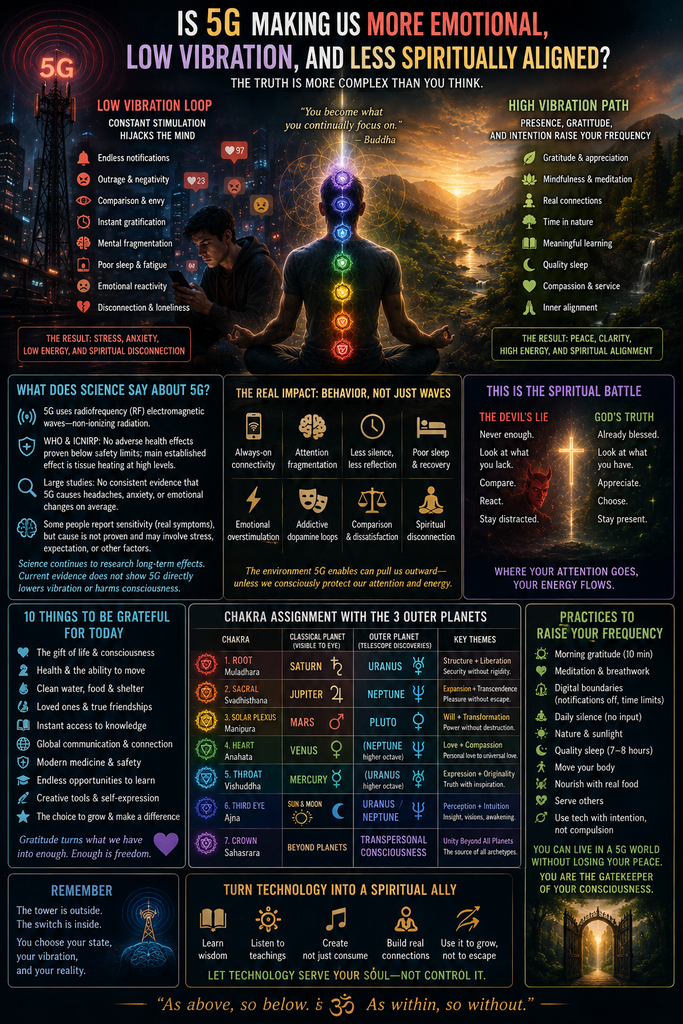
Something about modern human consciousness feels different.
People seem increasingly reactive.
Outrage spreads instantly.
Attention spans feel shorter.
Arguments escalate rapidly.
Many people struggle to sit silently without reaching for a phone.
Notifications interrupt conversations, meals, meditation, work, sleep, and even moments that once would have been completely private.
At the same time, wireless technology has become almost invisible.
4G became 5G.
Phones became permanently connected computers.
Smartwatches appeared.
Homes filled with Wi-Fi devices.
Cities became covered by wireless networks.
Streaming became instantaneous.
Social media became continuous.
This creates an understandable spiritual question:
Could 5G itself somehow be making human beings more emotional, lower-vibration, impulsive, or disconnected from their spiritual centre?
There are really two different questions hidden inside that question, and they should not be confused.
The first is biological:
Are the actual radiofrequency electromagnetic fields used by 5G directly changing our emotions or consciousness?
The second is cultural and spiritual:
Is the hyperconnected technological environment made possible by increasingly powerful wireless networks creating conditions that make people more distracted, reactive, compulsive, and spiritually disconnected?
Current scientific evidence provides little support for the first claim.
The second is much more plausible.
Perhaps the biggest spiritual effect of 5G is therefore not what the radio wave does when it touches the body.
It is what a permanently connected civilization does to the mind.
First: What Exactly Is 5G?
5G means fifth-generation mobile telecommunications technology.
It is not one mysterious frequency being broadcast everywhere.
5G networks can use several parts of the radiofrequency spectrum. Some frequencies overlap with ranges previously used by earlier mobile technologies, while some 5G systems can also use higher-frequency bands.
These radiofrequency electromagnetic fields are non-ionizing radiation.
That distinction matters.
Ionizing radiation such as X-rays has enough energy to remove electrons from atoms and directly damage biological molecules under sufficient exposure.
Radiofrequency radiation used for mobile telecommunications does not work that way.
According to the World Health Organization, the established mechanism by which sufficiently strong radiofrequency fields interact with the human body is tissue heating. WHO states that, at exposure levels below international limits, no adverse health effect has so far been causally established from wireless technologies, including the radiofrequency ranges relevant to 5G.
The International Commission on Non-Ionizing Radiation Protection’s exposure guidelines cover frequencies used by 5G as well as Wi-Fi, Bluetooth, mobile phones, and base stations.
So the statement:
“5G radiation has been proven to lower human spiritual vibration”
would not currently be scientifically justified.
“Spiritual vibration” itself is also not a recognized measurable biological variable.
But that does not end the conversation.
It may simply mean we have been looking at the wrong mechanism.
What Does the Research Say About Mood and Symptoms?
People sometimes report headaches, fatigue, sleeping difficulties, irritability, anxiety, concentration problems, or emotional discomfort that they attribute to electromagnetic fields.
Their symptoms should not automatically be dismissed.
However, determining the cause is different from determining whether the symptoms are real.
A 2024 systematic review of 41 human experimental studies involving 2,874 participants examined radiofrequency electromagnetic-field exposure and self-reported symptoms. Across the outcomes studied, exposure produced either no effect or small statistically nonsignificant effects. Participants—including people who identified themselves as sensitive to electromagnetic fields—were generally unable to determine whether the RF field was switched on better than chance.
There have also been individual case reports claiming symptoms following exposure to 5G base stations, including irritability, anxiety, sleep problems, and emotional distress. But uncontrolled case reports cannot establish that the radiofrequency exposure caused those symptoms, particularly when stronger controlled evidence does not consistently reproduce the effect.
So if someone feels different after 5G arrives in their neighbourhood, the experience should not be mocked.
But neither should the explanation automatically become:
“5G radiation changed my personality.”
There are many other variables occurring simultaneously.
And one of them is enormous.
5G Did Not Just Change Radio Waves — It Changed Human Behaviour
Consider what faster wireless connectivity actually enables.
Instant streaming.
Always-on social media.
Video everywhere.
Constant notifications.
Remote work.
Short-form video.
Cloud gaming.
AI.
Location services.
Online dating.
Continuous group chats.
24-hour news.
Video calls.
VR and AR.
Phones that rarely leave our bodies.
5G is therefore part of an infrastructure that makes constant connectivity increasingly effortless.
This distinction changes the entire discussion.
Perhaps the most consequential effect of 5G is not:
A tower emits a frequency → your consciousness drops.
Perhaps it is:
Better networks → more continuous connectivity → more screen exposure → more interruption → more emotional stimulation → less silence → less contemplation.
That chain has considerably more empirical support.
The Real “Frequency” May Be Psychological
Spiritual traditions often use the language of vibration metaphorically.
Higher vibration might describe:
Peace.
Compassion.
Gratitude.
Patience.
Presence.
Awareness.
Love.
Clarity.
Lower vibration might describe:
Fear.
Anger.
Jealousy.
Compulsion.
Outrage.
Envy.
Impulsiveness.
Addiction.
From this perspective, what matters is not necessarily the electromagnetic frequency measured in gigahertz.
What matters is the mental frequency at which consciousness is operating.
And modern technology can absolutely influence that.
A person who checks their phone every thirty seconds is living in a different attentional state from someone who spends an hour silently meditating.
The difference does not require mysterious radiation.
The difference exists in consciousness.
The 5G Era Makes Interruption Almost Frictionless
Imagine life thirty years ago.
You leave your house.
Unless someone physically finds you or calls a location where you happen to be, you are temporarily unreachable.
You walk.
Think.
Wait.
Stand in line.
Ride the subway.
Sit in a café.
Stare out a window.
These moments appear unproductive.
Spiritually, however, they provided something modern civilization increasingly lacks:
unstructured consciousness.
The mind had space to wander.
Process emotion.
Observe.
Become bored.
Reflect.
Today every empty five seconds can immediately be filled.
Phone comes out.
Scroll.
Message.
Video.
Notification.
News.
Game.
Music.
Podcast.
The mind no longer has to confront silence.
5G did not invent this behaviour.
But faster and more ubiquitous connectivity helps eliminate the remaining friction that once created natural pauses.
Spirituality Requires Friction
This may be one of the most important points.
Traditional spiritual practice frequently involves intentionally not satisfying an impulse immediately.
Meditation:
You want stimulation.
Remain seated.
Fasting:
You want food.
Wait.
Celibacy or sexual discipline:
Desire appears.
Observe it.
Silence:
You want to speak.
Remain quiet.
Prayer:
You want to control everything.
Surrender.
Buddhism, Christianity, Hinduism, Islam, Stoicism, and other traditions repeatedly train humans not to become slaves to every impulse.
Modern digital technology moves in the opposite direction.
Want entertainment?
Instantly available.
Want sexual imagery?
Instantly available.
Want food?
Order it.
Want social validation?
Post something.
Want outrage?
Open social media.
Want shopping?
One click.
Want conversation?
Message someone.
Want another video?
Swipe.
The distance between desire and gratification keeps shrinking.
Spiritually, that matters enormously.
A Lower-Vibration Society May Really Be an Instant-Gratification Society
If “low vibration” means being controlled by the lower impulses of consciousness, then one of the strongest forces lowering vibration may be instant gratification.
The sacral chakra wants pleasure.
The solar plexus wants power and validation.
The root chakra wants security.
None of these needs are inherently bad.
But when every impulse receives immediate stimulation, the lower centres can dominate consciousness.
The person spends less time cultivating:
Heart.
Compassion.
Reflection.
Higher perception.
Silence.
Spiritual connection.
The problem is therefore not necessarily that electromagnetic waves are attacking the chakras.
It may be that technology is constantly feeding whichever chakra makes the fastest consumer decision.
Social Media Is an Emotional Amplifier
The internet rewards emotion.
Especially intense emotion.
Outrage.
Fear.
Humiliation.
Desire.
Tribalism.
Shock.
Envy.
These emotions make people click.
Comment.
Share.
Argue.
Continue scrolling.
A quiet post saying:
“Everything is basically okay today”
usually does not generate the same engagement as:
“YOU WON’T BELIEVE WHAT THEY DID!”
Algorithms therefore do not need to be Satanic in some literal supernatural sense to create low-vibration conditions.
They simply need to optimize attention.
And anger is highly effective at capturing attention.
A 2024 meta-analysis covering 182 studies and more than one million young participants found small but significant associations between social-media use and depression and anxiety; problematic social-media use was also associated with sleep problems and lower well-being. The authors emphasized that causality and mechanisms remain complicated, but the relationship is meaningful enough to warrant continued investigation.
A more recent systematic review likewise linked problematic social-media use with stress, anxiety, depression, loneliness, poorer sleep, and difficulties with emotional regulation, although—as with most observational evidence—association does not mean every user will experience these effects or that social media is the sole cause.
That is a much stronger candidate for “lower vibration” than the radio wave itself.
The Outrage Chakra
Imagine a hypothetical chakra designed by Silicon Valley.
Its colour would be notification red.
Its mantra would be:
“Check again.”
Its spiritual practice would be:
Refresh.
Compare.
React.
Reply.
Refresh again.
Modern online life repeatedly pulls consciousness outward.
What did they say?
Who liked me?
Who unfollowed me?
What happened?
Who is winning?
Who is wrong?
What should I be angry about today?
The consciousness becomes permanently externally referenced.
Traditional spirituality generally moves in the opposite direction:
Turn inward.
Observe the mind.
Examine desire.
Notice anger.
Know yourself.
Listen.
Be still.
The conflict between digital culture and spiritual life may therefore be fundamentally a conflict over where attention lives.
Attention Is Spiritual Currency
Almost every spiritual tradition places enormous value on attention.
Prayer requires attention.
Meditation requires attention.
Mantra requires attention.
Contemplation requires attention.
Listening requires attention.
Gratitude requires attention.
Compassion requires attention.
If you cannot control where your attention goes, it becomes difficult to sustain any spiritual practice.
This is why the most spiritually significant thing a smartphone takes from you may not be privacy or even time.
It may be uninterrupted awareness.
A notification appears.
Your attention moves.
A vibration in your pocket.
Attention moves.
A red badge.
Attention moves.
Eventually the nervous system begins expecting interruption.
Even when nothing happens, you check.
At that point the external technology has become an internal habit.
The Throat Chakra Becomes Hyperactive
The throat chakra represents communication and expression.
Humanity now possesses perhaps the most powerful throat chakra in history.
Billions of people can broadcast thoughts instantly.
That should theoretically create unprecedented understanding.
Instead, it can produce endless noise.
Everyone speaks.
Few listen.
Every opinion is published.
Every frustration becomes a post.
Every private emotion can immediately become public content.
From a chakra perspective, this resembles an overactive throat chakra.
Expression without reflection.
Communication without wisdom.
Reaction without silence.
The solution is not eliminating communication.
It is remembering that a healthy throat chakra also knows when not to speak.
The Third Eye Becomes Overloaded With Information
The third-eye chakra is associated with perception, intuition, insight, and the ability to recognize patterns.
The modern person receives staggering amounts of visual and informational stimulation.
Videos.
Headlines.
Charts.
Comments.
Memes.
Advertisements.
Messages.
Predictions.
Political arguments.
AI-generated content.
There is more information available than any human nervous system can meaningfully integrate.
This can create the illusion of awareness while reducing actual wisdom.
Knowing more facts is not necessarily seeing more clearly.
The third eye requires discernment.
But constant stimulation can turn perception into fragmentation.
Instead of seeing patterns deeply, we bounce between thousands of disconnected fragments.
The Crown Chakra Requires Silence
The crown chakra is associated with transcendence, unity, surrender, higher consciousness, God, or connection beyond the individual ego.
Whatever metaphysical interpretation one uses, one thing is obvious:
Crown-oriented practices almost always contain some form of stillness.
Prayer.
Meditation.
Contemplation.
Silence.
Solitude.
Nature.
Surrender.
The always-connected technological environment makes these conditions less automatic.
Imagine trying to hear a whisper inside a nightclub.
The whisper may still exist.
But the environment makes it harder to notice.
Perhaps the spiritual problem with the 5G era is not that radiofrequency waves block the crown chakra.
Perhaps it is that there is never any silence in which the crown can be noticed.
Sleep May Be One of the Missing Links
Sleep has enormous consequences for emotional regulation.
When people sleep poorly, patience decreases.
Stress tolerance decreases.
Impulse control can worsen.
Negative emotions become harder to regulate.
Modern technology can interfere with sleep through late-night stimulation, notifications, compulsive use, and the tendency to keep devices close at hand.
APA notes that technology use can interfere with sleep, particularly when stimulating content and devices remain part of the bedtime environment.
A 2026 APA review of sleep science similarly describes a sleep-stress spiral in which insufficient sleep increases physiological stress and poor mental health can further disrupt sleep.
So consider the chain:
Phone until 1:30 AM.
Reduced sleep.
Wake exhausted.
Shorter patience.
More caffeine.
More stress.
More emotional reactivity.
More scrolling for relief.
More outrage.
More sleep disruption.
The person may interpret the result as:
“Human vibration is getting lower.”
Spiritually, that interpretation may describe the subjective experience accurately.
But the mechanism could be behavioural rather than electromagnetic.
5G Enables an Environment Where the Nervous System Rarely Rests
Our ancestors experienced danger.
Often much more physical danger than modern urban people do.
But they did not receive:
Breaking news alerts.
Work emails at midnight.
Relationship messages at breakfast.
Political outrage during lunch.
Financial-market updates every minute.
Group-chat conflicts in bed.
Social comparison while brushing their teeth.
A human nervous system evolved for episodic threats.
Digital civilization can create continuous low-level psychological activation.
The tiger leaves.
The notification system does not.
This can make people feel permanently slightly agitated.
And spiritually, agitation makes self-observation difficult.
What About Electromagnetic Hypersensitivity?
Some people genuinely report feeling ill around Wi-Fi, cell towers, phones, or other electromagnetic sources.
Symptoms can include headache, fatigue, concentration problems, anxiety, and sleep disturbance.
It would be disrespectful simply to tell someone that their suffering is imaginary.
The symptoms are real experiences.
But blinded experimental research has generally not found that sufferers can reliably distinguish real RF exposure from sham exposure, and the 2024 systematic review found no consistent acute symptom effect from exposures below regulatory limits.
That suggests other mechanisms may sometimes be contributing:
Stress.
Expectation.
Environmental factors.
Sleep.
Anxiety.
Device behaviour.
Noise.
Lighting.
Other exposures.
Or conditions not yet identified.
The appropriate response is investigation, not ridicule—and not immediately assuming a supernatural or electromagnetic explanation.
Could Science Discover Something New Later?
Certainly.
Science is not a declaration that everything has already been discovered.
Research continues.
Long-term exposures, new technologies, changing network architecture, and population-level effects deserve monitoring.
WHO itself has called for continued research into radiofrequency exposures as telecommunications technologies evolve.
But uncertainty does not mean every proposed mechanism is equally probable.
There is a crucial difference between:
“Science continues studying long-term RF exposure.”
and:
“Therefore 5G probably lowers consciousness.”
The first is reasonable.
The second goes beyond the evidence.
Spiritual discernment should include intellectual discernment.
The Nocebo Effect Can Also Affect Consciousness
There is another fascinating possibility.
Suppose someone becomes convinced:
“5G is harming me.”
Every time they notice a tower, anxiety appears.
They scan the body.
Is my head hurting?
Am I tired?
Do I feel strange?
Normal sensations become evidence.
Then stress increases.
Sleep worsens.
Symptoms genuinely increase.
This does not mean the person is pretending.
Expectation itself can produce real physiological and psychological effects.
The placebo effect works in a positive direction.
The nocebo effect works negatively.
From a spiritual perspective, this teaches something important.
Beliefs themselves can influence our internal vibration.
You can become so frightened of environmental energy that the fear produces more disturbance than the suspected energy source.
Therefore, obsessing about 5G can itself become low-vibration behaviour.
Fear of Technology Can Become Another Attachment
There is a spiritual trap here.
Someone learns about electromagnetic fields and becomes hypervigilant.
They measure constantly.
Avoid ordinary environments.
Become suspicious of every tower.
Interpret every headache as radiation.
Spend hours researching danger.
Their entire consciousness becomes organized around avoiding invisible threats.
Even if their original concern contained some reasonable uncertainty, the resulting consciousness is dominated by fear.
That is not spiritual freedom.
The Buddha would probably ask:
What is this fear doing to your mind?
Jesus might ask:
Has fear become your master?
A yogi might ask:
Can your internal stability survive an imperfect external environment?
Spirituality does not mean ignoring physical dangers.
It means responding proportionately without allowing fear to colonize consciousness.
Perhaps “5G” Is Better Understood as a Symbol
This is where the subject becomes more interesting.
5G can symbolize the final stage of something humanity has been building for decades:
permanent connectivity.
2G made mobile communication widespread.
3G brought the mobile internet.
4G made streaming and social media much more powerful.
5G increases capacity, speed, low-latency applications, and connectivity between devices.
Each generation removes another barrier between the human mind and the network.
Spiritually, that creates an extraordinary paradox.
Humanity has become more technologically connected while many people feel less inwardly connected.
Connected to everyone.
Disconnected from themselves.
Unlimited communication.
Less silence.
Unlimited information.
Less wisdom.
Unlimited entertainment.
More boredom.
Unlimited social access.
Persistent loneliness.
The problem may not be the network frequency.
The problem may be what consciousness does when every distraction becomes permanently available.
Satan Would Love Infinite Scroll
If we use Satan symbolically as the force of compulsion, distraction, pride, anger, envy, and separation, infinite scrolling is almost a perfect spiritual technology.
There is always another thing.
Another video.
Another attractive person.
Another argument.
Another outrage.
Another product.
Another comparison.
Another desire.
It teaches exactly the mentality spiritual traditions warn against:
Never enough.
Just one more.
Buddhist craving transformed into interface design.
The Devil would not need to shut down the crown chakra with electromagnetic radiation.
He could simply make the lower mind too entertained to ever look upward.
The Devil Does Not Need to Control the Tower if He Controls Your Attention
This may be the central spiritual thesis.
Imagine two people living beside the same 5G tower.
Person One:
Sleeps adequately.
Meditates.
Exercises.
Uses technology intentionally.
Turns notifications off.
Maintains real friendships.
Reads.
Spends time outdoors.
Uses social media selectively.
Person Two:
Sleeps five hours.
Scrolls until 2 AM.
Checks notifications constantly.
Argues online.
Consumes outrage.
Compares themselves with influencers.
Rarely exercises.
Never sits silently.
Their radiofrequency environment may be almost identical.
Their spiritual vibration is completely different.
That suggests the strongest variable may not be the tower.
It may be the relationship with the device connected to the tower.
5G Can Also Raise Consciousness
There is another side that should not be ignored.
The same network can provide:
Meditation instruction.
Buddhist teachings.
Christian sermons.
Quranic study.
Yoga classes.
Language exchange.
Spiritual communities.
Therapy.
Educational lectures.
Philosophy.
Music.
Virtual friendship.
Access to scriptures that once required travelling across continents.
Someone living in an isolated town can now listen to monks in Nepal, theologians in Rome, meditation teachers in India, philosophers in Japan, or spiritual communities anywhere in the world.
Technology itself therefore may be spiritually neutral.
It amplifies intention.
A knife can prepare food or injure someone.
A network can distribute wisdom or outrage.
The technology provides possibility.
Consciousness determines use.
5G Could Be a Spiritual Test
Perhaps the real spiritual meaning of increasingly powerful connectivity is that humanity is being confronted with abundance.
Can you have unlimited information without becoming mentally scattered?
Unlimited entertainment without becoming addicted?
Unlimited communication without becoming obsessed with approval?
Unlimited pornography without becoming sexually compulsive?
Unlimited shopping without becoming materialistic?
Unlimited opinions without becoming angry?
Unlimited social contact without abandoning solitude?
Unlimited AI assistance without abandoning your own judgment?
That is a much more challenging spiritual interpretation of 5G.
Technology gives us power.
Spirituality asks whether consciousness can handle it.
How to Protect Your “Vibration” in a 5G World
You do not necessarily need to hide from cell towers.
You may need to reclaim your attention.
1. Create a Phone-Free Morning
Do not allow the network to decide your consciousness within thirty seconds of waking.
Before checking messages:
Breathe.
Meditate.
Pray.
Stretch.
Practise gratitude.
Allow your own mind to establish its state before outside information enters.
2. Turn Off Nonessential Notifications
Every notification is a request to move consciousness.
Most are not emergencies.
Remove unnecessary interruptions.
Your attention should belong to you.
3. Protect the Last Hour Before Sleep
Reduce emotionally stimulating feeds, arguments, work messages, and endless scrolling late at night.
Sleep is spiritual infrastructure.
An exhausted mind is much easier for anger and compulsion to control.
4. Practise Daily Silence
Even ten minutes matters.
No music.
No podcast.
No phone.
No television.
Sit.
Allow boredom.
Underneath boredom you may discover mental activity that constant stimulation has been hiding.
5. Spend Time in Nature
Nature runs on a radically different rhythm from digital culture.
Trees do not send notifications.
Water does not demand replies.
The sky does not care about engagement metrics.
Nature pulls consciousness back toward physical reality.
6. Use Airplane Mode Intentionally
Not because airplane mode mystically cleanses the chakras.
Because it creates a boundary.
For thirty minutes, nothing can summon you.
That boundary can become spiritually powerful.
7. Practise Single-Tasking
Eat without scrolling.
Walk without watching videos.
Talk without checking messages.
Meditate without tracking every second through an app.
Give one activity your complete consciousness.
8. Curate Your Emotional Diet
Notice what your feeds produce.
After thirty minutes, are you:
Calmer?
Inspired?
Educated?
Connected?
Or:
Angry?
Envious?
Anxious?
Sexually overstimulated?
Hopeless?
The feed is feeding something.
Ask what.
9. Keep Real Human Contact
Digital connection can be genuine.
But embodied relationships provide forms of communication that screens cannot completely reproduce.
Eye contact.
Touch.
Silence.
Shared meals.
Walking together.
Physical presence helps ground consciousness.
10. Use the Network to Raise Rather Than Lower Consciousness
Listen to Dharma talks.
Learn meditation.
Read scripture.
Study philosophy.
Practise languages.
Make music.
Create.
Build communities.
Help people.
The same 5G network that delivers outrage can deliver wisdom.
The network does not decide.
You do.
A Chakra-Based Digital Reset
You could even approach technology through the chakra system.
Root Chakra — Ground
Put the phone down.
Feel your feet.
Exercise.
Clean your environment.
Return to the body.
Sacral Chakra — Regulate Pleasure
Notice whether entertainment has become compulsion.
Enjoy without needing constant stimulation.
Solar Plexus — Reclaim Control
Ask:
Am I choosing to open this app, or did the impulse choose for me?
Heart Chakra — Connect
Use technology to strengthen real relationships rather than merely accumulate followers.
Throat Chakra — Speak Carefully
Do not turn every passing emotion into public communication.
Third Eye — Discern
Question sensational claims.
Check sources.
Observe manipulation.
Notice when algorithms are trying to provoke you.
Crown Chakra — Disconnect
Create periods in which nothing external enters.
Meditate.
Pray.
Contemplate.
Remember that consciousness existed before the smartphone appeared.
Turn the Phone Into a Spiritual Instrument
Perhaps the most radical response is not rejecting technology.
It is consecrating its use.
Before opening social media, ask:
Why am I opening this?
Before replying angrily, breathe.
Before scrolling automatically, notice the urge.
Before going to sleep, turn the device away.
Before consuming, consider creating.
The phone can then become part of mindfulness practice.
Every impulse to check becomes a meditation bell.
You reach toward the phone.
Stop.
Observe.
What am I seeking?
Stimulation?
Validation?
Escape?
Connection?
Information?
Boredom relief?
Suddenly the smartphone becomes a mirror.
The Higher-Vibration Response Is Not Fear
If 5G becomes a spiritual issue, the spiritually aligned response should not be paranoia.
Fear itself lowers clarity.
The better response is discernment.
Current evidence does not establish that ordinary 5G radiofrequency exposure directly creates anger, impulsiveness, or spiritual disconnection. WHO and ICNIRP maintain that exposures within established guidelines have not been demonstrated to cause the kinds of adverse effects often attributed to 5G, while ongoing research continues as telecommunications systems evolve.
At the same time, substantial evidence does justify concern about how people use permanently connected technology, particularly when it disrupts sleep, encourages problematic social-media use, increases comparison, and displaces healthier activities.
Those two positions can coexist.
You do not need to claim invisible radiation is controlling humanity to believe that the technological environment is reshaping consciousness.
Maybe We Are Looking at the Wrong Waves
Perhaps the most important waves surrounding modern humanity are not 5G radio waves.
Perhaps they are:
Waves of outrage.
Waves of notifications.
Waves of fear.
Waves of comparison.
Waves of pornography.
Waves of advertising.
Waves of political anger.
Waves of misinformation.
Waves of constant entertainment.
Those really do enter consciousness.
And unlike radiofrequency energy, we know exactly where many of them end up.
In thought.
Emotion.
Behaviour.
Relationships.
Sleep.
Identity.
Attention.
Perhaps those are the frequencies we should be monitoring most carefully.
Conclusion: 5G May Be Changing Consciousness — Just Not in the Way We Think
There is currently no strong scientific evidence that ordinary exposure to 5G radiofrequency waves directly causes people to become more emotional, spiritually disconnected, impulsive, or “low vibration.”
That claim goes beyond what controlled research currently supports.
But there is another interpretation that may actually be more important.
5G belongs to a technological transformation that makes permanent connectivity increasingly effortless.
That environment can encourage:
Constant stimulation.
Shorter periods of silence.
Compulsive checking.
Outrage consumption.
Social comparison.
Sleep disruption.
Instant gratification.
Fragmented attention.
Reduced solitude.
And a consciousness that rarely turns inward.
Those conditions can look remarkably similar to what spiritual traditions would call a lower state of consciousness.
Perhaps 5G is therefore not spiritually dangerous because an invisible radio wave attacks the crown chakra.
Perhaps the danger is that the network becomes so convenient, entertaining, stimulating, and emotionally addictive that we forget we have a crown chakra at all.
The tower is outside.
The real switch is inside.
The same network can bring you hatred or Dharma.
Pornography or prayer.
Envy or education.
Endless scrolling or a meditation teacher.
Argument or friendship.
Distraction or knowledge.
Technology amplifies what consciousness chooses to pursue.
So perhaps the correct spiritual question is not:
“How do I escape 5G?”
It is:
“Can I remain spiritually sovereign in a world where everything is permanently connected?”
If the answer becomes yes, then the network loses its power to determine your vibration.
You can live inside a 5G city and maintain silence.
Carry a smartphone and practise nonattachment.
Use social media without becoming consumed by comparison.
Participate in technological civilization without allowing technology to colonize the mind.
Maybe that is the next stage of spiritual discipline.
Our ancestors learned how to find God in deserts, forests, temples, monasteries, mountains, and caves.
Our challenge may be different.
We have to learn how to find silence while the entire planet is online.