
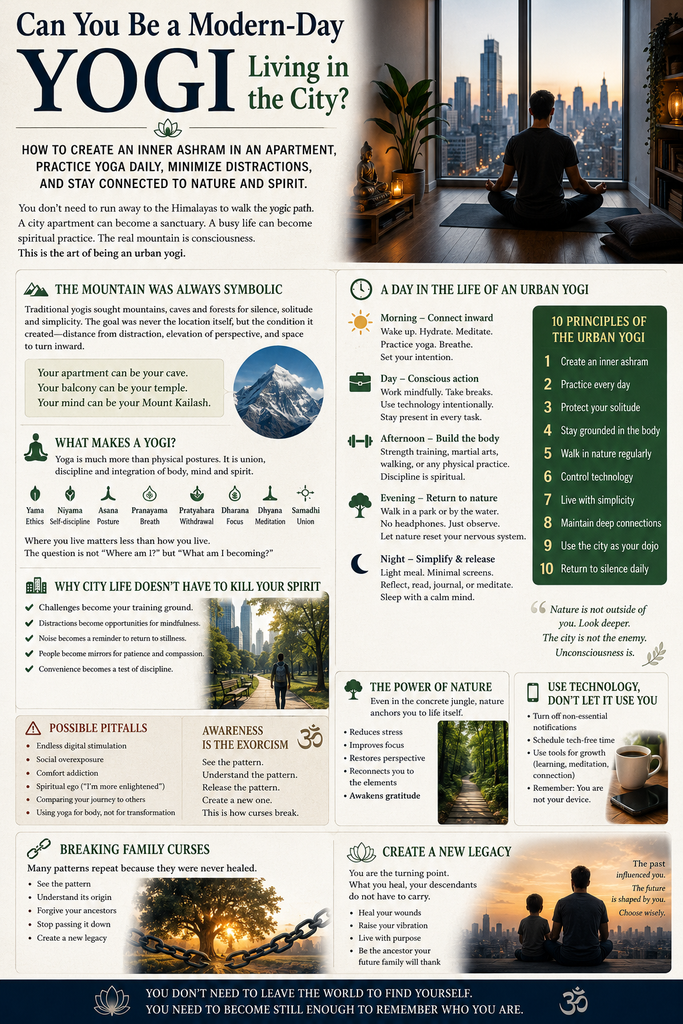
When people imagine a yogi, they often picture someone living far from civilization.
A cave in the Himalayas.
A simple hut beside a river.
An ashram surrounded by forests.
A monk sitting alone on a mountain.
No traffic.
No smartphone.
No neighbours.
No office towers.
No modern distractions.
From this image, it can seem contradictory to call yourself a yogi while living in a high-rise apartment in the middle of a major city.
But perhaps the location was never the most important part.
The mountain, cave and monastery were tools.
They created conditions that made inner work easier.
Silence.
Solitude.
Simplicity.
Distance from unnecessary social drama.
Physical discipline.
Time for meditation.
Contact with nature.
A modern person can deliberately recreate many of those conditions without abandoning civilization.
In fact, there is something strangely appropriate about the image of the urban yogi:
Living high above the streets in an apartment that functions almost like a mountain retreat.
Practising yoga every day.
Meditating.
Keeping social contact intentional rather than constant.
Walking through parks, ravines, waterfronts and green spaces.
Eating simply.
Reducing unnecessary consumption.
Using technology without becoming controlled by it.
Participating in society when necessary and withdrawing when unnecessary.
Perhaps you do not need to escape the city to become a yogi.
Perhaps you need to learn how to build an inner ashram inside the city.
What Actually Makes Someone a Yogi?
The word yogi should not simply mean:
“Someone who performs yoga poses.”
Yoga historically extends far beyond physical flexibility.
The Sanskrit word yoga is associated with union, discipline and integration.
In the classical yogic tradition, physical postures are only one part of a much larger process involving:
Ethical conduct.
Self-discipline.
Breath.
Control of the senses.
Concentration.
Meditation.
Inner stillness.
And eventually deeper states of consciousness.
So the real question is not:
Do you live in the Himalayas?
It is:
How much of your life is organized around consciousness rather than compulsion?
Someone can live in a cave and spend the entire day fantasizing about money, sex and status.
Another person can live on the twentieth floor of a Toronto apartment building, meditate daily, practise yoga, walk in nature, live simply and develop remarkable inner discipline.
Which one is living more like a yogi?
The answer may not be determined by geography.
The Mountain Was Always Symbolic
Mountains appear repeatedly in spiritual traditions.
Shiva resides on Mount Kailash.
Moses encounters God on Mount Sinai.
Buddhist monasteries were often built in remote mountainous environments.
Christian hermits withdrew into deserts and caves.
Taoist sages sought mountain retreats.
Why?
Partly because mountains physically separate the practitioner from ordinary society.
But mountains also symbolize something deeper.
Elevation.
Perspective.
Stillness.
Distance from noise.
The movement from the crowded horizontal world toward the vertical dimension of consciousness.
When you climb upward, ordinary activity appears smaller below you.
A city apartment high above street level can create an unexpectedly similar psychological effect.
You look out through the window.
Cars move below.
People move through streets.
Lights appear at night.
The city continues functioning.
But you are physically separated from much of it.
Your apartment can become a kind of vertical hermitage.
Not literally Mount Kailash.
But symbolically, the architecture can serve a similar purpose.
The Apartment as a Modern Cave
The yogic cave has an important function.
It limits external stimulation.
A cave contains very little.
Stone.
Silence.
Darkness.
Perhaps a mat.
Perhaps a candle.
The point is not interior design.
The point is that fewer things compete for attention.
A modern apartment can become the same thing—or the opposite.
It can become:
Television constantly running.
Phone notifications.
Food delivery.
Social media.
Video games.
Streaming.
Online shopping.
Endless entertainment.
Or it can become deliberately simple.
A meditation corner.
Yoga mat.
Plants.
Books.
Clean surfaces.
Natural light.
Incense if desired.
A small altar.
Minimal clutter.
The apartment then changes from a consumption centre into a practice centre.
The physical environment begins reminding the mind:
This is where I return to myself.
You Do Not Need to Reject Technology
A modern yogi does not necessarily need to live like someone from 2,000 years ago.
There is no spiritual virtue in rejecting electricity merely because ancient yogis did not have it.
The question is whether technology serves consciousness or controls consciousness.
A modern yogi can use:
A smartphone.
Artificial intelligence.
Online banking.
Streaming music.
Video calls.
GPS.
Computers.
Virtual communities.
But they use those tools deliberately.
The phone does not enter every empty moment automatically.
The yogic question becomes:
Am I using this because I chose to, or because I cannot tolerate five seconds without stimulation?
That distinction is enormous.
The modern yogi may not abandon technology.
He develops non-attachment to technology.
Daily Yoga Changes the Meaning of the Home
A home normally functions as a place to:
Sleep.
Eat.
Watch television.
Store possessions.
A yogi adds another function:
Training consciousness.
Practising yoga every day changes the relationship with the apartment.
One corner becomes associated with discipline.
Every time the mat is rolled out, the body understands:
Now we practise.
This creates ritual.
And ritual transforms space.
A studio apartment can become more spiritually powerful than an elaborate temple if spiritual practice consistently occurs there.
The sacredness does not necessarily come from architecture.
It comes from repeated intention.
Asana Keeps the Urban Yogi Embodied
City life pulls consciousness into the head.
Emails.
Work.
Apps.
Information.
Traffic.
Finances.
Planning.
Social media.
News.
The modern person can spend almost the entire day living psychologically from the neck upward.
Yoga reverses that.
Suddenly attention moves toward:
Breath.
Feet.
Hips.
Spine.
Balance.
Muscular tension.
Flexibility.
Pain.
Posture.
The body becomes real again.
This grounding is especially important for someone living a highly digital life.
The yogi does not escape the body.
He enters it completely.
Headstands and Inversions Symbolize Reversal
Inversions have a beautiful symbolic quality within urban yoga.
Ordinary life constantly tells us to see the world one way.
Stand upright.
Look outward.
Follow routine.
An inversion literally turns perspective upside down.
The floor becomes the ceiling.
The body reorganizes around balance.
Attention becomes intense.
You cannot comfortably scroll through social media while maintaining a controlled headstand.
For those moments, consciousness becomes immediate.
Spiritually, this represents something larger:
Yoga teaches us that changing perspective changes reality.
The city outside may remain the same.
But the consciousness observing it changes.
The Urban Yogi Needs Less Social Contact, Not No Human Connection
Traditional yogis sometimes sought extended solitude because social interaction continuously activates the ego.
Who likes me?
Who dislikes me?
What do they think?
What should I say?
Who has higher status?
Who offended me?
Who owes me something?
Social life generates enormous mental activity.
A modern practitioner may therefore find value in deliberately reducing unnecessary social contact.
This does not require becoming antisocial.
It means distinguishing:
connection from stimulation.
You may keep a small number of meaningful relationships.
Attend selected gatherings.
Spend time with people you genuinely value.
Then return to solitude.
This can be healthier than maintaining dozens of shallow relationships simply because modern culture treats constant social activity as desirable.
Solitude Is Different From Loneliness
Loneliness says:
“Nobody is here for me.”
Solitude says:
“I am comfortable being with myself.”
The external situation can look identical.
One person sits alone in an apartment and feels abandoned.
Another sits in the same apartment and experiences freedom.
The difference is the relationship with consciousness.
A yogi deliberately develops the ability to remain alone without immediately escaping into stimulation.
You sit.
You breathe.
You read.
You practise.
You cook.
You observe the city.
You walk.
You think.
Eventually solitude stops feeling empty.
It begins feeling spacious.
Minimizing Social Contact Can Protect Energy
Many spiritual traditions contain the idea that social environments influence consciousness.
You may describe this psychologically:
Other people’s moods affect you.
Or energetically:
People exchange energy.
Either language captures something recognizable.
Spend several hours with angry people and notice what happens.
Spend time with compulsive gossip and notice.
Spend time with calm people and notice.
Relationships shape internal states.
A modern yogi therefore becomes selective.
Not because other people are spiritually inferior.
But because attention and emotional energy are finite.
You do not need access to everyone.
Everyone does not need access to you.
But Isolation Can Become Ego Too
There is a danger.
A person can begin saying:
“I am more spiritual than ordinary people.”
“Everyone drains my energy.”
“Society is beneath me.”
“I don’t need anyone.”
This can turn spiritual solitude into narcissism.
The ego simply changes costume.
Before:
“Look how socially popular I am.”
After:
“Look how spiritually detached I am.”
Both remain ego.
Healthy solitude should make someone calmer and more compassionate.
If isolation creates increasing contempt for humanity, the practice may have become unbalanced.
A true urban yogi can enter society without being psychologically swallowed by it.
Walks in Nature Become Urban Pilgrimages
The city may appear to be the opposite of nature.
Concrete.
Glass.
Roads.
Traffic.
Buildings.
But most cities contain pockets where natural rhythm remains accessible.
Parks.
Ravines.
River valleys.
Waterfronts.
Botanical gardens.
Forested trails.
Urban forests.
Even tree-lined residential streets.
A daily or regular walk through these spaces can become an urban form of pilgrimage.
Do not always use headphones.
Let the environment become the meditation.
Feel temperature.
Hear birds.
Watch water.
Notice wind.
Look at trees.
Walk without needing a destination.
Nature reintroduces a slower rhythm than digital consciousness normally permits.
Walking Is One of the Oldest Spiritual Practices
Walking and spirituality have always belonged together.
Buddhist walking meditation.
Christian pilgrimage.
Hindu pilgrimage.
Taoist wandering.
Zen temple walks.
The human mind changes when the body moves rhythmically.
Thoughts process differently.
Emotions settle.
The environment moves past slowly enough to be observed.
An urban yogi can turn an ordinary walk into practice.
With each step:
Feel the ground.
Notice breathing.
Relax the shoulders.
Observe thought without following every thought.
This turns a city park into a meditation hall.
You Can Practise Pratyahara in a City
In classical yoga, pratyahara refers to withdrawal or regulation of the senses.
That may sound as though one must flee civilization.
But the city creates an advanced laboratory for it.
Advertisements everywhere.
Phones buzzing.
Music.
Cars.
Food smells.
Attractive people.
Screens.
Stores.
Noise.
The senses are constantly being invited outward.
Pratyahara does not necessarily mean eliminating all of that.
It means developing the ability to encounter stimulation without automatically following it.
A notification appears.
You do not immediately check.
A shop displays something attractive.
You notice desire without purchasing.
An argument occurs nearby.
You do not become involved.
Someone attractive walks past.
You notice without mentally constructing an entire fantasy.
This is real sensory discipline.
Perhaps a city actually provides more opportunities to practise pratyahara than a cave.
The City Becomes the Advanced Course
A beginner meditator may require silence.
An advanced practitioner eventually asks:
Can I remain centred when silence disappears?
Meditation in an apartment is one level.
Remaining calm on a crowded subway is another.
Remaining aware while walking through downtown is another.
Maintaining compassion during irritating interactions is another.
The city can therefore function as advanced yogic training.
The mountain teaches stillness because little disturbs you.
The city tests whether the stillness survives disturbance.
The Modern Yogi Can Work
Historically, some yogis renounced ordinary economic life.
But spiritual practice does not necessarily require unemployment.
The Bhagavad Gita famously develops the concept of acting without becoming attached to the fruits of action.
This creates an ideal framework for the modern urban yogi.
Work.
Earn.
Build.
Create.
Invest.
Take responsibility.
But observe attachment.
Can you work hard without making your occupation your identity?
Can you earn money without worshipping money?
Can you experience success without becoming arrogant?
Can you experience failure without collapsing?
This becomes karma yoga inside modern economic life.
You Can Own Things Without Being Owned by Them
A modern yogi does not necessarily need zero possessions.
But simplicity remains useful.
Ask:
Do I actually use this?
Does this serve my life?
Or am I accumulating because accumulation temporarily stimulates me?
Minimalism and yoga naturally complement each other.
Every object requires:
Space.
Maintenance.
Attention.
Money.
Mental representation.
Reducing unnecessary possessions creates physical and psychological room.
The goal is not owning nothing.
It is reducing the number of things capable of controlling attention.
Your Apartment Can Be an Ashram
An ashram is not merely a building.
It is a place organized around spiritual practice.
So organize your home accordingly.
Perhaps create:
A meditation area.
Yoga space.
Bookshelf with spiritual texts.
A candle or incense area.
Plants.
A simple altar.
A comfortable place to sit in silence.
Reduce unnecessary clutter.
Avoid keeping televisions constantly running.
Let natural light enter.
Keep the space clean.
The environment begins influencing consciousness.
Over time, simply sitting in that part of the apartment may trigger calm because the nervous system associates the space with practice.
Morning Practice Is Especially Powerful
The first part of the day establishes momentum.
A modern yogi might begin:
Wake.
Avoid checking the phone immediately.
Drink water.
Meditate.
Practise yoga.
Do breathwork.
Practise gratitude or prayer.
Perhaps read a few pages of philosophy or scripture.
Only afterward open the gates of civilization.
Messages.
News.
Work.
Markets.
Social media.
The principle is:
Enter your own consciousness before allowing the world to enter it.
That may be one of the most important spiritual disciplines of modern life.
The Window Can Become Your Mountain View
High-rise living creates a fascinating perspective.
Look downward.
Hundreds or thousands of people move through the city.
Cars stop and start.
Lights change.
Construction occurs.
People rush.
From above, individual dramas become visually smaller.
This can become a contemplative exercise.
People below are:
Falling in love.
Arguing.
Going to work.
Losing jobs.
Buying things.
Meeting friends.
Feeling lonely.
Celebrating.
Grieving.
Every apartment contains another life.
The city becomes a living mandala.
Instead of viewing high-rise living as spiritually artificial, the elevation can create perspective.
The apartment becomes your mountain ledge above the valley of civilization.
Practice the Witness
One central yogic idea is learning to observe consciousness.
The city creates endless material.
A siren sounds.
Observe reaction.
Someone annoys you.
Observe.
The elevator is slow.
Observe impatience.
A neighbour makes noise.
Observe anger.
Traffic blocks you.
Observe frustration.
Someone praises you.
Observe pleasure.
Someone ignores you.
Observe ego.
Suddenly ordinary city inconveniences become spiritual teachers.
The urban yogi does not require perfect conditions.
Every disturbance reveals another part of the mind.
Food Can Remain Simple
Urban life provides extraordinary food access.
Restaurants.
Delivery apps.
Convenience stores.
Late-night ordering.
This can become constant stimulation.
A yogic approach may deliberately simplify eating.
Cook more.
Eat whole foods.
Eat consciously.
Avoid eating merely because you are bored.
Occasionally allow hunger without immediately responding.
You do not need an extreme ascetic diet.
The spiritual question is simpler:
Am I eating to nourish the body or constantly using food to stimulate consciousness?
You Can Create Digital Fasting
Ancient yogis did not need rules about smartphones.
Modern ones do.
A digital fast could mean:
No phone for the first hour of the morning.
No social media one day per week.
Airplane mode during meditation.
No phone during walks.
No screens during meals.
No endless scrolling before bed.
Occasional hours with no internet.
The modern sensory environment is so intense that deliberate technological withdrawal may function almost like ancient retreat practice.
The cave is sometimes one airplane-mode button away.
The City Yogi Still Needs Community
Complete withdrawal can eventually become limiting.
Spiritual growth also occurs through relationship.
Patience requires other people.
Compassion requires other people.
Generosity requires other people.
Boundaries require other people.
Forgiveness usually requires other people.
So an urban yogi may maintain a small but intentional social ecosystem.
Perhaps:
A few close friends.
A meditation community.
A yoga class.
A spiritual discussion group.
Family.
Occasional cultural events.
The goal is quality over quantity.
You do not have to become socially saturated to remain connected.
The Hermit and the Householder Can Meet
Traditional spirituality often separates two archetypes.
The hermit renounces society.
The householder participates in it.
The modern urban yogi can combine aspects of both.
Householder:
Pays bills.
Works.
Maintains a home.
Uses technology.
Has relationships.
Participates in civilization.
Hermit:
Values silence.
Limits unnecessary interaction.
Meditates.
Lives simply.
Seeks solitude.
Practises nonattachment.
Walks alone in nature.
The apartment becomes the meeting point between those lifestyles.
You participate without becoming completely absorbed.
An Urban Yogi Can Be More Tested Than a Mountain Yogi
This sounds paradoxical.
It may be easier to feel peaceful when nothing is happening.
The city constantly tests practice.
Can you maintain mindfulness with construction outside?
Can you stay calm when public transit is delayed?
Can you remain compassionate around rude people?
Can you avoid consumer temptation while walking past hundreds of stores?
Can you remain sexually disciplined in an environment saturated with images?
Can you maintain solitude while carrying a device capable of contacting thousands of people?
That is serious practice.
The city is not the enemy of yoga.
It provides resistance.
Nature Is Still Necessary
At the same time, urban nervous systems often benefit from deliberately returning to natural environments.
Human beings evolved around:
Sky.
Trees.
Earth.
Water.
Sunlight.
Wind.
Natural textures.
The city replaces many of these with:
Concrete.
Artificial lighting.
Climate control.
Screens.
Engines.
So regular nature walks can become an important counterbalance.
You do not necessarily need wilderness.
Even thirty minutes in a substantial park can shift attention.
The important thing is remembering that the human organism belongs to nature even while living inside architecture.
The Balcony Can Become a Tiny Monastery Garden
If your apartment has a balcony, use it spiritually.
Plants.
Herbs.
A chair.
Perhaps nothing else.
Sit outside.
Observe the weather.
Feel wind.
Look at the moon.
Watch clouds.
Urban apartments can make residents strangely disconnected from seasons.
A balcony reconnects the body with the outside world.
Even several pots of living plants change the psychological quality of a space.
The City at Night Can Become Meditation
There is a unique spirituality in looking across a city at night.
Thousands of lights.
Millions of lives.
Silence at altitude despite activity below.
The individual ego can feel simultaneously important and tiny.
You are one consciousness among millions.
This resembles the Buddhist contemplation of interconnected life.
Each light represents someone with:
Desires.
Fear.
History.
Love.
Suffering.
Plans.
Looking across the skyline can become a form of metta meditation:
May all these people be safe.
May they find peace.
May their suffering decrease.
Suddenly the city becomes an object of compassion rather than irritation.
The Urban Yogi Should Not Hate the City
This is essential.
If your entire spiritual identity depends upon believing civilization is corrupt, noisy, shallow and beneath you, you remain psychologically attached to it through opposition.
Hatred is still attachment.
The yogic attitude is more balanced.
Cities provide:
Medicine.
Culture.
Food.
Libraries.
Technology.
Human connection.
Art.
Economic opportunity.
Education.
Transportation.
Yoga studios.
Temples.
Parks.
The city contains both distraction and opportunity.
The yogi learns to take what is useful while not becoming consumed by the rest.
Use Convenience Without Losing Competence
Modern life can make people passive.
Delivery.
AI.
Apps.
Automation.
An urban yogi can deliberately preserve embodied competence.
Cook.
Clean.
Carry groceries sometimes.
Repair things.
Walk instead of always driving.
Use stairs.
Work with the hands.
Exercise.
This keeps the root chakra grounded.
Spirituality should not create someone who can meditate deeply but cannot manage ordinary life.
The Apartment Is Not the Prison—the Mind Is
Someone may dream:
“If only I lived in India.”
“If only I were in the Himalayas.”
“If only I had a cabin.”
Then spirituality would become easy.
Maybe.
But the same mind would travel there.
The anxiety comes too.
The desires come too.
The resentments come too.
The phone probably comes too.
Geography can help.
It does not replace internal transformation.
A person who cannot sit peacefully in an apartment may discover that they also cannot sit peacefully on a mountain.
Eventually, the retreat has to become internal.
Shiva Can Live in the High-Rise
Shiva is traditionally associated with Mount Kailash—the archetypal yogi on the mountain.
But spiritually, perhaps Mount Kailash represents a state of consciousness as much as geography.
Stillness above chaos.
Meditation above compulsion.
Awareness above ego.
From that perspective, a modern apartment above a city can become a symbolic Kailash.
Cars move below.
Society moves.
Commerce continues.
People rush.
And above it, someone sits quietly.
Breathing.
Meditating.
Practising yoga.
Not because the city disappeared.
Because inner noise temporarily did.
That image may be more authentically yogic than trying to imitate an ancient lifestyle superficially.
A Sample Day for the Modern Urban Yogi
Morning
Wake without immediately checking notifications.
Drink water.
Meditate for 30–60 minutes.
Practise yoga or mobility.
Spend several minutes in gratitude, prayer or contemplation.
Eat simply.
Day
Work normally.
Use technology intentionally.
Take breaks to breathe and reconnect with the body.
Walk whenever practical.
Avoid unnecessary digital stimulation.
Late Afternoon
Strength training, yoga, martial arts or another physical practice.
Evening
Take a walk through a park, ravine, waterfront or quiet neighbourhood.
Sometimes walk without headphones.
Observe.
Social Life
Choose meaningful contact rather than filling every evening.
Some nights meet people.
Other nights deliberately remain alone.
Night
Read.
Meditate briefly.
Reduce screens.
Look over the city.
Let the nervous system settle.
The lifestyle is not dramatic.
That is precisely the point.
Yoga becomes integrated into ordinary life.
Ten Principles of the Urban Yogi
1. Create an Inner Ashram
Your home should help calm consciousness rather than constantly stimulate it.
2. Practise Every Day
Consistency matters more than dramatic retreats.
3. Protect Solitude
Do not treat every empty evening as something that must be filled socially.
4. Stay Physically Grounded
Yoga, strength work, walking and hands-on activity keep spirituality connected with the body.
5. Walk in Nature
Use the natural spaces available inside the city.
6. Control Technology
Phones and AI are tools—not masters.
7. Consume Less
Reduce unnecessary possessions, information and stimulation.
8. Maintain a Few Deep Relationships
Spirituality does not require emotional isolation.
9. Use City Friction as Practice
Noise, delays, temptation and difficult people become opportunities for mindfulness.
10. Return to Silence Every Day
The city will continually pull awareness outward.
Return inward deliberately.
The Real Mountain Is Consciousness
Perhaps we have misunderstood the yogi’s mountain.
The important movement is not necessarily:
City → wilderness.
It is:
Noise → silence.
Compulsion → awareness.
Attachment → freedom.
Stimulation → presence.
Ego → witness.
A person can make those movements from almost anywhere.
A cave may make them easier.
An apartment does not make them impossible.
In some ways, accomplishing them while living inside one of humanity’s busiest environments may demonstrate even greater integration.
Conclusion: The City Can Become Your Ashram
Yes, you can be a modern-day yogi while living in an apartment in the city.
Not because living high above street level literally transforms an apartment into the Himalayas.
But the symbolism is surprisingly appropriate.
You can create altitude.
Distance.
Silence.
Simplicity.
Daily practice.
Intentional solitude.
Nature contact.
Spiritual discipline.
You can wake each morning and practise yoga before interacting with the digital world.
Meditate while the city moves beneath you.
Limit social contact without closing your heart.
Walk through urban forests and parks.
Return home and treat your apartment as a sanctuary rather than merely a place of consumption.
Use modern technology while practising ancient nonattachment.
Participate in society without allowing society to occupy every corner of your consciousness.
Perhaps the twenty-first-century yogi does not always look like a man sitting outside a cave in India.
Sometimes he lives on the fifteenth floor.
There is a laptop nearby.
A smartphone is charging.
Traffic moves beneath the window.
The refrigerator hums.
The internet exists.
But the yoga mat is open.
The room is quiet.
The phone is face down.
The breath slows.
And for the next hour, the city has no claim on his mind.
That is still yoga.
Perhaps the deepest lesson is that the mountain was never simply a mountain.
It represented enough distance from the noise to hear consciousness clearly.
If you can create that distance internally, then a high-rise apartment can become a cave.
A city park can become a forest monastery.
A morning walk can become pilgrimage.
An elevator ride can become mindfulness.
And the city itself can become part of your spiritual training.
You do not always need to leave civilization to find the yogi.
Sometimes you simply need to close the door, roll out the mat, become still, and discover that the Himalayas were pointing toward a place inside you all along.