
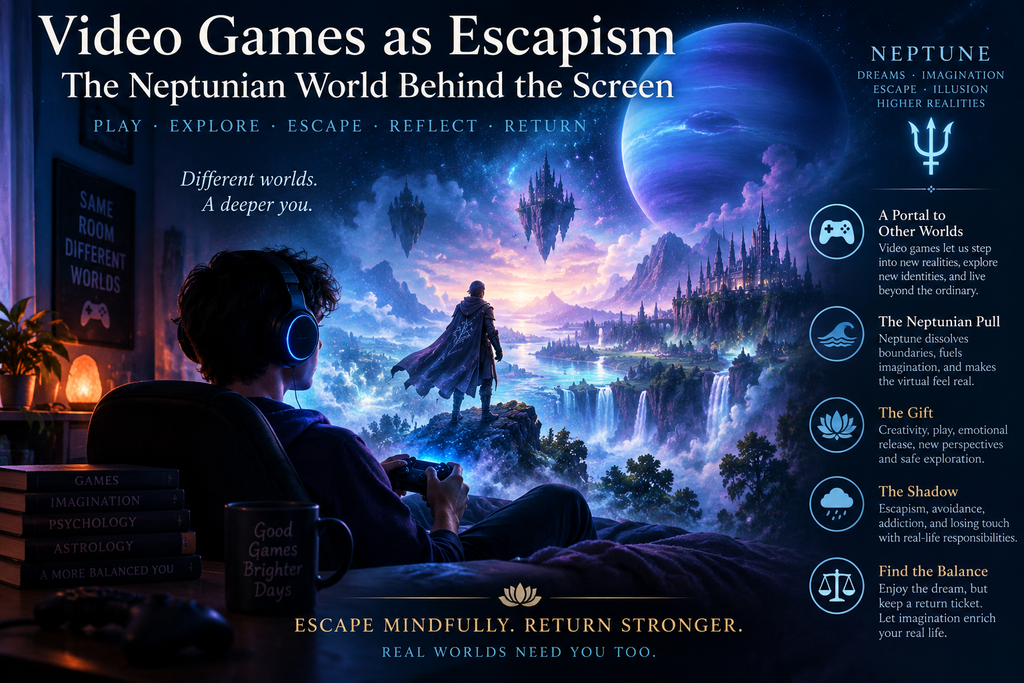
Video games are often criticized for being a form of escapism.
And in a basic sense, they are.
You sit in one physical place, pick up a controller, look at a screen, and suddenly your consciousness is somewhere else.
You may be:
driving through Tokyo at midnight,
fighting monsters in a fantasy kingdom,
building a civilization,
exploring another planet,
running a football club,
living through a romantic storyline,
or becoming a completely different person.
For a few hours, ordinary reality fades into the background.
From an astrological perspective, this makes video games one of the most Neptunian technologies ever created.
Neptune is the planet associated with dreams, fantasy, imagination, altered states, illusion, transcendence and escape.
If Saturn represents hard physical reality, Neptune represents the desire to dissolve its boundaries.
And what does a video game do?
It allows you to temporarily leave one reality and enter another.
Neptune: The Planet That Wants to Leave the Ordinary World
Astrologically, Neptune governs experiences that blur the line between what is real and what is imagined.
Dreams.
Movies.
Music.
Mysticism.
Fantasy.
Intoxication.
Meditation.
Religious ecstasy.
Virtual worlds.
Neptune is not necessarily interested in practical reality.
Saturn asks:
What is real?
Neptune asks:
What else could be real?
That distinction makes Neptune enormously creative.
Without Neptune, human beings might never imagine things beyond immediate physical existence.
But Neptune also has a shadow.
The same impulse that creates art can create escapism.
The same imagination that produces beautiful worlds can become a refusal to participate in ordinary life.
Video games sit directly on that boundary.
They can be both creative transcendence and avoidance.
Every Game Is a Small Alternate Reality
Think about how unusual gaming actually is.
You remain physically inside your bedroom, yet emotionally you may feel:
fear,
competition,
achievement,
curiosity,
attachment,
frustration,
ambition,
grief,
or triumph
over events that are happening entirely inside a constructed digital world.
Your body knows you are sitting in a chair.
But your mind participates somewhere else.
That is incredibly Neptunian.
Neptune dissolves ordinary borders.
The player stops being entirely aware of:
the room,
the clock,
the weather,
the outside world.
Instead, consciousness merges with the game.
An hour disappears.
Then another.
Suddenly you look up and realize it is 2 a.m.
That loss of ordinary time is part of Neptune’s symbolism too.
Why Video Games Are Such Effective Escapism
Ordinary life is full of uncertainty.
Work may not reward you immediately.
Relationships are complicated.
Money requires patience.
Health requires maintenance.
Social status can be ambiguous.
Success may take years.
Video games simplify these systems.
Complete mission.
Gain experience.
Level up.
Receive reward.
Unlock item.
Defeat enemy.
Advance story.
The feedback loop is clear.
That can feel extremely comforting.
The game gives structure to a life temporarily free from the ambiguity of ordinary existence.
Ironically, video games combine Neptune’s fantasy with Saturn’s structure.
The world may be imaginary.
But the rules are precise.
That combination makes games extraordinarily compelling.
The Digital Dream State
There is another way to understand gaming.
Dreams create worlds while we sleep.
Video games create worlds while we are awake.
A dream can place you somewhere impossible and make it feel temporarily real.
Gaming does something similar, but interactively.
You do not merely watch the dream.
You control part of it.
That arguably makes video games even more Neptunian than cinema.
A movie asks you to enter someone else’s fantasy.
A video game allows you to participate in the fantasy.
You become the warrior.
The driver.
The detective.
The hero.
The ruler.
The survivor.
The explorer.
It is a waking dream with buttons.
The Avatar as a Neptunian Identity
Video games also allow identity to become fluid.
You may play someone:
older,
younger,
stronger,
richer,
more attractive,
more courageous,
more powerful,
or completely nonhuman.
Your physical identity temporarily becomes less important.
Again, Neptune dissolves boundaries.
The question shifts from:
Who am I?
to:
Who can I experience being?
This can be psychologically valuable.
Games allow people to experiment with personalities and roles without real-world consequences.
A quiet person can become a commander.
A cautious person can become reckless.
Someone powerless in ordinary life can become extraordinarily powerful.
Sometimes this reveals genuine parts of the psyche that have little opportunity for expression elsewhere.
Escapism Is Not Automatically Bad
The word escapism usually sounds negative.
But human beings have always escaped ordinary reality temporarily.
We read novels.
Watch plays.
Tell stories.
Listen to music.
Meditate.
Travel.
Daydream.
Attend religious ceremonies.
Watch movies.
The mind periodically needs distance from practical reality.
A healthy escape can function like sleep.
You step away.
Your nervous system changes state.
You return refreshed.
In this sense, playing a game after a difficult day may be no more spiritually problematic than watching a film or reading a fantasy novel.
The real issue is not:
“Am I escaping?”
The better question is:
“Do I eventually come back?”
Neptune Becomes Dangerous When the Escape Replaces Life
This is Neptune’s shadow side.
Neptune does not always know when to stop dissolving boundaries.
At its healthiest, Neptune provides:
imagination,
compassion,
art,
mysticism,
inspiration.
At its most difficult, Neptune can represent:
avoidance,
confusion,
self-deception,
addiction,
fantasy replacing reality.
That distinction applies perfectly to gaming.
There is a major difference between:
“I played for two hours because I wanted to relax.”
and:
“I played for twelve hours because I didn’t want to think about my life.”
The activity may look identical from the outside.
The intention is completely different.
The Real Question: What Are You Escaping From?
When gaming becomes excessive, it can be useful to ask:
What becomes uncomfortable when the game turns off?
Loneliness?
Boredom?
Stress?
Career dissatisfaction?
Relationship problems?
Lack of purpose?
Fear of failure?
Social anxiety?
Emptiness?
The game may not actually be the central problem.
It may simply be the most efficient door leading away from the problem.
Neptune frequently works this way.
It offers fog when reality becomes painful.
The spiritual task is not necessarily to destroy the fog.
It is to understand why you needed it.
Games Provide Artificial Achievement
One powerful form of gaming escapism involves accomplishment.
Modern games constantly provide goals.
You level up.
Your character becomes stronger.
Your ranking improves.
Your inventory expands.
Your city grows.
Your team wins.
Your car becomes faster.
Progress is measurable.
Real life rarely offers such immediate feedback.
You can work for months and feel no different.
You can exercise for weeks before noticing major changes.
You can build a business for years before it succeeds.
A game can provide the emotional experience of achievement within minutes.
That can be useful.
But it can also become dangerous if digital achievement begins replacing real achievement.
You may own a kingdom digitally while ignoring your bank account.
You may have a perfect virtual garage while never maintaining your real car.
You may command armies while avoiding a difficult phone call.
That is where Neptune’s illusion becomes obvious.
The symbolic victory starts replacing the material one.
Saturn Is the Antidote to Excessive Neptune
Astrologically, Saturn provides one of the best counterbalances to Neptune.
Neptune dissolves.
Saturn defines.
Neptune dreams.
Saturn builds.
Neptune imagines.
Saturn asks:
What are you actually doing?
A healthy gamer therefore needs Saturn.
Set limits.
Finish responsibilities.
Sleep properly.
Exercise.
Work.
Pay bills.
Maintain relationships.
Then enter the fantasy world.
The goal is not to destroy Neptune.
Without Neptune, life becomes painfully dry.
The goal is to put Neptune inside a Saturnian container.
You might think of it this way:
Neptune creates the ocean. Saturn builds the shoreline.
Without the ocean, there is no imagination.
Without the shoreline, everything floods.
The Root Chakra: Come Back Into the Body
Gaming is intensely mental and visual.
The body can almost disappear from awareness.
Hours may pass with little movement.
From a chakra perspective, excessive gaming may therefore create a symbolic imbalance toward the upper centers while neglecting the root.
The root chakra asks:
Are you grounded?
Have you eaten properly?
Have you moved?
Have you slept?
Have you interacted with the physical environment?
Gaming is essentially consciousness floating inside a digital world.
Grounding brings it back.
Walk outside.
Stretch.
Lift weights.
Cook.
Clean.
Work with your hands.
Touch physical objects.
Feel your feet against the floor.
A powerful gaming session can feel almost like astral travel.
The body eventually needs to be reclaimed.
The Sacral Chakra: Play Is Still Sacred
Gaming also has a positive relationship with the sacral chakra.
The sacral center is associated with:
play,
creativity,
pleasure,
imagination,
flow.
Adults sometimes forget that play has value.
Not every activity needs to make money.
Not every hobby needs to improve productivity.
Sometimes enjoyment itself matters.
Games can create a healthy flow state where attention becomes absorbed in challenge and creativity.
The sacral chakra reminds us that entertainment is not automatically wasted time.
Pleasure becomes problematic only when it destroys balance.
The Solar Plexus: Virtual Power Versus Real Power
Many games revolve around power.
Become stronger.
Gain equipment.
Win battles.
Increase influence.
Control territory.
The solar plexus is also associated with power, will and agency.
That makes gaming psychologically interesting.
Someone who feels powerless in ordinary life may gravitate toward environments where power is easily measurable.
In the game:
your actions matter.
Your skill matters.
Your decisions matter.
The world responds.
That can feel deeply satisfying.
The spiritual challenge is to transfer some of that agency back into reality.
If you can patiently grind for fifty hours to improve a character, perhaps you can use the same persistence to improve your body, finances, career or craft.
Gaming itself may teach discipline.
The question is whether that discipline remains trapped inside the screen.
The Third Eye: The World-Building Chakra
Video games may be especially connected symbolically with the third eye.
The third eye represents imagination, visualization and inner perception.
Game designers essentially construct worlds inside consciousness.
Before a game becomes code, it exists as imagination.
Characters.
Cities.
Weapons.
Stories.
Music.
Physics.
Entire civilizations.
Then thousands or millions of players enter that imagination.
From a spiritual perspective, game development is a remarkable act of collective visualization.
One person’s imaginary world becomes somewhere millions of other minds can temporarily inhabit.
That is an extraordinary expression of human imagination.
Neptune and the Metaverse
As technology becomes more immersive, Neptune’s connection with gaming may become even stronger.
Virtual reality.
Persistent online worlds.
AI characters.
Procedurally generated environments.
Digital economies.
Artificial companions.
Eventually, the distinction between physical and virtual experience may become increasingly difficult to define emotionally.
A virtual friendship may feel real.
A digital object may hold significant value.
An AI character may generate genuine attachment.
A virtual environment may become someone’s preferred social space.
This creates a very Neptunian future.
Reality itself becomes more fluid.
The spiritual question will increasingly become:
What deserves to be called real?
If an experience changes your emotions, memories and identity, does it matter that it happened digitally?
Neptune would probably say:
Not as much as you think.
Saturn would answer:
But the physical consequences still matter.
We may need both.
Gaming Can Also Be a Spiritual Mirror
What you repeatedly choose in games can sometimes reveal aspects of your personality.
Do you always play healers?
Leaders?
Thieves?
Warriors?
Explorers?
Builders?
Diplomats?
Do you enjoy competition?
Cooperation?
Discovery?
Optimization?
Chaos?
These preferences may not mean anything profound.
But occasionally, a game provides a safe environment where unconscious desires become visible.
A person who constantly chooses freedom-oriented games may feel constrained in ordinary life.
Someone obsessed with building may have a strong creative drive.
Someone who always protects other players may naturally identify with caretaking.
The fantasy can reveal the psyche.
That is another Neptunian quality.
Dreams often speak symbolically.
Games can sometimes do the same.
When Escapism Becomes Restoration
The healthiest relationship with gaming may involve conscious escapism.
You know you are leaving reality temporarily.
You know why.
You enjoy the experience.
Then you return.
Perhaps gaming provides:
rest,
social connection,
creativity,
challenge,
nostalgia,
or emotional decompression.
That can be beneficial.
The difference is awareness.
Unconscious escapism says:
“I don’t want to face my life.”
Conscious escapism says:
“I am stepping away from life temporarily so I can return with more energy.”
The first is avoidance.
The second can be restoration.
Neptune Needs a Return Ticket
Perhaps this is the simplest spiritual rule for gaming.
Whenever you enter Neptune, bring a return ticket.
Enter the fantasy.
Explore the world.
Become the hero.
Build the empire.
Drive the impossible car.
Fight the dragon.
Enjoy the dream.
But eventually:
turn off the screen,
stand up,
eat,
sleep,
exercise,
call someone,
work,
build something,
and return to your physical life.
Because Neptune’s worlds can be beautiful.
But you still incarnated here.
The goal is not necessarily to choose between fantasy and reality.
The goal is to allow imagination to enrich reality instead of replacing it.
That may be the healthiest spiritual relationship with video games.
They become not prisons from reality, but temporary portals.
Places where consciousness can play.
Dream.
Explore.
Experiment.
Recover.
And then come back.
Because the problem was never escaping for a while.
The danger begins only when you forget where home is.