
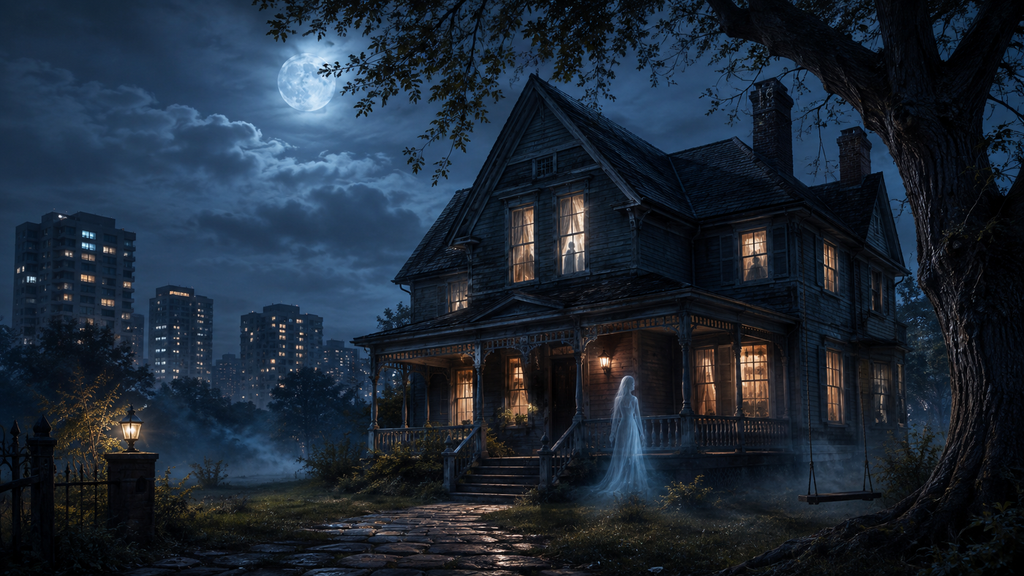
Ghost stories overwhelmingly seem to happen in houses.
The old Victorian home.
The farmhouse at the edge of town.
The family house where someone died decades ago.
The abandoned mansion.
The cottage with one room nobody likes entering after dark.
Apartments certainly have ghost stories too, but culturally, houses seem to dominate paranormal folklore.
Why?
There is no scientific evidence establishing that ghosts actually prefer houses, or even that ghosts exist in the literal sense. But if we look at the question through folklore, psychology and spiritual traditions, there are several reasons why houses might seem more likely to become haunted.
The simplest explanation may be this:
A house accumulates more identity.
And if hauntings are connected with memory, attachment, emotional energy or spirits remaining close to places that mattered to them, houses may provide much stronger anchors than apartments.
1. Houses Often Stay in Families Much Longer
An apartment is frequently temporary.
People move in.
They stay a few years.
They move out.
Another tenant arrives.
A house, however, may remain within the same family for decades.
Children are born there.
People grow up there.
Parents grow old there.
Arguments happen there.
Weddings are celebrated there.
Someone may eventually die there.
Over time, the property becomes woven into the family’s identity.
From a spiritual perspective, that may matter.
If a spirit remains attached to places carrying powerful emotional memories, the family home could be one of the strongest possible anchors.
A person may have spent forty years inside the same house.
They may have renovated it.
Raised children there.
Planted the garden.
Cooked thousands of meals in the kitchen.
Sat in the same chair every evening.
Their personality becomes connected with the building.
This creates a very different relationship from someone renting an apartment for eighteen months.
2. Houses Accumulate More Emotional Energy
Many paranormal traditions describe certain locations as retaining emotional impressions.
This idea is sometimes called residual haunting.
The theory is that powerful emotional events somehow leave an energetic imprint upon a location.
A death.
A traumatic argument.
A period of intense grief.
A joyful family celebration.
Decades of habitual activity.
If you accept this spiritual model, houses may accumulate more of these impressions simply because they often have longer uninterrupted histories.
Imagine a house built in 1880.
Perhaps fifteen families have lived there.
Several generations were born and died within its walls.
There were marriages.
Illnesses.
Financial struggles.
Celebrations.
Wars.
Deaths.
Children growing up.
Every generation adds another layer.
Spiritually, the property begins resembling an emotional archive.
3. Houses Usually Have More Physical Anchors
Ghost stories frequently involve objects.
An old mirror.
A rocking chair.
A piano.
A photograph.
A wedding dress.
A grandfather clock.
A bedroom.
A staircase.
A basement workshop.
The theory behind object attachment is that spirits—or residual energy—may remain associated with physical objects carrying strong personal significance.
Houses often preserve these objects for generations.
Apartments tend to be cleared between tenants.
Furniture leaves.
Walls are repainted.
Possessions are removed.
The next resident starts again.
A family home may contain the same table for sixty years.
If spiritual attachment exists, the house contains considerably more potential anchors.
4. Houses Have Basements, Attics and Forgotten Spaces
There is also a surprisingly practical reason houses feel more haunted.
They contain more strange spaces.
Basements.
Attics.
Crawl spaces.
Unused bedrooms.
Garages.
Cellars.
Storage rooms.
Old closets.
These places naturally create mysterious noises.
Pipes contract.
Wood expands.
Animals move inside walls.
Heating systems turn on.
Old foundations settle.
Air pressure moves doors.
At night, ordinary sounds can become frightening.
An apartment usually has fewer unexplained spaces.
You may know almost exactly what lies behind every wall.
In an old house, there may literally be parts of the building you rarely enter.
Psychologically, mystery creates room for paranormal interpretation.
Spiritually, these unused areas are also often imagined as places where stagnant energy collects.
5. Houses Have Stronger Connections to the Land
This may be one of the biggest spiritual differences.
An apartment is primarily connected with a building.
A house is connected with both the building and the land underneath it.
Many spiritual traditions treat land as having its own history and energy.
Before the house existed, something else may have happened there.
Perhaps another house stood there.
Perhaps the land belonged to another family.
Perhaps it was farmland.
Perhaps a battle occurred nearby.
Perhaps indigenous communities lived in the area.
Perhaps someone died on the property.
If paranormal phenomena can attach to land rather than simply buildings, detached houses may seem especially significant because residents often feel ownership of the entire physical location.
This may explain stories where a new house is supposedly haunted despite being recently built.
According to paranormal folklore, the issue may not be the building.
It may be the land.
6. People Become More Territorial About Houses
There is another spiritual idea that deserves attention:
territorial attachment.
People often say:
“This is my house.”
Not:
“This is the house I happen to occupy.”
Home ownership can become deeply tied to identity.
Someone may spend thirty years paying off a mortgage.
They may personally renovate every room.
They may repeatedly insist:
“I will never leave this house.”
Then they die.
If consciousness somehow continues, such strong attachment could theoretically make moving on psychologically difficult.
The spirit may still think of the property as:
mine.
This theme appears constantly in ghost folklore.
The elderly owner who refuses to leave.
The former resident who appears in one particular room.
The deceased parent who still seems to patrol the house.
The person who dies but continues performing familiar routines.
The stronger the attachment to the physical home, the stronger the supposed spiritual tether might be.
7. Apartments Constantly Mix Different People’s Energy
Apartments have their own strange spiritual characteristic.
They are densely populated.
An apartment building may contain hundreds of people living extremely close together.
From an energetic perspective, that means the building contains enormous amounts of human activity.
People are constantly:
moving,
talking,
cooking,
arguing,
sleeping,
watching television,
walking through hallways,
opening doors.
This constant activity may make subtle paranormal phenomena harder to distinguish.
A strange sound in a detached house at 3 a.m. can seem significant.
The same sound in an apartment building might simply be your neighbour dropping something upstairs.
In other words, apartment life creates energetic and acoustic noise.
If spirits exist, perhaps they aren’t less common in apartments.
Perhaps they are simply harder to notice.
8. Houses Give Ghost Stories a Clearer Identity
Imagine someone says:
“My apartment building is haunted.”
Which part?
Apartment 504?
The hallway?
The elevator?
The basement?
The entire twenty-storey building?
The story becomes diffuse.
But when someone says:
“That house is haunted,”
the location has a clear boundary.
The property becomes almost like a character.
This makes haunted-house stories easier to remember and pass down.
The architecture itself gains personality.
People point toward it.
They tell children not to enter.
Stories become attached to the address.
Over decades, folklore reinforces the reputation.
Sometimes the belief in the haunting may become stronger than whatever originally caused it.
9. Houses Frequently Have Longer Architectural Histories
Many famous haunted locations are old houses.
That matters because old buildings naturally accumulate strange characteristics.
Uneven floors.
Old electrical wiring.
Unusual airflow.
Cold spots.
Creaking wood.
Historical renovations.
Sealed doorways.
Hidden rooms.
Old photographs.
Outdated plumbing.
All of these can contribute to unusual experiences.
Psychologically, people are also more likely to expect paranormal activity in an old house.
Expectation influences perception.
If you walk into a pristine new condominium with bright lighting and modern furniture, your mind may not immediately interpret a noise as supernatural.
Walk into a dark 150-year-old farmhouse during a thunderstorm and the same noise suddenly becomes much more interesting.
10. Death Historically Happened at Home
Modern societies often associate death with hospitals.
Historically, however, people frequently died inside their homes.
Before modern medical systems became widespread, serious illness and end-of-life care commonly occurred within the family household.
That means old houses may genuinely have seen numerous deaths.
If ghost beliefs involve a spirit lingering near the place where death occurred, historical houses naturally become likely candidates.
An old apartment building can certainly share this history.
But a detached family home often creates a stronger narrative connection:
“Grandmother died in that bedroom.”
That specificity makes the haunting story much more powerful.
11. Houses May Hold Stronger Ancestor Energy
If we move fully into spiritual interpretation, houses may operate almost like informal ancestral temples.
Family photographs remain on the walls.
Grandparents’ furniture stays in the living room.
Inherited jewellery remains upstairs.
A deceased parent’s tools stay in the garage.
Holiday traditions happen in the same rooms every year.
The living continually reinforce the presence of those who came before them.
This does not necessarily mean the house is haunted negatively.
Sometimes what people describe as a haunting may be closer to ancestor presence.
A familiar smell.
A dream involving the deceased.
A light flickering around an anniversary.
The sensation that somebody is nearby.
An object appearing somewhere unexpected.
Believers may interpret these experiences not as a trapped ghost but as a deceased family member maintaining some connection to the household.
In that sense, the family home becomes a bridge between generations.
12. Apartments May Actually Have Plenty of Ghosts
We should not assume apartment buildings are spiritually empty.
If anything, large apartment buildings may have extraordinary amounts of human history concentrated into small areas.
Hundreds or thousands of people may have lived inside one building over several decades.
People have undoubtedly experienced:
birth,
love,
illness,
loneliness,
arguments,
death,
and grief
within those units.
From a paranormal perspective, apartments could theoretically contain tremendous amounts of residual energy.
The difference may simply be that individual units change identity constantly.
Apartment 703 does not become:
“the Johnson family home.”
Instead it becomes a temporary container for dozens of unrelated lives.
The spiritual history becomes layered but anonymous.
13. Ghosts May Be Attracted to Identity More Than Architecture
This may ultimately be the most interesting idea.
Perhaps ghosts do not particularly care whether a building is:
a house,
an apartment,
a hotel,
a castle,
or a hospital.
Perhaps what matters is attachment.
A spirit might remain connected to:
a person,
an object,
a memory,
a piece of land,
or a place that represented home.
If so, houses seem haunted more often because houses tend to accumulate exactly these things.
More continuity.
More belongings.
More family history.
More emotional investment.
More ownership.
More memories.
More identity.
The building itself may not be the important part.
The important part is everything humans poured into it.
Why the Classic Haunted House Makes Spiritual Sense
That may explain why the haunted house appears repeatedly across cultures.
A house is more than shelter.
It is a container for human life.
We sleep there.
Eat there.
Fight there.
Love there.
Raise children there.
Become sick there.
Grow old there.
Sometimes die there.
If emotional or spiritual energy can remain associated with physical places, few locations would carry more concentrated human meaning than the home.
Perhaps that is why ghost stories rarely begin:
“There was once a haunted office cubicle.”
Instead they begin:
“There was an old house…”
Because houses accumulate stories.
And sometimes, according to spiritual belief, perhaps they accumulate the people who created those stories as well.