At first glance, allergies and introversion seem completely unrelated.
One involves the immune system. The other is a personality trait involving a person’s relationship with stimulation, social interaction and solitude.
Yet there is an intriguing overlap.
Some studies of people with allergic rhinitis have found higher scores on measures of social introversion, although the evidence is limited and certainly does not establish that allergies cause introversion.
But there is another fascinating connection when we move from psychology into spirituality and astrology:
Neptune.
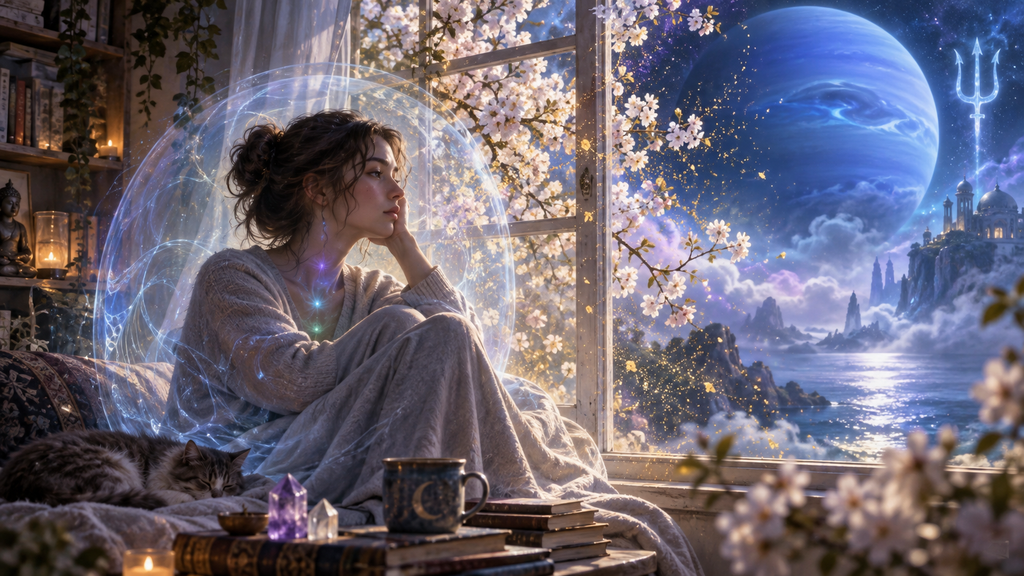
In modern astrology, Neptune is the planet of sensitivity.
It represents intuition, receptivity, dreams, altered states, subtle perception and the dissolution of boundaries.
And in some systems of medical astrology, Neptune is also associated with allergies, hypersensitivity and immune-system disturbances. Astrological authors have specifically connected Neptune with physical sensitivity and allergic reactions, often interpreting its symbolism through the planet’s tendency to blur the boundary between the individual and the surrounding environment.
That gives us an intriguing symbolic triangle:
Allergies = physical sensitivity.
Introversion = sensitivity to external stimulation.
Neptune = sensitivity and porous boundaries.
From this perspective, perhaps the deeper theme linking allergies and introversion isn’t simply personality.
It is sensitivity itself.
First: Allergies Do Not Automatically Make Someone Introverted
It is important to make this distinction.
There is no established medical principle saying:
Allergies = introversion.
Plenty of extroverts suffer from allergies.
Plenty of introverts have none.
Introversion is generally considered a relatively stable personality characteristic, while allergies involve an immune reaction to particular substances.
There have nevertheless been some interesting findings.
A small study examining allergic rhinitis found higher social-introversion scores among allergic male participants, while earlier research also reported increased Social Introversion scores among women with perennial allergic rhinitis.
These findings are interesting, but they are correlations—not proof that an allergic immune system creates an introverted personality.
A much more plausible everyday connection may be that allergies change someone’s tolerance for stimulation.
Allergies Can Make the Outside World More Exhausting
Imagine two people attending the same outdoor party.
For one person, the environment contains:
sunshine,
trees,
music,
conversation,
food,
friends.
For the person with allergies, the exact same environment may also contain:
pollen,
itchy eyes,
congestion,
sneezing,
fatigue,
headaches,
difficulty breathing comfortably,
and poor sleep from the night before.
The first person experiences a party.
The second person’s nervous and immune systems are simultaneously managing a party and an environmental challenge.
Naturally, that person may want to leave earlier.
They may prefer a quieter indoor environment.
They may need more recovery afterward.
From the outside, this behaviour can resemble introversion.
But sometimes:
“I don’t want to socialize anymore”
really means:
“My entire system has reached its limit.”
Allergies Can Lower the Threshold for Stimulation
Allergic rhinitis can interfere with sleep and contribute to fatigue, daytime sleepiness and impaired quality of life.
When a person is exhausted, something predictable happens:
their tolerance for stimulation decreases.
Crowds become more tiring.
Noise becomes more irritating.
Conversation requires greater effort.
Solitude becomes increasingly attractive.
Someone who normally enjoys five hours of socializing may suddenly want to go home after two.
That does not necessarily mean their personality changed.
Their stimulation threshold changed.
And that concept provides an important bridge between allergies and introversion.
Then We Come to Neptune
This is where the spiritual interpretation becomes particularly interesting.
Neptune is the modern planetary ruler of Pisces.
Astrologically, Neptune represents things that dissolve ordinary boundaries:
dreams,
mysticism,
intuition,
imagination,
psychic sensitivity,
compassion,
altered states,
spiritual experience,
and sometimes confusion.
Neptune does not like hard divisions.
Where Saturn says:
“This is me and that is you.”
Neptune says:
“Where exactly does one end and the other begin?”
This is why some medical-astrology traditions connect Neptune with permeability, hypersensitivity, allergies and autoimmune-type symbolism. One medical-astrology text describes Neptune in terms of membrane permeability and the breakdown of boundaries between the organism and its environment, specifically discussing allergies under Neptune.
Another contemporary medical-astrology source similarly associates Neptune with allergies, autoimmunity and heightened physical, emotional and energetic sensitivity.
Obviously, this is astrological symbolism rather than established medicine.
But symbolically, it is remarkably appropriate.
Allergies Are Almost a Neptunian Boundary Problem
Think about what happens during an allergy.
Something harmless enters the environment:
pollen,
dust,
animal dander,
a food protein.
The body interprets that substance as something requiring a defensive response.
In simplistic symbolic terms, the immune system is asking:
“What belongs here and what doesn’t?”
That is fundamentally a question of boundaries.
And Neptune is astrologically associated with the dissolving or blurring of boundaries.
So the allergic person can be interpreted symbolically as someone whose body is extraordinarily sensitive to the distinction between:
self and environment.
That doesn’t mean Neptune literally causes histamine release.
It means the symbolism fits.
And now compare that with introversion.
The Introvert Has an Environmental Boundary Too
The introvert frequently asks another version of the same question:
“How much of the outside world do I want entering my internal world?”
How many people?
How much conversation?
How much noise?
How many notifications?
How much emotional intensity?
How much social obligation?
How much stimulation?
An extroverted person may walk into a crowded party and become energized.
A strongly introverted person may enjoy exactly the same party—and then require several hours alone afterward.
Why?
The person’s psychological system has processed a tremendous amount of external information.
The introvert therefore retreats temporarily to restore equilibrium.
Again, that sounds remarkably Neptunian.
The boundary between the person and their environment may feel more permeable.
The Strong Neptune Person May Absorb More
Astrologically, people with prominent Neptune or Pisces energy are often described as highly receptive.
They may notice subtle emotional changes.
Atmosphere matters.
Tone matters.
Music affects them strongly.
Crowded environments can feel intense.
Other people’s emotions may seem unusually easy to absorb.
Whether someone interprets this literally as energetic sensitivity or psychologically as heightened perception, the subjective experience can be similar:
The outside world gets inside easily.
That can create beautiful qualities.
Empathy.
Creativity.
Intuition.
Imagination.
Spiritual receptivity.
Artistic sensitivity.
But it can also create overload.
And overload naturally creates the desire for retreat.
This is where Neptune begins providing an elegant symbolic link between sensitivity and introversion.
Allergies May Be the Physical Version of “Too Much”
There is a phrase almost every sensitive person understands:
“It’s too much.”
Too much pollen.
Too much noise.
Too many people.
Too much social media.
Too much emotional energy.
Too many conversations.
Too many obligations.
Too much information.
Modern society often assumes that greater tolerance for stimulation equals strength.
But perhaps sensitivity is not weakness.
Perhaps different nervous systems simply have different thresholds.
The allergy sufferer’s body may metaphorically say:
“There is too much entering my system.”
The introvert may say:
“There is too much entering my mind.”
The spiritually sensitive person might say:
“There is too much energy around me.”
All three statements share a similar structure.
That structure is profoundly Neptunian.
Neptune’s Gift Is Sensitivity—Its Challenge Is Boundaries
Neptune is sometimes described only positively:
spirituality,
intuition,
mysticism,
compassion.
But every planetary archetype has a difficult side.
The same openness that creates empathy can create overwhelm.
The same imagination that creates art can create escapism.
The same sensitivity that allows subtle perception can make ordinary environments exhausting.
This produces one of Neptune’s central spiritual lessons:
Sensitivity without boundaries becomes overload.
That applies beautifully to both allergies and introversion.
The goal is therefore not necessarily to become less sensitive.
The goal is to become better at regulating what sensitivity receives.
Saturn May Be Neptune’s Medicine
Astrologically, Neptune dissolves boundaries.
Saturn creates them.
This makes Saturn an interesting balancing principle.
Saturn says:
Enough.
Stop.
This is the limit.
This belongs here.
That stays outside.
I will leave now.
I need solitude.
I need sleep.
I cannot take on another obligation.
Spiritually, someone with strong Neptunian sensitivity may therefore benefit from developing healthy Saturnian qualities:
routine,
boundaries,
structure,
discernment,
discipline,
rest,
and knowing when to say no.
Think of Neptune as water.
Without boundaries, water spreads everywhere.
Saturn provides the container.
You don’t eliminate the water.
You give it a vessel.
That may also be an excellent spiritual model for introversion.
The Root Chakra: Come Back Into the Body
Chakra symbolism adds another dimension.
The root chakra concerns grounding, physical presence, security and belonging in the material world.
Neptune tends upward and outward.
It dissolves.
It dreams.
It transcends.
When someone feels overly sensitive, grounding becomes extremely valuable.
Walk.
Exercise.
Cook.
Stretch.
Work with your hands.
Feel your feet against the ground.
Breathe slowly into your abdomen.
Do something physical that brings consciousness back into the body.
The spiritual goal is not:
“Escape this overwhelming world.”
It becomes:
“I can remain grounded while experiencing this world.”
The Solar Plexus: Build an Energetic Gate
The solar plexus chakra is associated with autonomy, willpower and personal boundaries.
A useful metaphor is to stop thinking about boundaries as walls.
Think of them as gates.
A wall says:
“Nobody enters.”
A broken boundary says:
“Everybody enters.”
A gate says:
“I decide.”
That is enormously important for introverts and sensitive people.
You don’t need to isolate yourself.
You need control over how much stimulation enters and when.
Go to the party.
Enjoy yourself.
Then go home.
Spend time with people.
Then meditate.
Participate in society.
Then restore yourself through solitude.
That is not antisocial behaviour.
It is energetic regulation.
The Heart Chakra: Sensitivity Can Become Empathy
The gift hidden inside sensitivity is perception.
Someone who becomes overwhelmed easily may also recognize overwhelm in others.
Someone who notices subtle shifts in atmosphere may notice when another person becomes uncomfortable.
Someone who spends substantial time observing rather than talking may become unusually perceptive about people.
Sensitivity can therefore evolve into heart-chakra qualities:
compassion,
empathy,
patience,
gentleness,
understanding.
Instead of thinking:
“Why am I so sensitive?”
the spiritual question becomes:
“How can I use sensitivity wisely?”
The Third Eye: Sensitivity Needs Discernment
This is another important balancing chakra.
Not everything you feel belongs to you.
Not every uncomfortable sensation carries a spiritual message.
Not every difficult atmosphere contains “negative energy.”
Not every allergy represents emotional symbolism.
Not every desire to withdraw means something profound.
Sometimes pollen is simply pollen.
Sometimes you’re tired.
Sometimes someone is annoying.
Sometimes your nose is congested.
Spiritual maturity involves being able to hold both possibilities.
The third eye asks:
“What is actually happening here?”
That prevents sensitivity from turning into superstition.
Introversion May Protect the Sensitive System
Perhaps introversion sometimes serves an adaptive purpose.
If someone’s body, nervous system or psyche processes environmental stimulation intensely, solitude provides recovery.
The introvert closes the door.
The stimulation decreases.
The nervous system settles.
Thoughts become clearer.
Emotional boundaries restore themselves.
Then the person can return outward again.
Spiritually, solitude becomes almost like energetic filtration.
You are not rejecting humanity.
You are clearing the accumulated noise.
That is why many contemplative traditions deliberately incorporate solitude.
Monks retreat.
Yogis meditate.
Mystics spend time alone.
Even extremely compassionate people periodically withdraw from society.
Why?
Because receptivity needs recovery.
Neptune, Pisces and the Mystical Introvert
There is another interesting implication.
Neptune and Pisces are associated astrologically with:
meditation,
dreams,
mysticism,
spirituality,
music,
imagination,
and the invisible world.
Many of these activities flourish in solitude.
It is difficult to enter deep meditation while simultaneously participating in five conversations.
Dreams happen when the external world becomes quiet.
Art often requires withdrawal.
Introspection requires space.
Perhaps part of the spiritual value of introversion is precisely this ability to turn attention inward.
The same sensitivity that makes the external world exhausting can sometimes make the internal world extraordinarily rich.
That may be Neptune’s bargain.
The volume outside becomes overwhelming.
But when you turn inward, there is an ocean.
Don’t Turn Neptune Into a Medical Diagnosis
This point is extremely important.
Astrology should not be used to diagnose allergies.
Do not conclude:
“I have Neptune in the sixth house, therefore I will develop allergies.”
Do not stop medical treatment because an astrologer believes a Neptune transit explains your symptoms.
And don’t tell someone:
“Your allergies exist because your aura is too open.”
Allergic disease has genuine biological mechanisms.
If symptoms are significant, they belong in the realm of appropriate medical evaluation and treatment.
The astrological interpretation serves another purpose.
It gives us a symbolic language through which to contemplate sensitivity.
Medicine asks:
“What biological mechanisms are creating the allergic response?”
Astrology asks:
“What does the archetype of hypersensitivity mean in this person’s life?”
Those are different questions.
They do not have to compete.
Perhaps the Real Theme Is Permeability
This may ultimately be the strongest connection between allergies, introversion and Neptune.
The allergic body is sensitive to what enters physically.
The introverted mind is selective about how much stimulation enters psychologically.
The Neptunian personality is symbolically sensitive to what enters emotionally and energetically.
All three revolve around permeability.
The challenge is therefore not to become completely closed.
Complete closure would eliminate much of what makes sensitivity valuable.
The person who cannot absorb anything cannot absorb beauty either.
Music cannot move them.
Other people’s emotions cannot touch them.
Spiritual experience cannot penetrate them.
Love cannot reach them.
Neptune’s gift requires openness.
Its lesson requires boundaries.
Perhaps the healthiest sensitive person therefore becomes neither completely open nor completely closed.
They become selectively permeable.
They learn:
when to socialize,
when to retreat,
when to listen,
when to stop listening,
when to absorb,
when to release,
when to remain open,
and when to close the gate.
That may be the deeper spiritual relationship between allergies and introversion.
It is not that allergies mechanically create introverts.
It is that both can symbolically express something Neptune understands extremely well:
Some beings experience the boundary between themselves and the world more intensely than others.
Their spiritual task may not be to destroy that sensitivity.
It may be to master it.
Because sensitivity without boundaries becomes suffering.
But sensitivity combined with grounding, discernment and healthy boundaries can become something completely different:
intuition, empathy, creativity and wisdom.