When someone we love dies, the modern world usually focuses almost entirely on the living.
We arrange the funeral. We grieve. We remember them. Eventually, everyone is expected to continue with life.
But many ancient cultures approached death differently.
They believed that the relationship between the living and the dead continued after physical death, and that family members had responsibilities toward those who had passed.
The deceased were not necessarily regarded as having simply disappeared.
They had become ancestors.
And ancestors could still be loved, remembered, honoured and—in many traditions—spiritually supported.
We cannot scientifically establish what happens to consciousness after death. But if you approach spirituality from the possibility that consciousness or spirit continues, ancient ancestor traditions provide a surprisingly consistent principle:
Do not abandon the dead emotionally or spiritually simply because their body is gone.
Instead, maintain a loving connection while also allowing them to continue their journey.
The Ancient Idea: The Dead Still Belong to the Family
Ancestor veneration appeared in many civilizations independently.
Ancient Chinese traditions developed elaborate systems in which families maintained shrines, spirit tablets and offerings for deceased relatives. Food, drink and incense could be offered at family shrines or graves, and ancestors were regarded as continuing members of the family.
Ancient Egyptians likewise maintained relationships with deceased relatives. Mortuary chapels contained offering tables where food and drink could symbolically sustain the deceased person’s ka, while tomb inscriptions and objects were designed to help ensure continued well-being in the afterlife.
Ancient Romans honoured their familial dead through domestic practices and festivals such as Parentalia, during which families visited tombs and made offerings to ancestral spirits. Roman traditions could include flowers, grain, wine and other simple offerings.
The details differed enormously.
But the basic intuition was remarkably similar:
Death changes the relationship. It does not necessarily end the relationship.
What Would It Mean to “Protect” Someone’s Spirit?
If an afterlife exists, protecting someone’s spirit should probably not be imagined as physically defending them from invisible monsters.
A healthier spiritual interpretation is:
- helping them leave this world peacefully,
- surrounding their memory with love rather than fear,
- praying or intending that they find guidance,
- maintaining their dignity,
- remembering them so that they remain integrated into the family lineage,
- and avoiding emotional attempts to imprison them among the living.
In other words, spiritual protection is closer to blessing someone on a journey than holding onto them.
This distinction matters.
Love says:
“Go peacefully. You are loved. May you be protected wherever you are going.”
Attachment says:
“Do not leave me.”
Ancient ancestor traditions can teach us the first without requiring the second.
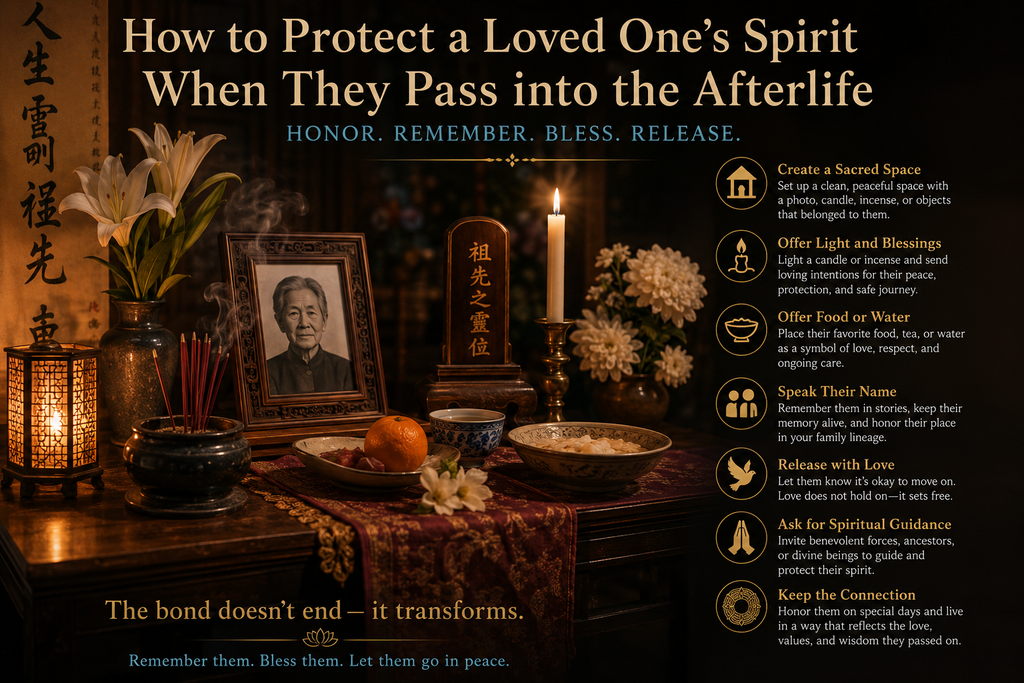
1. Create a Small Ancestor Space
One of the most enduring ancestor practices is establishing a physical location where the deceased can be remembered.
Ancient Chinese families used ancestral tablets and household shrines. In ancient Egypt, spaces connected with tombs and household ancestor practices allowed families to maintain ritual relationships with the dead.
A modern version can be extremely simple.
Place a photograph of your loved one somewhere peaceful.
You might add:
- a candle,
- flowers,
- incense,
- an object that belonged to them,
- something representing your family,
- or a small bowl of water.
It does not have to become an elaborate shrine.
The important element is intentional remembrance.
You are creating a place that says:
“You belonged here. You still matter.”
2. Light a Candle and Offer a Blessing
Fire has been used symbolically in religious rituals throughout human history.
For a modern ancestor practice, lighting a candle can represent consciousness, guidance and the continuation of light beyond physical darkness.
You might sit quietly before the photograph and say something such as:
May you be protected.
May you be free from fear.
May you find peace.
May wise and compassionate beings guide you.
May you release anything that still binds you to suffering here.
May you continue wherever you need to go.
You do not need to know exactly where the person is.
You are sending the intention.
Someone with Buddhist sympathies might recognize something similar to Metta—directing loving-kindness toward another being.
The emotional energy is not:
“Come back.”
It is:
“Wherever you are, may you be well.”
3. Offer Water or Food
Food offerings appear repeatedly in ancestor traditions.
Ancient Chinese families presented food and drink to ancestors, while ancient Egyptian mortuary practices included offerings intended to sustain the deceased in the afterlife.
You do not have to believe that a spirit literally consumes physical food.
The offering itself carries symbolism.
Putting down a cup of tea your grandmother loved, your father’s favourite fruit, or something traditionally associated with your family communicates:
“We remember who you were.”
You can leave the offering temporarily and dispose of it respectfully afterward.
The spiritual significance is not the physical calories.
It is hospitality extended beyond death.
There is something deeply human about continuing to offer care even when you can no longer physically care for the person.
4. Speak Their Name
One of the most powerful aspects of ancestor traditions is preserving identity.
Ancestor tablets recorded names and lineage. Tomb inscriptions preserved identities. Family rituals repeated the memory of those who had gone before.
Speaking someone’s name can therefore become a ritual in itself.
Say:
“I remember you.”
Tell younger relatives stories about them.
Preserve photographs.
Write down important memories.
Keep family history alive.
Whether or not spirits literally perceive these actions, something objectively meaningful happens:
The person continues influencing the living world through memory.
Their lessons, humour, sacrifices, mistakes and wisdom become part of the family rather than disappearing.
This may be one of the deepest meanings of ancestor worship.
5. Tell Them They Are Allowed to Leave
This may be one of the most important practices.
When someone dies suddenly, relatives sometimes emotionally beg:
“Don’t leave me.”
That reaction is completely understandable.
But if consciousness does continue after death, constantly pulling someone emotionally backward may be the opposite of what we want.
Instead, try telling them:
“You don’t need to stay here for us.”
“We will be okay.”
“Continue your journey.”
“We love you enough to let you go.”
You can still maintain an ancestral relationship afterward.
There is a difference between remembering someone and binding someone.
Your home does not have to become their prison.
It can become somewhere their memory is welcomed while their spirit remains free.
6. Ask Benevolent Spiritual Forces to Guide Them
Many cultures imagined the afterlife as a journey requiring guidance.
Ancient Egyptian funerary traditions explicitly included objects, texts and rituals intended to protect and guide the deceased through the dangers of the afterlife.
Different religious traditions would naturally interpret spiritual guidance differently.
A Christian might pray:
“May God receive and protect them.”
A Buddhist might wish:
“May they receive a favourable rebirth and be free from suffering.”
A Hindu might pray for progress toward liberation and favourable transition.
Someone with a more eclectic spiritual outlook might simply say:
“May compassionate beings, ancestors and forces of light guide you safely.”
You do not need to construct an elaborate cosmology.
The essence is:
You are asking that whatever is benevolent in existence accompany the person where you cannot.
7. Ask the Ancestors to Receive Them
This is one of the most beautiful ideas that can be adapted from ancestor traditions.
Imagine the deceased not entering the afterlife alone.
Imagine the family members who went before them receiving them.
Grandparents.
Parents.
Brothers.
Sisters.
Friends.
Generations whose names may even have been forgotten.
You might say:
“Ancestors of our family who came before us, receive them with love. Help them understand what has happened. Guide them safely onward.”
Whether taken literally or symbolically, it transforms the mental image of death.
Instead of imagining someone entering darkness alone, you imagine them returning to a lineage.
The family exists on both sides of death.
8. Keep Important Memorial Days
Ancient ancestor traditions often involved recurring ritual rather than one funeral followed by silence.
Chinese families made offerings on significant occasions and maintained ancestor rituals across generations. Roman Parentalia established dedicated days for remembering familial dead.
You could create your own tradition.
Remember the person on:
- their birthday,
- the anniversary of their death,
- New Year’s Day,
- important family holidays,
- or another meaningful annual date.
Light a candle.
Place flowers nearby.
Prepare their favourite food.
Tell a story about them.
Spend five minutes remembering them.
Ancestor practice does not require thinking about death every day.
It means periodically making space for those who helped create the world you inherited.
9. Live in a Way That Honours Them
Perhaps the strongest offering cannot be placed on an altar.
It is your life.
Imagine saying to your ancestors:
“Because you existed, I exist. I will try to make something worthwhile from the life that reached me through you.”
Take whatever was good in your loved one and continue it.
If they were generous, become more generous.
If they loved music, keep music alive.
If they valued education, teach someone.
If they struggled terribly with something, perhaps your offering is breaking that pattern.
This transforms ancestor worship from superstition into intergenerational responsibility.
You are no longer merely asking ancestors to protect you.
You are honouring them by becoming a better descendant.
10. Do Not Feed Fear
There is an important caution.
Ancestor spirituality should not become obsessive fear about whether your deceased relative is trapped, suffering, haunted or surrounded by hostile entities.
We cannot know those things with certainty.
A ritual intended to create peace should not create terror.
If you perform ancestor practices, approach them through:
love rather than fear,
gratitude rather than anxiety,
remembrance rather than obsession,
release rather than attachment.
If you find yourself repeatedly performing rituals because you fear something terrible will happen to the deceased unless you perform them perfectly, the practice has lost its purpose.
The ritual is an expression of love.
It is not a spiritual ransom payment.
A Simple Modern Ancestor Protection Ritual
You can combine these ideas into a simple ceremony.
Place a photograph of the deceased before you.
Light a candle or incense safely.
Place a glass of water beside the photograph.
Sit quietly.
Then say:
“I remember you.
Thank you for the life we shared.
If any fear, confusion or attachment remains around you, may it dissolve.
May you be surrounded by compassion.
May those who loved you and went before you receive you.
May your ancestors guide you.
May whatever is benevolent in this universe protect you.
May you continue your journey freely.
You do not need to remain here for us.
You are loved.
You are remembered.
Go in peace.”
Then remain silent for several minutes.
If emotions arise, allow them.
Eventually extinguish the candle.
You might pour the water outside afterward as a symbolic return to nature.
Nothing complicated is required.
The Living Protect the Dead Through Love—and the Dead Protect the Living Through Memory
Ancient ancestor traditions frequently imagined a reciprocal relationship.
The living cared for the ancestors through remembrance and offerings.
The ancestors, in return, were believed capable of blessing and protecting their descendants. Ancient Chinese ancestor religion particularly emphasized this continuing relationship between generations.
Whether interpreted literally or psychologically, there is something profound here.
Your ancestors shaped you.
Their genetics are in your body.
Their decisions altered the circumstances into which you were born.
Their stories shaped your family.
Their successes and failures created consequences that may still be unfolding generations later.
Perhaps ancestor worship began because ancient people understood something modern individualistic societies sometimes forget:
A human being is not an isolated event.
We are links in extraordinarily long chains.
Someone existed before us.
Someone may exist after us.
And death does not erase the importance of the link.
So when someone you love dies, perhaps the spiritual response does not have to be desperately trying to hold onto them.
Instead:
Remember them.
Bless them.
Thank them.
Ask that they be protected.
Invite the ancestors to receive them.
And then give them the greatest gift love can sometimes provide:
Permission to continue their journey.