
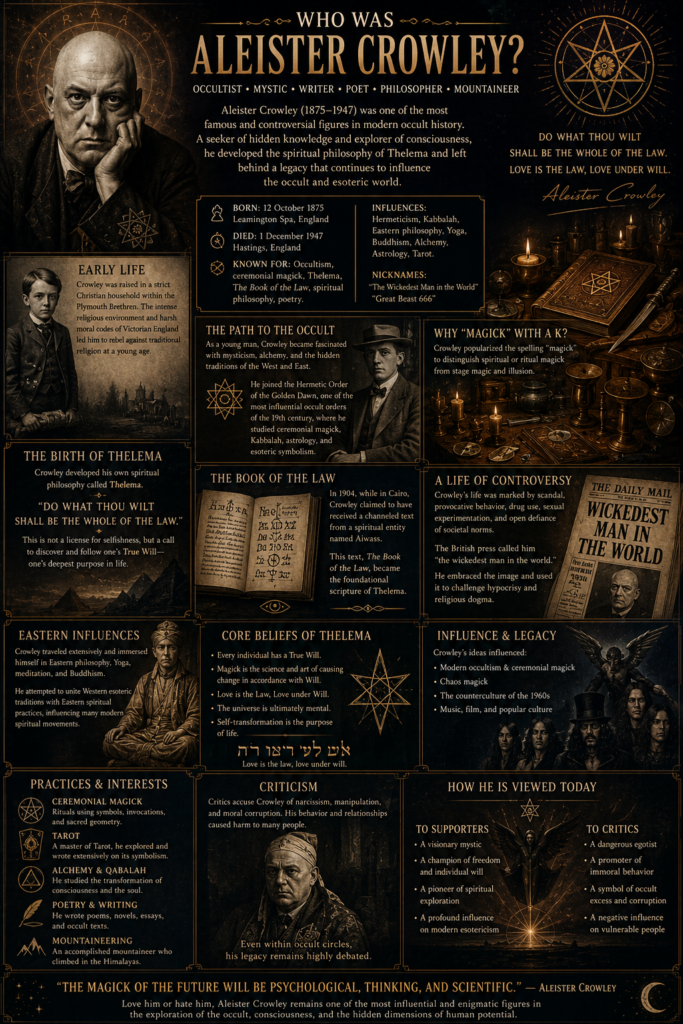
One of the Most Controversial Occult Figures in Modern History
Aleister Crowley was:
- an occultist
- writer
- mystic
- ceremonial magician
- poet
- mountaineer
born in:
- 1875 in England.
He became one of the most famous—and infamous—figures in modern occult history.
To supporters, Crowley was:
- a spiritual revolutionary
- philosopher of personal will
- explorer of consciousness.
To critics, he was:
- narcissistic
- scandalous
- manipulative
- morally destructive.
Even today, his name remains heavily associated with:
- occultism
- ritual magick
- Thelema
- esoteric spirituality.
Early Life and Religious Upbringing


Crowley was born into a strict Christian family associated with:
→ the Plymouth Brethren.
His childhood environment was:
- intensely religious
- morally strict
- heavily focused on sin and judgment.
As he grew older, Crowley rebelled strongly against:
- traditional religious authority
- Victorian moral constraints.
This rebellion became a major theme throughout his life.
His Interest in the Occult
As a young man, Crowley became fascinated with:
- mysticism
- alchemy
- ritual magic
- Eastern philosophy
- esoteric symbolism.
He eventually joined:
→ the Hermetic Order of the Golden Dawn
one of the most influential occult societies of the late 19th century.
The group studied:
- ceremonial magic
- Kabbalah
- astrology
- Tarot
- mystical correspondences.
Why He Added the “K” to Magick


Crowley popularized the spelling:
→ “magick”
with a “k.”
He used this spelling to distinguish:
- spiritual/ritual magick
from:
- stage magic and illusion performance.
For Crowley, magick involved:
- consciousness
- will
- ritual transformation
- symbolic systems.
Thelema: Crowley’s Spiritual Philosophy
Crowley eventually developed his own spiritual philosophy called:
→ Thelema.
The central idea is often summarized by the famous phrase:
“Do what thou wilt shall be the whole of the Law.”
This statement is frequently misunderstood.
Crowley did not simply mean:
- “do whatever you want.”
Rather, he claimed humans should discover and follow their:
→ “True Will”
meaning:
- their deepest purpose or authentic path.
The Book of the Law


In 1904, Crowley claimed he received a channeled text called:
→ The Book of the Law
which became the foundational scripture of Thelema.
Crowley said the text was dictated by a spiritual entity named:
→ Aiwass.
Skeptics interpret this as:
- subconscious creation
or - psychological experience.
Believers often interpret it spiritually.
Crowley’s Reputation and Scandal
Crowley became notorious during his lifetime for:
- provocative behavior
- drug use
- sexual experimentation
- anti-establishment attitudes
- occult rituals.
British media labeled him:
“The Wickedest Man in the World.”
Part of this reputation came from:
- sensational journalism
- public fear of occultism
- Crowley’s own dramatic personality.
He often intentionally cultivated controversy.
Crowley and Eastern Philosophy


Crowley was heavily influenced by:
- yoga
- meditation
- Buddhism
- Hindu philosophy.
He attempted to combine:
- Western occult traditions
with - Eastern spiritual practices.
This fusion later influenced many modern:
- New Age
- occult
- consciousness exploration movements.
Was Crowley Satanic?
One of the biggest misconceptions is that Crowley was literally:
→ satanic.
Crowley often used shocking imagery and symbolism to:
- provoke society
- challenge religious norms
- attack Victorian morality.
However, his actual philosophy was more focused on:
- will
- consciousness
- self-transformation
- mystical exploration
than worship of a literal devil figure.
That said:
many people still strongly criticize aspects of his work and behavior.
Crowley’s Influence on Modern Culture


Crowley’s influence spread far beyond occult circles.
His ideas affected:
- modern ceremonial magick
- chaos magick
- occult revival movements
- counterculture spirituality
- some psychological and symbolic systems.
References to Crowley also appear in:
- music
- film
- literature
- pop culture.
The Psychological Interpretation of Crowley
Some modern thinkers interpret Crowley less as:
- a supernatural magician
and more as:
- a psychological explorer of consciousness.
His rituals may be viewed as:
- symbolic systems
- subconscious programming
- altered-state practices
- archetypal exploration.
Criticism of Crowley


Crowley remains controversial because critics point to:
- manipulation
- egoism
- destructive behavior
- drug addiction
- exploitative relationships.
Even some occult practitioners distance themselves from:
- his personality
while still acknowledging: - his historical influence.
Why Crowley Still Fascinates People
Crowley continues to intrigue people because he represents:
- rebellion against convention
- spiritual experimentation
- the search for hidden knowledge
- exploration of consciousness.
He combined:
- philosophy
- ritual
- symbolism
- mysticism
- psychology
- performance
into a highly provocative public persona.
Final Thought
Aleister Crowley was one of the most influential and controversial occult thinkers of the modern era.
To some, he was:
- a visionary mystic.
To others:
- a dangerous egotist.
His legacy remains deeply debated.
But regardless of opinion, Crowley helped shape much of modern occult culture by pushing ideas about:
- consciousness
- ritual
- symbolism
- personal will
- spiritual experimentation.
And perhaps that is why his name still survives today:
Because he embodied humanity’s ongoing fascination with:
power, mystery, rebellion, and the hidden dimensions of the mind.