
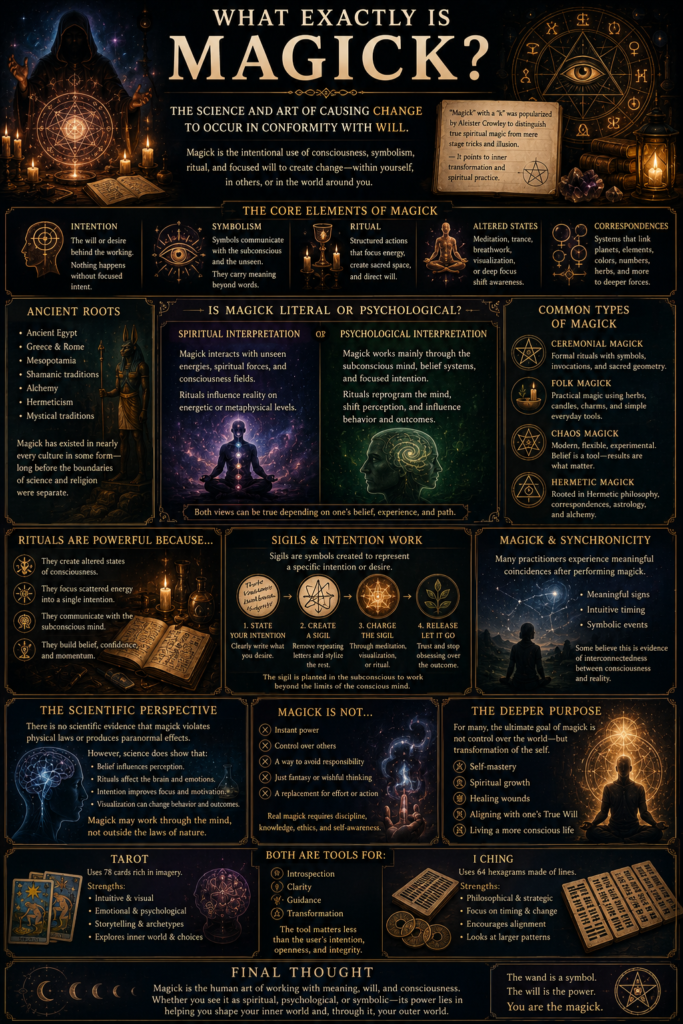
Why “Magick” Is Spelled With a K
The word:
→ “magick”
(with a “k”)
became especially associated with occultist Aleister Crowley, who used the spelling to distinguish:
- spiritual or ritual magick
from:
- stage magic and illusion tricks.
Today, “magick” is often used to describe:
practices intended to influence consciousness, perception, inner transformation, or symbolic reality through ritual, intention, and symbolism.
Different people interpret magick very differently:
- spiritually
- psychologically
- symbolically
- metaphysically.
The Simplest Definition of Magick
One famous definition by Crowley described magick as:
“The Science and Art of causing Change to occur in conformity with Will.”
In simpler terms:
magick is often viewed as:
→ using focused intention, symbolism, ritual, and consciousness to create change.
That change may be:
- internal
- emotional
- psychological
- spiritual
or, according to believers: - external and energetic.
Ancient Roots of Magick


Magick-like practices appear throughout human history:
- ancient Egypt
- Greece
- Mesopotamia
- shamanic cultures
- alchemy
- Hermetic traditions
- ceremonial rituals.
Historically, magick was often intertwined with:
- religion
- medicine
- astrology
- spirituality
- philosophy.
The separation between:
- science
- religion
- magick
was not always clear in ancient cultures.
The Core Components of Magick
Most magickal systems involve combinations of:
Intention
Focused desire or will.
Symbolism
Using symbols to communicate with the subconscious or spiritual reality.
Ritual
Structured actions designed to focus consciousness.
Altered States
Meditation, trance, chanting, visualization, or deep focus.
Correspondence Systems
Associations involving:
- planets
- colors
- elements
- numbers
- astrology
- sacred geometry.
Is Magick Literal or Psychological?


This is one of the biggest debates surrounding magick.
Spiritual Interpretation
Some practitioners believe magick interacts with:
- spiritual energies
- consciousness fields
- unseen forces
- synchronicity.
Psychological Interpretation
Others view magick primarily as:
- subconscious programming
- symbolic psychology
- focused intention
- ritualized self-transformation.
In this view:
rituals influence:
- perception
- confidence
- emotional states
- behavior patterns.
Why Rituals Feel Powerful
Humans respond deeply to:
- symbols
- repetition
- ceremony
- focused attention.
Rituals can create:
- emotional intensity
- altered awareness
- psychological anchoring
- increased focus.
Even outside supernatural belief, rituals may still affect:
→ mindset and behavior.
Magick and the Subconscious Mind


Many modern occult thinkers believe magick primarily operates through:
→ the subconscious mind.
Symbols, rituals, and focused intention may influence:
- beliefs
- emotional patterns
- perception
- unconscious behavior.
This overlaps surprisingly with:
- psychology
- meditation
- visualization practices.
Common Types of Magick
Different traditions practice different forms.
Ceremonial Magick
Complex rituals involving:
- symbols
- planetary correspondences
- invocations
- sacred geometry.
Folk Magick
Simple practical rituals involving:
- charms
- candles
- herbs
- protective symbols.
Chaos Magick
A modern system emphasizing:
- belief flexibility
- symbolic experimentation
- psychological results.
Hermetic Magick
Rooted in:
- ancient esoteric philosophy
- astrology
- alchemy
- correspondences.
Sigils and Intention Work


One common magickal technique involves:
→ sigils.
These are symbolic designs representing:
- intentions
- desires
- psychological focus.
Some practitioners believe sigils work by:
- embedding intentions into the subconscious mind.
Others believe they influence:
- external energetic reality.
Magick and Synchronicity
Many practitioners report experiences involving:
- meaningful coincidences
- intuitive timing
- symbolic events
- synchronicities.
Psychologist Carl Jung explored synchronicity as:
→ meaningful coincidence without obvious causal connection.
Some magick practitioners interpret synchronicity as evidence that:
- consciousness and symbolism interact with reality in subtle ways.
The Scientific Perspective


Modern science does not recognize magick as:
- a proven supernatural force.
There is no scientific evidence that rituals can:
- directly violate physical laws
or - produce paranormal effects reliably.
However, psychology does recognize that:
- belief
- ritual
- expectation
- visualization
- focused intention
can strongly influence:
- behavior
- emotions
- confidence
- perception.
Why Magick Endures
Magick continues to fascinate people because it combines:
- mystery
- symbolism
- personal transformation
- spirituality
- empowerment
- ritual psychology.
It gives people a framework for interacting with:
→ uncertainty and meaning.
The Difference Between Fantasy and Real Magick Traditions
Hollywood often portrays magick as:
- instant supernatural power
- fireballs
- dramatic curses
- impossible abilities.
Real historical magick traditions were usually more focused on:
- consciousness
- symbolism
- ritual discipline
- spiritual philosophy
- inner transformation.
The Deeper Purpose of Magick


For many practitioners, the ultimate goal of magick is not:
- controlling the universe
but:
→ transforming the self.
In many traditions, magick becomes:
- self-mastery
- spiritual growth
- psychological integration
- conscious intention.
Final Thought
Magick is one of humanity’s oldest attempts to explore:
- consciousness
- symbolism
- intention
- transformation
- the unseen dimensions of experience.
Some view it:
- spiritually.
Others view it:
- psychologically.
Some see it as:
- ritualized subconscious influence.
Others believe it interacts with deeper metaphysical realities.
But regardless of interpretation, magick consistently reveals something deeply human:
Humans instinctively seek ways to influence reality through meaning, intention, symbols, and focused consciousness.
And perhaps that search itself is the real heart of magick.