
Why Dreams Fascinate Humanity
For thousands of years, humans have believed dreams could contain:
- hidden messages
- spiritual insight
- emotional truth
- prophecy
- subconscious symbolism
Dream interpretation appears in:
- ancient Egypt
- Greece
- China
- Indigenous traditions
- modern psychology
Even today, dreams remain mysterious because they often feel:
- emotionally intense
- symbolic
- deeply personal
- strangely meaningful.
The big question is:
What are dreams actually trying to tell us?
What Modern Science Says About Dreams
Modern neuroscience suggests dreams may involve:
- memory processing
- emotional regulation
- subconscious integration
- imagination
- neurological activity during sleep.
Meanwhile, psychological traditions often view dreams as:
→ symbolic reflections of the unconscious mind.
Spiritual traditions may interpret dreams as:
- messages
- visions
- spiritual encounters
- intuitive guidance.
Different systems explain dreams differently.
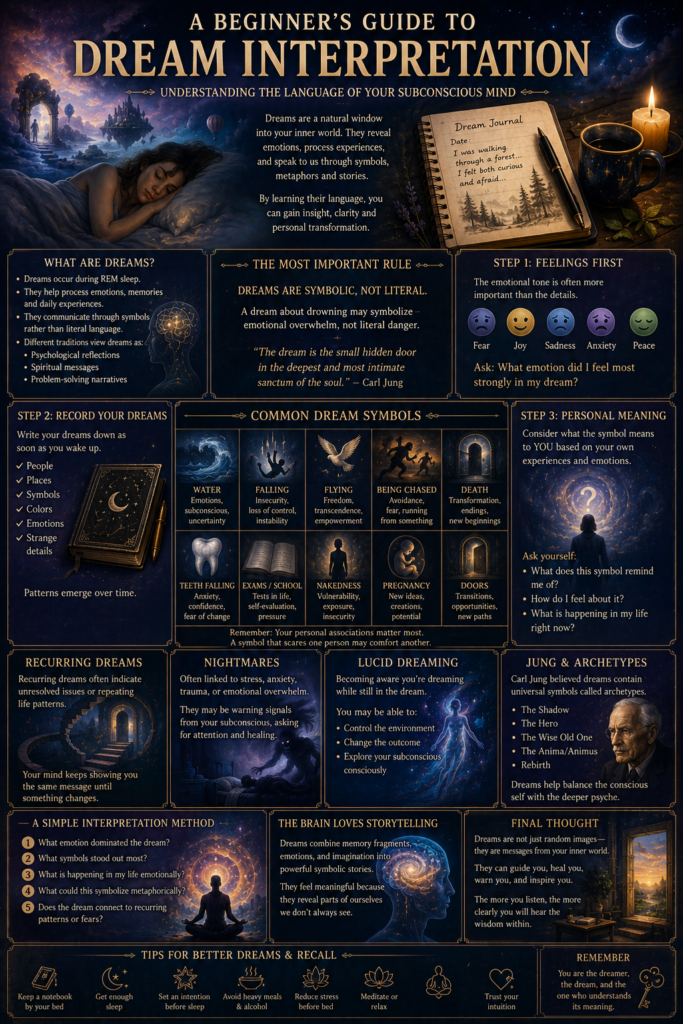
The Most Important Rule: Dreams Are Symbolic


One of the biggest beginner mistakes is interpreting dreams:
→ too literally.
Dreams usually communicate through:
- metaphor
- emotion
- symbols
- exaggeration
- narrative fragments.
For example:
dreaming about drowning may symbolize:
- emotional overwhelm
—not necessarily literal danger.
Step 1: Focus on Emotion First
The emotional tone of a dream is often more important than:
- the exact imagery.
Ask yourself:
- What emotion did I feel most strongly?
- fear?
- joy?
- shame?
- excitement?
- grief?
Dreams often reflect:
→ emotional states the conscious mind may suppress or ignore.
Step 2: Record Dreams Immediately


Dream memories fade quickly.
Keeping a dream journal is one of the best ways to improve dream recall.
Write down:
- symbols
- emotions
- locations
- people
- colors
- strange details
even if they seem random.
Patterns often emerge over time.
Step 3: Identify Symbols
Dream interpretation relies heavily on:
→ symbolism.
Common dream symbols often include:
Water
May symbolize:
- emotions
- subconscious mind
- uncertainty
- intuition.
Falling
Often linked to:
- insecurity
- loss of control
- instability.
Flying
Can symbolize:
- freedom
- transcendence
- escape
- empowerment.
Being Chased
Often reflects:
- avoidance
- fear
- unresolved pressure.
Death
Usually symbolizes:
- transformation
- endings
- identity change
—not literal death.
Personal Meaning Matters Most


A symbol’s meaning depends heavily on:
→ personal association.
For example:
- dogs may symbolize comfort to one person
but - fear to another.
This is why dream dictionaries can only provide:
- rough starting points.
Your emotional relationship to the symbol matters more.
Carl Jung and Archetypes
Carl Jung believed dreams often contain:
→ archetypes
These are universal symbolic patterns such as:
- the shadow
- the hero
- the wise old figure
- the anima/animus
- rebirth symbolism.
Jung believed dreams attempted to:
- balance the conscious personality
- reveal hidden psychological truths.
Recurring Dreams Are Especially Important


Recurring dreams often indicate:
- unresolved emotional issues
- repeating life patterns
- persistent subconscious tension.
The mind may repeatedly present the same symbolic situation until:
→ something is emotionally acknowledged or processed.
Nightmares Often Reflect Stress
Nightmares are frequently linked to:
- anxiety
- trauma
- stress
- emotional overwhelm
- unresolved fear.
Although frightening, nightmares sometimes serve as:
→ emotional warning signals.
The goal is usually not:
- punishment
but:
- attention and processing.
Lucid Dreaming
Lucid dreaming occurs when:
→ a person becomes aware they are dreaming while still inside the dream.
Some people can partially:
- control dream environments
- interact consciously with dream imagery.
Lucid dreaming practices often involve:
- reality checks
- dream journaling
- sleep awareness techniques.
Spiritual Interpretations of Dreams


Many spiritual traditions view dreams as:
- messages from the soul
- ancestral communication
- divine guidance
- symbolic prophecy.
Others interpret dreams psychologically rather than supernaturally.
There is no universal agreement.
The Brain Loves Storytelling
Humans naturally create:
- narratives
- patterns
- symbolic meaning.
Dreams often combine:
- memory fragments
- emotional concerns
- subconscious imagery
into strange symbolic stories.
This explains why dreams can feel:
- deeply meaningful
even when surreal.
Don’t Obsess Over Literal Predictions
One unhealthy mistake is assuming:
→ every dream predicts the future literally.
This can create:
- paranoia
- anxiety
- obsessive interpretation.
Most dreams appear to function more like:
- emotional mirrors
or - symbolic processing systems
than exact prophecy.
A Simple Beginner Dream Interpretation Method


After waking, ask:
1. What emotion dominated the dream?
2. What symbols stood out most?
3. What is happening in my life emotionally right now?
4. What might this symbolize metaphorically?
5. Does the dream connect to recurring patterns or fears?
Why Dreams Still Matter
Dreams fascinate humans because they blur the boundary between:
- imagination
- emotion
- memory
- consciousness
- mystery.
Even modern science still does not fully understand:
→ why dreams feel so meaningful.
Final Thought
Dream interpretation is ultimately less about:
- decoding rigid secret messages
and more about:
→ understanding the symbolic language of the subconscious mind.
Dreams often reveal:
- fears
- desires
- unresolved emotions
- hidden tensions
- psychological transformation.
Whether viewed:
- spiritually
- psychologically
or - symbolically
dreams remind us of something profound:
Much of human consciousness exists beneath the surface of ordinary waking awareness.
And every night, the dreaming mind quietly tries to speak in symbols.