
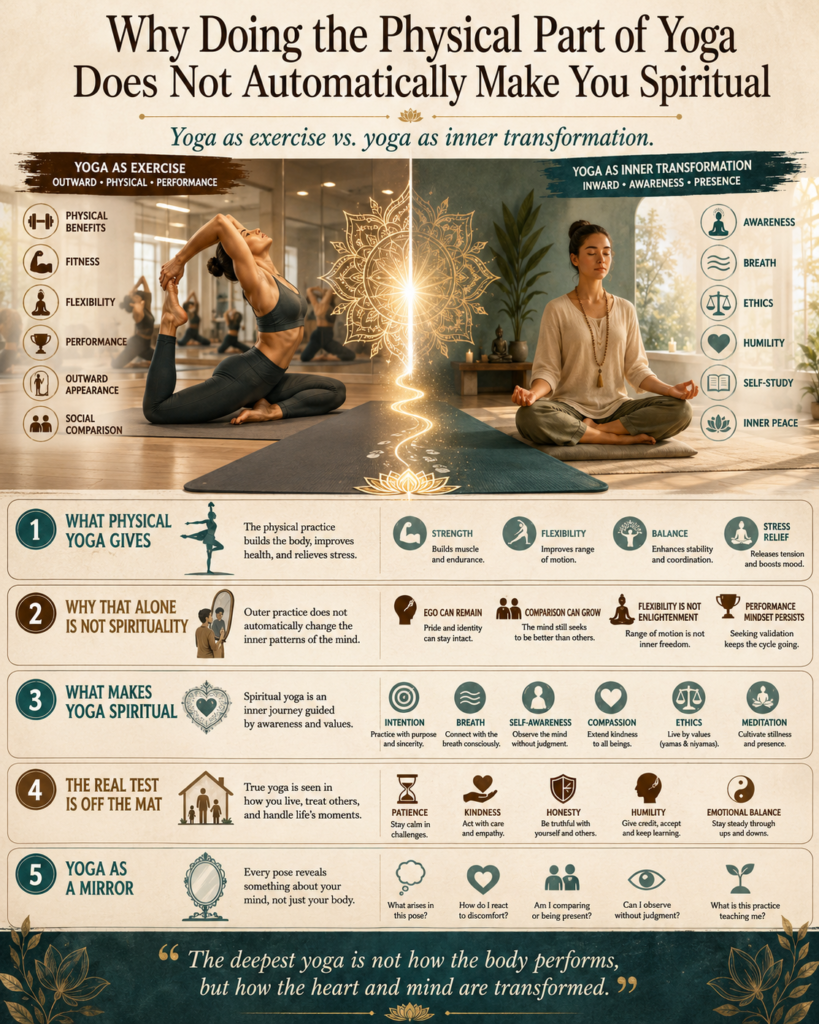
Yoga has become one of the most popular wellness practices in the modern world. People practice it in gyms, studios, parks, homes, retreats, and even corporate offices. For many, yoga means stretching, flexibility, fitness, balance, core strength, and stress relief.
All of these benefits are real and valuable.
But there is an important truth that is often forgotten:
Doing yoga poses does not automatically make someone spiritual.
A person can perform advanced postures, hold impressive handstands, twist into difficult shapes, and still remain ego-driven, impatient, angry, judgmental, or disconnected from deeper awareness.
The physical part of yoga can open the door to spirituality.
But walking through that door requires intention.
Yoga Is More Than Exercise
In the modern world, yoga is often reduced to the body.
People think of yoga as:
- Stretching
- Flexibility
- Fitness
- Posture correction
- Core strength
- Relaxation
- Breath control
These are useful benefits. But traditionally, yoga was not created merely as a workout system.
Yoga was a spiritual discipline meant to unite the body, mind, breath, and consciousness.
The word “yoga” is often translated as union.
This union can mean the union of body and mind, breath and awareness, self and higher truth, or individual consciousness with divine consciousness.
So if someone practices only the physical postures without awareness, humility, ethics, or self-inquiry, they may be doing something useful — but they may not be practicing yoga in its deeper sense.
They may simply be exercising with ancient poses.
The Body Can Become Another Ego Project
One of the ironies of modern yoga is that a practice designed to dissolve ego can sometimes become another way to strengthen it.
A person may start comparing bodies, outfits, flexibility, strength, beauty, or social media images.
Instead of asking, “Am I becoming more peaceful?” they ask, “Do I look impressive?”
Instead of asking, “Am I becoming more compassionate?” they ask, “Can I do a more advanced pose than the person beside me?”
This is not spiritual growth.
This is ego wearing yoga clothes.
The body becomes another trophy.
The practice becomes another performance.
The mat becomes another stage.
Spiritual yoga does not ask, “How impressive do I look?”
It asks, “How awake am I becoming?”
Flexibility Is Not Enlightenment
Being physically flexible does not automatically make someone emotionally flexible.
A person may be able to touch their toes but still be unable to apologize.
A person may be able to do a deep backbend but still have a closed heart.
A person may be able to sit in lotus posture but still be ruled by jealousy, resentment, greed, or pride.
Physical ability is not the same as spiritual maturity.
Spiritual maturity appears in how someone treats others.
It appears in patience, honesty, humility, compassion, discipline, forgiveness, and self-awareness.
The real test of yoga is not whether you can balance on your hands.
It is whether you can remain balanced when life does not go your way.
The Purpose of Asana
The physical postures of yoga, called asanas, are not meaningless. They are powerful.
They can strengthen the body, open blocked areas, improve circulation, calm the nervous system, deepen the breath, and prepare the mind for meditation.
But traditionally, asana was not the final goal.
It was preparation.
The body is trained so the mind can become steady.
The breath is regulated so the emotions can become calmer.
The nervous system is balanced so meditation becomes possible.
In this sense, the body is the doorway.
But the body is not the temple’s inner chamber.
To go deeper, one must bring awareness into the practice.
Breath Turns Exercise Into Practice
One major difference between yoga and ordinary stretching is breath.
If someone moves through poses while thinking about work, checking the mirror, competing with others, or rushing toward the next posture, the practice remains mostly physical.
But when breath becomes conscious, the practice changes.
Breath brings the mind into the body.
Breath teaches patience.
Breath reveals tension.
Breath shows where we are forcing.
Breath transforms movement into meditation.
A simple pose done with deep awareness can be more spiritual than an advanced pose done with vanity.
Intention Matters
The same yoga pose can have completely different meanings depending on intention.
A forward fold can be a hamstring stretch.
Or it can be an act of surrender.
A backbend can be a flexibility drill.
Or it can be a practice of opening the heart.
A warrior pose can be a leg exercise.
Or it can be a reminder to stand with courage and integrity.
A headstand can be an impressive inversion.
Or it can be a meditation on changing perspective, reversing habitual energy, and humbling the ego.
The posture itself is not enough.
The consciousness inside the posture is what matters.
Yoga Without Ethics Is Incomplete
Classical yoga includes ethical teachings, not only physical movements.
In many yogic traditions, these include principles such as:
- Non-harm
- Truthfulness
- Self-discipline
- Contentment
- Moderation
- Self-study
- Devotion or surrender to something higher
Without ethics, yoga becomes incomplete.
A person may be physically disciplined but morally careless.
They may practice every morning but still lie, manipulate, gossip, exploit others, or act with arrogance.
This is why spirituality cannot be measured by how often someone practices poses.
It is measured by how deeply the practice changes their character.
Spirituality Shows Up Off the Mat
The real yoga begins after the class ends.
Can you remain calm in traffic?
Can you speak kindly when irritated?
Can you admit when you are wrong?
Can you forgive without becoming weak?
Can you set boundaries without hatred?
Can you face desire without being ruled by it?
Can you experience success without arrogance?
Can you experience failure without self-destruction?
This is where yoga becomes spiritual.
The mat is the training ground.
Life is the examination.
The Danger of Spiritual Aesthetics
Modern culture often confuses spiritual appearance with spiritual depth.
Someone may wear mala beads, post yoga photos, use Sanskrit words, burn incense, drink herbal tea, and decorate their room with spiritual symbols — yet still avoid the real inner work.
Spiritual aesthetics can be beautiful.
But they are not the same as transformation.
The real question is not:
“Do I look spiritual?”
The real question is:
“Am I becoming less selfish, less reactive, less cruel, less unconscious?”
Spirituality is not an aesthetic.
It is a refinement of consciousness.
Pain Can Also Be Misunderstood
Some people believe pushing harder means going deeper.
But forcing the body is not spiritual.
Pain is not proof of devotion.
Aggressive stretching, competitive postures, and ignoring injury can actually show disconnection from the body.
True yoga teaches listening.
It teaches respect.
It teaches the difference between discomfort that helps growth and pain that signals harm.
A spiritual practice should make a person more sensitive, not more violent toward themselves.
The Body Is Sacred, But It Is Not the Whole Path
The body matters.
Yoga should not reject the body.
The body is the vessel through which we breathe, love, serve, meditate, and experience life.
Taking care of the body is spiritual when done with gratitude and awareness.
But the body is not the whole path.
A beautiful body does not guarantee a beautiful soul.
A strong body does not guarantee a strong conscience.
A flexible body does not guarantee an open heart.
The body can support spiritual growth, but it cannot replace it.
How to Make Physical Yoga More Spiritual
To bring more spirituality into physical yoga, begin with intention.
Before practice, ask:
“What am I here to learn?”
“What am I ready to release?”
“How can this practice make me more compassionate?”
During practice, stay aware of the breath.
Notice when ego appears.
Notice when comparison appears.
Notice when impatience appears.
Notice when you force.
Notice when you resist.
At the end, sit quietly. Do not rush away. Let the practice become meditation.
Then carry one lesson from the mat into your day.
Maybe today’s lesson is patience.
Maybe it is humility.
Maybe it is courage.
Maybe it is softness.
Maybe it is discipline.
This is how yoga becomes more than movement.
Yoga as a Mirror
Yoga does not automatically make someone spiritual.
But it can show a person where they are not spiritual yet.
It reveals ego.
It reveals impatience.
It reveals tension.
It reveals avoidance.
It reveals where the body is tight and where the mind is restless.
This is why yoga is powerful.
Not because the pose itself saves you.
But because the pose becomes a mirror.
And if you are willing to look honestly, that mirror can become a path.
Final Thoughts
Doing the physical part of yoga is beneficial, but it does not automatically make a person spiritual.
Stretching can improve flexibility.
Strength poses can build the body.
Inversions can improve focus and change perspective.
Breathwork can calm the nervous system.
But spirituality requires something more.
It requires awareness.
It requires humility.
It requires ethics.
It requires compassion.
It requires self-study.
It requires bringing the lessons of the mat into ordinary life.
Yoga becomes spiritual not when the body performs beautifully, but when the heart becomes softer, the mind becomes clearer, and the ego becomes less dominant.
The deepest yoga is not about touching your toes.
It is about what you learn on the way down.