Few spiritual symbols are as misunderstood in modern culture as the pentacle.
For many people, seeing a five-pointed star inside a circle immediately triggers associations with dark magic, occult rituals, or Satanism. Popular films, horror media, and decades of cultural misunderstanding have created the impression that the pentacle is somehow dangerous or inherently evil.
But historically, this could not be further from the truth.
For thousands of years, the pentacle was one of humanity’s most widely recognized symbols of protection, balance, harmony, and spiritual order.
Its negative reputation is relatively recent, and much of the confusion comes from later groups deliberately reversing the symbol and assigning it a completely different meaning.
Understanding the pentacle reveals how powerful symbols can become misunderstood when history is forgotten.
The Ancient Origins of the Pentacle
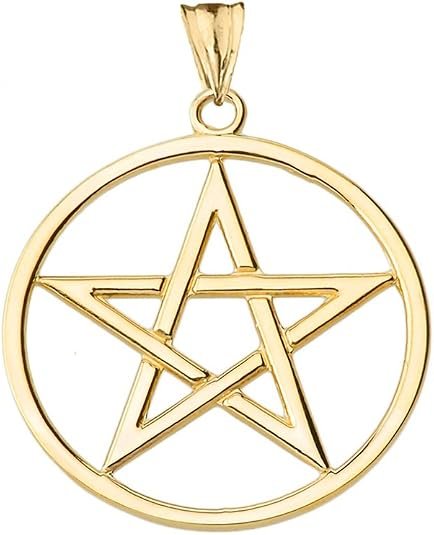
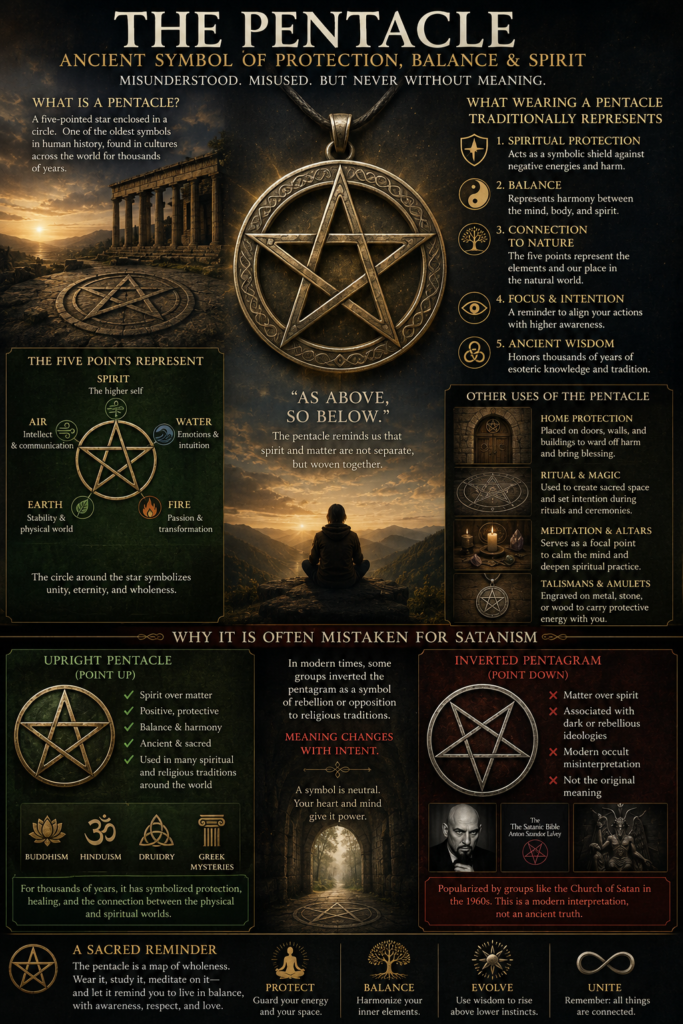
The pentacle consists of a five-pointed star enclosed within a circle.
It has appeared throughout history in civilizations stretching from ancient Mesopotamia to classical Greece, medieval Europe, and many esoteric traditions.
One of the earliest philosophical groups to emphasize the pentagram was associated with Pythagoras and the Pythagorean School.
To them, the pentagram represented mathematical perfection and universal harmony.
The five points were often associated with:
- Earth
- Water
- Fire
- Air
- Spirit
The surrounding circle symbolized unity and the interconnected nature of existence.
The pentacle was not originally a symbol of rebellion against religion.
It was a symbol of cosmic order.
What Wearing a Pentacle Traditionally Represents
Across many mystical traditions, wearing a pentacle has long been associated with personal protection.
The upright pentacle — with one point facing upward — symbolizes spirit governing the material world.
In this arrangement:
The upper point represents spirit or higher consciousness.
The four lower points represent the physical elements of existence.
This creates the idea that higher awareness remains in control of instinct, desire, and physical existence.
Traditionally people wear pentacles for several reasons.
1. Spiritual Protection
The pentacle has often been worn as an energetic shield.
Many traditions believe sacred geometry creates symbolic boundaries that help protect against unwanted energies, harmful intentions, or emotional disturbance.
In medieval Europe, pentagrams were often placed over doorways for protection.
2. Balance Between Mind and Body
Because the five points correspond to the classical elements, wearing a pentacle can symbolize internal balance.
It serves as a reminder to keep life in equilibrium.
Too much emotion creates instability.
Too much logic creates detachment.
Too much desire creates chaos.
The pentacle represents integration.
3. Focus During Meditation or Ritual
Many practitioners use sacred symbols as psychological anchors.
Wearing a pentacle during meditation can serve as a reminder to stay centered and maintain awareness.
In this sense, the symbol works similarly to prayer beads in Buddhism or a cross necklace in Christianity.
The object itself does not create power.
It reminds the mind of an intended state.
4. Connection to Ancient Wisdom Traditions
Many wear symbolic jewelry simply to feel connected to ancient traditions of philosophy, spirituality, and esoteric study.
The pentacle carries thousands of years of symbolic heritage.
For some, wearing it represents respect for older systems of knowledge.
Other Uses of the Pentacle Beyond Wearing It
Historically, pentacles were not limited to jewelry.
They appeared in many practical and ceremonial uses.
Protective Symbols in Homes
Throughout parts of Europe, pentagrams were carved into doors, walls, and barns.
People believed the symbol protected the home from harmful forces.
Ritual Circles
In various ceremonial traditions, pentacles were drawn on the ground during rituals.
The symbol represented a sacred boundary separating ordinary space from intentional spiritual space.
Meditation and Visualization
Some practitioners place pentacle symbols on altars or meditation spaces.
The geometry can act as a visual focus point to calm attention and reinforce symbolic meaning.
Talismans and Objects
Historically, pentacles were engraved on metal disks, stones, amulets, and written charms.
These were carried as symbolic protective objects.
Why People Mistakenly Associate It With Satanism
The misunderstanding largely comes from modern history.
In older traditions, the upright pentacle represented harmony.
However, later occult movements began experimenting with inversion.
When the pentagram is turned upside down — with two points facing upward — many traditions interpret the symbolism differently.
Rather than spirit being above matter, the inversion suggests instinct or material forces dominating spiritual awareness.
This reversal eventually became adopted by some modern occult and rebellious subcultures.
The most famous example came through organizations such as Church of Satan.
They deliberately used the inverted pentagram partly because inversion creates psychological opposition to traditional religious symbolism.
This was not the original meaning.
It was a later reinterpretation.
The Same Symbol Can Carry Different Meanings
This is not unique to the pentacle.
History repeatedly shows symbols being reinterpreted over time.
As discussed with the Buddhist swastika and Nazi appropriation, meaning often depends on cultural context.
An upright pentacle historically represented harmony, balance, and spiritual integration.
An inverted pentagram later became associated in popular culture with rebellion, opposition, and darker symbolism.
The geometry itself is neutral.
Interpretation changes.
Why Sacred Geometry Matters
Across cultures, humans repeatedly developed geometric symbols.
Circles, triangles, mandalas, crosses, spirals, and stars all appear independently across civilizations.
Why?
Because geometry gives visual form to invisible concepts.
The pentacle represents the relationship between spirit and physical existence.
It serves as a map of balance.
This may explain why so many traditions viewed it as protective.
Not because the object itself contains magic.
But because symbols help organize consciousness.
Final Thoughts
The pentacle has spent thousands of years as a symbol of protection, harmony, and spiritual balance.
Long before horror movies and popular culture connected it to darker imagery, it represented some of humanity’s oldest philosophical ideas.
Wearing a pentacle has traditionally symbolized:
- Protection
- Balance
- Spiritual awareness
- Connection to sacred geometry
- Harmony between the physical and spiritual worlds
Its association with Satanism is largely a modern misunderstanding caused by later groups intentionally reversing the symbol and changing its meaning.
The lesson is larger than the pentacle itself.
Symbols are rarely inherently good or evil.
Meaning comes from intention.
The same shape can represent harmony in one era and rebellion in another.
Perhaps the true power of symbols lies not in the object itself —
But in what consciousness chooses to project onto it.
If this is for your metaphysical/spiritual content series, this would pair well with a dramatic sacred-geometry themed cover image too.