
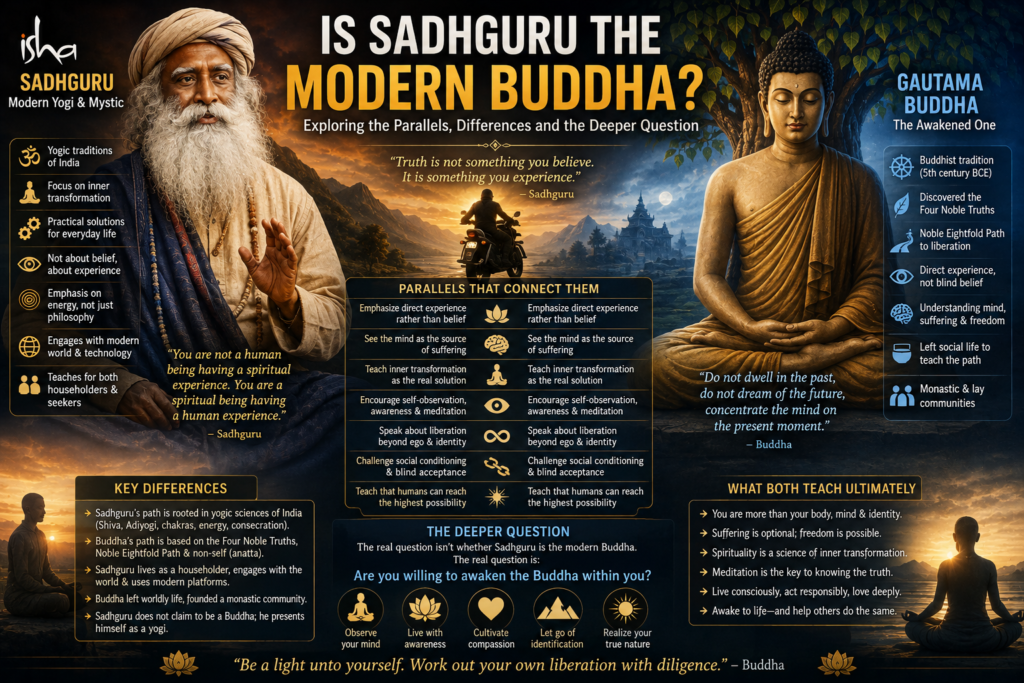
Sadhguru is one of the most recognizable spiritual teachers of the modern world.
He speaks about consciousness, suffering, karma, meditation, attachment, identity, death, liberation, and learning to experience life without becoming trapped inside the mind. He rejects blind belief, encourages people to investigate experience directly, and presents ancient Indian spiritual practices in language designed for ordinary modern people.
Those characteristics inevitably invite comparison with another Indian spiritual teacher who appeared roughly 2,500 years earlier:
Gautama Buddha.
Could Sadhguru therefore be considered a kind of modern Buddha?
The answer depends entirely on what we mean by “Buddha.”
If we mean:
“Is Sadhguru literally the modern incarnation or Buddhist equivalent of Gautama Buddha?”
There is no basis within mainstream Buddhism for saying so.
Sadhguru is a yogi and guru whose teachings emerge primarily from the broader Indian yogic tradition rather than from Buddhism. His Isha Foundation describes his approach as offering yogic methods for inner transformation rather than adherence to a belief system. (Isha Foundation)
But if the question means:
“Does Sadhguru occupy a role in modern society that resembles some aspects of the role Gautama Buddha occupied in ancient India?”
Then the comparison becomes much more interesting.
There are striking parallels—but also enormous differences.
First, What Does “Buddha” Actually Mean?
The word Buddha means “awakened one.”
Within Buddhist tradition, Gautama is not simply considered a wise philosopher, meditation teacher, motivational speaker, or unusually peaceful human being.
He is regarded as a fully awakened Buddha—one who completely penetrated the causes of suffering and attained liberation from samsara.
Early Buddhist texts repeatedly describe the Buddha as fully awakened, accomplished in knowledge and conduct, a guide for those capable of training, and a teacher of both humans and gods. (SuttaCentral)
His central discovery is expressed through the Four Noble Truths:
There is suffering and dissatisfaction.
Suffering has causes.
Suffering can cease.
There is a path leading toward its cessation.
That path is traditionally summarized as the Noble Eightfold Path, incorporating right view, intention, speech, action, livelihood, effort, mindfulness, and concentration. (SuttaCentral)
Therefore, calling someone a Buddha in the strict Buddhist sense is a much larger claim than simply calling them enlightened or spiritually impressive.
Interestingly, Sadhguru Himself Uses “Buddha” More Broadly
Sadhguru has spoken extensively and admiringly about Gautama Buddha.
In one of his teachings for Buddha Purnima, he describes Gautama as one of the great spiritual forces in human history and argues that Gautama was not the only person who could become a Buddha. Sadhguru uses the term more broadly for someone who has transcended identification with the intellect and mind. (Isha Foundation)
That is Sadhguru’s yogic interpretation of the term, and it should be distinguished from the more technical definitions found in Buddhist traditions.
But it tells us something important.
Sadhguru does not appear to regard Buddhahood as belonging exclusively to one historical man.
For him, Gautama represents a human possibility.
That idea itself is quite Buddhist in spirit.
The Buddha did not teach that awakening was something ordinary humans could merely admire from a distance. Buddhism developed around the possibility that other beings could follow a path toward awakening themselves.
So perhaps the more useful question is not:
“Is Sadhguru Gautama Buddha 2.0?”
but:
“Does Sadhguru demonstrate some of the qualities we associate with an awakened teacher in the modern world?”
Similarity #1: Both Emphasize Experience Over Belief
This may be the strongest similarity.
Sadhguru repeatedly distinguishes spirituality from belief. In his teachings, a seeker should be willing to say, “I do not know,” rather than adopting conclusions about realities they have not personally experienced. He describes spirituality as an inward investigation rather than adherence to an ideology. (Isha Foundation)
This strongly resembles the exploratory quality many people admire in Buddhism.
Buddhist practice is not simply about intellectually agreeing that the Buddha was correct.
Meditation asks the practitioner to observe experience.
Watch craving.
Watch anger.
Watch thoughts.
Watch bodily sensations.
Watch impermanence.
Watch how attachment creates suffering.
The teaching becomes personally verifiable through observation.
Sadhguru approaches spirituality similarly.
He tends to say, in effect:
Do not believe something merely because someone sacred said it. Develop the perception necessary to know for yourself.
This may be one reason people with Buddhist sympathies often find Sadhguru familiar even though he is not primarily teaching Buddhism.
Similarity #2: Both See the Mind as a Source of Suffering
Buddhism places tremendous emphasis on the relationship between craving, ignorance, mental conditioning, and suffering.
Sadhguru also repeatedly returns to the strange fact that the human mind—despite being our most sophisticated instrument—can become a machine for producing misery.
He argues that people become trapped within their thoughts, emotions, memories, opinions, and identities rather than using the mind consciously. In his discussion of becoming a “Buddha,” he specifically describes spiritual development as moving beyond domination by the mind rather than sinking beneath it through intoxication or compulsive pleasure. (Isha Foundation)
This sounds remarkably close to the Buddhist project.
The problem is not that thought exists.
The problem is identification.
A thought appears:
“I am angry.”
Instead of observing anger, we become anger.
A desire appears.
We become desire.
Fear appears.
We become fear.
Someone insults us.
The mind repeats the event for three days.
The original experience may have lasted thirty seconds.
The mind continues manufacturing suffering long after the external event has disappeared.
Both Buddhist meditation and Sadhguru’s yogic teaching attempt to create distance between awareness and mental activity.
Similarity #3: Both Are Ultimately Teaching Liberation
Neither Gautama Buddha nor Sadhguru presents spirituality primarily as a method for becoming more successful at accumulating possessions.
Both speak about a much deeper possibility.
The Buddhist goal is liberation from the cycle of ignorance, craving, suffering, karma, death, and rebirth.
Sadhguru similarly presents yoga as a means of turning inward and discovering a dimension of human experience beyond the accumulated identities of body and mind. (Isha Foundation)
Their metaphysical explanations are not identical.
Their terminology is different.
Their practices are different.
But the direction has a similarity:
Human beings are living far below the full possibility of consciousness.
Ordinary consciousness is not the final destination.
Something can awaken.
Similarity #4: Both Emerged From the Indian Yogic World
It is easy to imagine Buddhism and Hinduism as two sealed religions.
Historically, that is misleading.
Gautama Buddha emerged from the wider Indian spiritual environment. His world already contained yogis, renunciants, meditation systems, karma, rebirth, austerities, gurus, wandering ascetics, and competing theories about liberation.
Buddhism was one of numerous spiritual movements developing in ancient India.
Interestingly, Sadhguru himself emphasizes this point when discussing Buddhism, describing Gautama’s teaching as part of a wider landscape of Indian spiritual movements before it later became institutionalized as a religion. (Isha Foundation)
Sadhguru therefore does not encounter Buddha as a completely foreign religious figure.
He approaches him as another enormous figure emerging from India’s long tradition of inner exploration.
This helps explain why Sadhguru can speak enthusiastically about Buddha without becoming Buddhist.
To him, Gautama belongs to the larger human science of awakening.
Similarity #5: Neither Requires a Creator God at the Centre
One of the most striking characteristics of Buddhism is that liberation does not depend upon belief in an omnipotent creator God.
Gods can exist within Buddhist cosmology, but they are not the source of nirvana.
The central question is:
What creates suffering, and how can consciousness become free from it?
Sadhguru also frequently avoids making belief in God the foundation of spiritual practice.
His criticism is often directed equally at confident theism and confident atheism when either position becomes a belief about something the person has not actually experienced. (Isha Foundation)
The emphasis moves from:
“What should I believe?”
toward:
“What can I actually know through consciousness?”
This makes both approaches attractive to people who desire spirituality without accepting a conventional Western religious structure.
Similarity #6: Sadhguru Presents Spirituality as Something Practical
One reason Gautama Buddha’s teaching became so influential was that it presented a path.
Do this.
Observe this.
Avoid this.
Develop this.
Meditate in this way.
Examine your mind.
Ethics, meditation, and wisdom work together.
Sadhguru also tries to move spirituality from philosophy into practice.
Isha’s most prominent example is Inner Engineering, which combines teachings with yogic practices and Shambhavi Mahamudra Kriya. (Isha Foundation)
Whether one accepts every spiritual claim surrounding these practices is a separate question.
The important similarity is methodological.
Both traditions effectively say:
Spirituality is something you practise, not merely something you discuss.
You cannot become peaceful by endlessly reading about peacefulness.
You cannot become mindful by agreeing that mindfulness sounds good.
Eventually, something must be done with the body, mind, attention, behaviour, and consciousness.
Similarity #7: Both Translate Spirituality for the Audience Around Them
Gautama Buddha taught using concepts his audience understood.
Kings received teachings appropriate to kings.
Monastics received detailed instructions.
Householders received practical ethical guidance.
People were met at different levels.
Sadhguru does something similar for modern culture.
He discusses relationships, business, anxiety, sexuality, food, death, ecology, technology, education, politics, motorcycles, work, and ordinary psychological problems.
He frequently communicates ancient yogic ideas through contemporary metaphors.
That matters.
A modern spiritual teacher probably cannot communicate exactly like a wandering ascetic living in India 2,500 years ago.
The cultural interface has changed.
The underlying spiritual question may remain similar:
How do I become free from unnecessary suffering?
But the modern seeker also owns a smartphone, works in an office, watches YouTube, flies internationally, drives a car, pays a mortgage, and lives within an information environment that Gautama could never have imagined.
Sadhguru’s great strength is translating ancient Indian spirituality into that environment.
Similarity #8: Both Challenge Social Conditioning
Buddhist awakening requires recognizing that many things we assume to be permanent, personal, and desirable are not what they appear to be.
Sadhguru similarly attacks social conditioning.
He frequently separates what someone has accumulated—from culture, family, education, memory, and society—from what that person fundamentally is.
That is not identical to the Buddhist doctrine of anatta, or non-self.
But psychologically, the practices can point in a similar direction.
We normally say:
My nationality.
My politics.
My religion.
My profession.
My opinions.
My memories.
My body.
My personality.
My reputation.
And eventually:
“This is me.”
Spiritual practice begins examining whether all these accumulated identities truly constitute the deepest self.
Buddhism takes that investigation in a particularly radical direction.
Sadhguru takes it in a yogic direction.
But both disturb the ordinary ego.
Similarity #9: Sadhguru Clearly Respects Gautama Buddha
This comparison is not something being imposed upon a teacher hostile to Buddhism.
Sadhguru regularly tells stories about Gautama, Zen masters, Buddhist monks, enlightenment, and Buddhist history. Isha has published entire collections of Sadhguru’s Buddha stories, and Sadhguru describes Gautama as an extraordinary spiritual phenomenon. (Isha Foundation)
This is significant because it shows that Sadhguru sees Gautama less as the founder of a competing religion and more as an example of what a human being can become.
He even teaches an article explicitly titled “Become a Buddha.” (Isha Foundation)
That might be the strongest clue for understanding the relationship.
Sadhguru is not trying to become another Gautama.
He is saying that Gautama demonstrated a possibility available to human consciousness.
But Here Is the Major Difference: Sadhguru Is Not a Buddhist Teacher
Despite all these similarities, calling Sadhguru the modern Buddha can become misleading.
His primary framework is yogic, not Buddhist.
Isha explicitly presents him as a yogi and mystic offering classical yogic sciences and practices. (Isha Foundation)
His teachings frequently involve concepts and sacred figures associated with the larger Hindu and yogic world.
Adiyogi.
Shiva.
Consecration.
Chakras.
Kundalini.
Prana.
Lingas.
Tantra.
Yogic cosmology.
Guru-disciple transmission.
Buddhism shares portions of the same historical Indian spiritual environment, particularly in Vajrayāna, but these are not interchangeable systems.
A person following Sadhguru is therefore not automatically practising Buddhism.
Buddha’s Core Framework Is Distinct
Gautama Buddha articulated a very specific path.
The Four Noble Truths.
The Noble Eightfold Path.
Dependent origination.
Karma.
Rebirth.
Impermanence.
Non-self.
Meditative absorption.
Nirvana.
Monastic discipline.
These became the foundation from which Buddhist traditions developed. The early discourses preserve the Four Noble Truths and Eightfold Path as central organizing structures of the teaching. (SuttaCentral)
Sadhguru sometimes discusses similar subjects, but he does not organize his entire teaching around those specifically Buddhist doctrines.
That makes him philosophically adjacent in some places rather than Buddhist.
The Question of the Self Is Particularly Important
One of Buddhism’s most radical teachings concerns anatta—the absence of a permanent, independently existing self.
Buddhist practice repeatedly investigates whether body, sensation, perception, mental formations, or consciousness can legitimately be identified as a permanent “me.”
Classical yoga develops a different philosophical vocabulary around consciousness.
Those traditions can produce experiences that sound very similar—dissolution of ego, transcendence of mental identity, freedom from attachment—but their explanations of what ultimately remains can differ substantially.
Sadhguru’s own account of his transformative experience on Chamundi Hill describes his ordinary sense of boundaries dissolving so completely that he no longer experienced a clear division between himself and his surroundings. According to his account, the experience lasted hours and eventually became an abiding transformation. (Isha Foundation)
That experience certainly resembles descriptions of mystical awakening across traditions.
But mystical similarity does not erase philosophical differences.
Sadhguru Had a Very Different Life From Gautama
The biographies are dramatically different.
Gautama became a wandering renunciant.
He lived without the ordinary household structure and eventually established a community of monks and nuns.
Sadhguru’s path developed through a modern household life. Isha’s own biography records that he married Vijaykumari after the experience he describes as his awakening and continued teaching yoga while married. (Isha Foundation)
Sadhguru also openly enjoyed motorcycles, automobiles, business, adventure, and engagement with the material world.
This is not merely a superficial difference.
Sadhguru’s message frequently emphasizes that spirituality does not require withdrawing from modern life.
You can build.
Work.
Drive.
Lead organizations.
Engage with environmental issues.
Have relationships.
Use technology.
And still pursue inner liberation.
That gives his teaching a very different social texture from the historical Buddha’s renunciant model.
A Buddha on a Motorcycle?
This difference actually makes the comparison fascinating.
Imagine trying to copy Gautama Buddha literally in the twenty-first century.
Would an awakened teacher have to wander barefoot?
Beg for food?
Avoid technology?
Refuse automobiles?
Live without an organization?
There is no obvious reason awakening would require reproducing the external lifestyle of ancient India.
Sadhguru’s modernity raises an interesting spiritual possibility:
Perhaps an awakened-looking teacher today would ride a motorcycle.
Perhaps he would use YouTube.
Perhaps he would speak at business conferences.
Perhaps he would discuss ecology.
Perhaps he would fly across continents.
Perhaps ancient spiritual seriousness does not require ancient aesthetics.
That does not prove Sadhguru is a Buddha.
But it shows why evaluating a modern teacher entirely through the external image of Gautama can be misleading.
Gautama Created a Tradition That Outlived Him for Millennia
This is one area where historical comparison becomes difficult.
Gautama’s teaching eventually generated one of the world’s great religious and philosophical civilizations.
Theravāda.
Mahāyāna.
Zen.
Pure Land.
Vajrayāna.
Tibetan Buddhism.
Chan.
Seon.
Nichiren.
Countless monasteries, philosophical schools, meditation systems, scriptures, artistic traditions, and cultures developed from the Buddhist movement.
Sadhguru is still a contemporary figure.
Isha Foundation has built a substantial international spiritual organization with yoga programs and social initiatives, but history has not yet had centuries to judge what will remain. The organization describes itself as a nonprofit founded and guided by Sadhguru and focused on inner transformation and social initiatives. (Isha Foundation)
We therefore cannot yet compare historical impact fairly.
The Buddha has had approximately two and a half millennia of cultural development after his lifetime.
Sadhguru’s legacy is still being created.
Buddha Was Not Primarily a Celebrity
There is another major difference produced by modernity.
Sadhguru exists inside global media culture.
Videos.
Podcasts.
Interviews.
Social media clips.
Mass events.
Celebrity conversations.
Books.
Internet controversies.
Short quotes stripped from longer teachings.
Gautama lived in an oral culture.
His teachings spread through communities of practitioners rather than algorithms.
This gives Sadhguru both an advantage and a problem.
The advantage is extraordinary reach.
A person who would never enter an ashram may encounter a profound spiritual idea while watching a three-minute video.
The problem is compression.
Deep teachings can become slogans.
Nuanced spiritual concepts can become entertainment.
A guru can become a personality brand.
Followers can become fans rather than practitioners.
This is perhaps one of the unique challenges of being a spiritual teacher in the twenty-first century.
The Modern Buddha Would Have to Navigate Fame
This raises an interesting question:
Could Gautama Buddha survive social media?
Imagine Buddha giving a two-hour teaching and a fifteen-second section becoming viral.
Imagine thousands of accounts debating whether he was enlightened.
Imagine reaction videos.
Critics.
Supporters.
Merchandise.
Memes.
Political questions.
Celebrity interviews.
Every sentence examined publicly.
This is the environment in which Sadhguru operates.
Whether someone likes him or dislikes him, his spiritual teaching occurs under conditions radically different from those confronting an ancient Indian teacher.
Being spiritually influential today requires navigating an attention economy that constantly tries to transform wisdom into content.
Sadhguru’s Style Is More Provocative
Gautama is traditionally remembered through an image of extraordinary composure.
Sadhguru can be playful, sarcastic, provocative, humorous, forceful, and occasionally confrontational.
He tells jokes.
Uses contemporary slang.
Challenges questioners.
Drives vehicles.
Makes dramatic statements.
This leads some people to think:
“An enlightened person shouldn’t behave like that.”
But that assumption itself may come from our cultural image of what enlightenment is supposed to look like.
Zen masters sometimes behaved unexpectedly.
Tantric masters could be unconventional.
Indian gurus have long appeared in very different temperaments.
Spiritual realization, if real, would not necessarily erase personality.
The real test would be whether personality remains an unconscious prison or becomes an instrument used consciously.
What About Sadhguru’s Enlightenment Claim?
Sadhguru describes a profound transformation occurring on Chamundi Hill on September 23, 1982.
In his account, while sitting on a rock with his eyes open, his normal sense of individuality disappeared and his sense of self expanded beyond the boundaries of his body. He says several hours passed although the experience seemed brief, and that similar experiences subsequently occurred until the shift became an ongoing reality. (Isha Foundation)
Followers interpret this as enlightenment.
A skeptic might interpret it as an intense mystical or altered-state experience.
Science currently has no objective test that can examine someone and announce:
“This person is enlightened.”
Buddhist traditions themselves usually caution against reducing awakening to unusual experiences alone.
So no outsider can conclusively prove Sadhguru’s internal state.
The reasonable position is:
Sadhguru describes himself as having undergone a profound realization; what metaphysical status one assigns to that experience depends partly upon one’s philosophical framework.
Could He Be “A” Buddha Rather Than “The” Buddha?
This distinction may resolve the entire question.
Gautama Buddha is the Buddha when discussing the historical founder of Buddhism.
But “Buddha” can also function more broadly as an awakened being.
Sadhguru himself explicitly uses the term in this broader sense, saying Gautama was not the only possible Buddha and presenting Buddhahood as a state humans can move toward. (Isha Foundation)
Could Sadhguru therefore be a Buddha?
Within Sadhguru’s own spiritual vocabulary, someone convinced that he has genuinely transcended ordinary identification with mind might reasonably use the term metaphorically.
Within traditional Buddhism, however, determining Buddhahood involves much more specific doctrinal criteria and lineage understandings.
So the safest conclusion is:
Sadhguru can be compared with a Buddha-like modern spiritual teacher without automatically declaring him a Buddha in the formal Buddhist sense.
Perhaps Sadhguru Is Better Described as a Modern Guru With Buddha-Like Qualities
This description may be more accurate.
Sadhguru resembles Gautama in several ways:
He emphasizes inner transformation over belief.
He treats human suffering largely as a problem of consciousness.
He encourages direct experience.
He promotes meditation and disciplined spiritual practice.
He questions social conditioning.
He teaches that ordinary identity is not the ultimate human possibility.
He speaks about liberation rather than merely worldly success.
He teaches large numbers of householders rather than reserving spirituality for specialists.
And he repeatedly expresses deep admiration for Gautama Buddha. (Isha Foundation)
But Sadhguru remains unmistakably Sadhguru.
He belongs to the yogic world.
His spiritual language is shaped strongly by Shiva and Adiyogi.
His methods are yogic.
His institutional structure is different.
His relationship with society is different.
His public personality is different.
And his philosophical framework is not identical with Buddhism.
The Comparison Says Something Important About Buddhism
Perhaps the most valuable aspect of asking whether Sadhguru is a modern Buddha is that the question forces us to reconsider what Buddha represents.
If Buddha means merely:
“A bald man sitting cross-legged peacefully under a tree,”
then probably not.
If Buddha means:
“A historical teacher who established the specific path now called Buddhism,”
then Sadhguru clearly is not Gautama’s equivalent.
But if Buddha symbolizes:
A human being who demonstrates that consciousness can move beyond compulsive thought, fear, attachment, identity, and unnecessary suffering,
then the comparison becomes far more reasonable.
Sadhguru’s teaching repeatedly points toward precisely that possibility.
Buddhism Itself Warns Against Worshipping Personality
There is also a danger in the question.
Humans constantly want to turn teachers into idols.
We ask:
Is he enlightened?
Is she a saint?
Is he the next Buddha?
Is he a reincarnation?
Is this guru superior to that guru?
Eventually the spiritual path becomes celebrity ranking.
But the important question is not whether Sadhguru has achieved some cosmic title.
The important question is:
Does following the teaching make you more conscious?
Less reactive?
Less angry?
Less compulsive?
More compassionate?
More perceptive?
More responsible?
More capable of sitting peacefully with your own mind?
More able to see reality without immediately filtering everything through ego?
Those outcomes matter more than the label placed upon the teacher.
A Teacher Is a Door, Not the Destination
This principle applies equally to Buddha and Sadhguru.
A spiritual teacher may point toward something.
But worshipping the finger does not produce the experience to which it points.
You can watch thousands of Sadhguru videos without becoming conscious.
You can own hundreds of Buddhist books without understanding your mind.
You can place Buddha statues throughout your house and remain consumed by anger.
You can memorize spiritual quotations while behaving terribly toward everyone around you.
Transformation requires practice.
The teacher cannot meditate for you.
The guru cannot become conscious for you.
Buddha cannot remove your attachment while you insist upon maintaining it.
The value of a teacher is ultimately measured through what becomes possible within the student.
Would Gautama Recognize Something Familiar in Sadhguru?
This is impossible to answer historically, but it is an interesting thought experiment.
Gautama might disagree with significant parts of Sadhguru’s metaphysical language.
Sadhguru might disagree with later forms of institutional Buddhism.
Yet they might recognize something familiar in one another:
Human beings are suffering largely because they do not understand their own minds.
Identity is much less solid than it appears.
Pleasure alone cannot create lasting fulfilment.
Compulsion is not freedom.
Direct experience matters more than borrowed belief.
Meditation changes perception.
Consciousness can develop.
And liberation requires turning inward rather than rearranging the external world endlessly.
Those similarities are substantial.
So, Is Sadhguru the Modern Buddha?
Literally and doctrinally: probably not the right description.
Sadhguru is not the founder of a modern Buddhism, does not primarily teach through Buddhist doctrine, and is better understood through India’s yogic and guru traditions.
Spiritually and metaphorically: there is a meaningful comparison.
He occupies a role that resembles something Gautama represented in ancient India—a teacher telling large numbers of people that ordinary compulsive consciousness is not the limit of human possibility.
Both insist that transformation must occur within.
Both distrust second-hand belief.
Both place enormous importance on mastering the mind.
Both present liberation as something experiential.
Both challenge people to stop merely accumulating information about spirituality and actually transform consciousness.
And perhaps most interestingly, Sadhguru himself treats Gautama not as an unreachable religious idol but as evidence of what a human being can become. (Isha Foundation)
Conclusion: The Better Question Is Whether We Can Become Buddhas
Perhaps asking whether Sadhguru is the modern Buddha misses the most radical part of both men’s messages.
If Gautama were simply a supernatural exception, Buddhism would become admiration.
If Sadhguru were simply a uniquely enlightened celebrity, yoga would become fandom.
The far more challenging possibility is that these teachers are pointing toward something latent within ordinary human beings.
Gautama’s existence asks:
How awake could a human consciousness become?
Sadhguru’s teaching asks a remarkably similar question.
Perhaps that is why the comparison feels natural.
Sadhguru is not Gautama Buddha reborn in modern clothing, and he should not simply be inserted into Buddhist doctrine.
He is something more culturally specific: a contemporary Indian yogi translating ancient methods of inner transformation for a global technological civilization.
But he occupies a recognizable archetype.
The person who has looked inward.
The person who claims to have moved beyond ordinary identification.
The teacher who returns to society and says:
There is another way to experience being human.
In that broader sense, perhaps calling Sadhguru a “modern Buddha-like figure” is not unreasonable.
But the truly Buddhist response might be to stop obsessing over whether Sadhguru deserves the title.
The more important question is:
What are you doing with your own consciousness?
Because if awakening is possible, the point was never to create another Buddha to worship.
The point was to discover whether there is a Buddha waiting to awaken within you.