
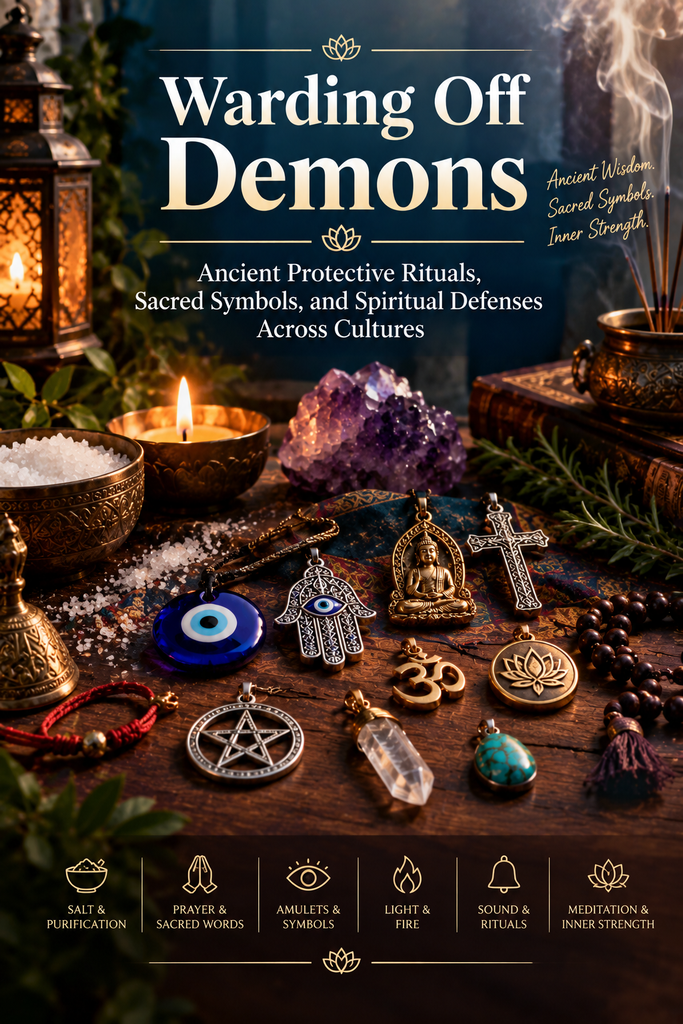
Introduction: Humanity’s Ancient Search for Spiritual Protection
Across cultures and throughout history, people have developed rituals intended to protect themselves from demons, malevolent spirits, harmful supernatural influences, and unseen forces.
From salt scattered across thresholds to prayers spoken before sleep, these practices reflect a longstanding human desire to establish a sense of safety between the ordinary world and what is perceived as the supernatural.
In some traditions, demons are understood as independent spiritual beings. In others, harmful spirits are associated with illness, misfortune, temptation, or disturbances in the natural order. Religious explanations differ considerably, and what one culture interprets as a demonic influence may be understood differently in another.
Nevertheless, certain protective themes recur across civilizations: purification, sacred words, protective objects, light, boundaries, and the cultivation of spiritual strength.
This article explores some of the most fascinating traditional methods people have used to ward off demons and malevolent spirits, including salt, incense, prayer, protective amulets, sacred water, bells, and meditation. It also examines how these practices can provide psychological reassurance and a meaningful framework for confronting fear.
These rituals are best understood as religious and cultural practices rather than scientifically verified methods of repelling supernatural beings. You can explore their symbolism without needing to assume that a demon is present or that an unusual experience has a supernatural cause.
1. Salt: The Ancient Symbol of Purification
Salt is one of the most widespread substances associated with spiritual purification and protection.
Throughout history, salt has been valuable for preserving food, supporting everyday life, and facilitating trade. Its practical importance helped it acquire symbolic associations with preservation, incorruptibility, hospitality, and purity.
In various folk traditions, salt has been used to mark boundaries or protect homes from harmful spiritual influences.
Traditional practices include:
- Placing a small dish of salt near an entrance.
- Scattering a small amount across a threshold as part of a folk ritual.
- Adding salt to ritual cleansing water where the relevant tradition permits it.
- Using salt symbolically during ceremonies intended to mark a fresh beginning.
In Japanese Shinto practice, salt is associated with purification, and it is sometimes used in ritual or customary settings. Salt also appears in certain Japanese customs involving entrances and hospitality. In some European folk traditions, salt was believed to repel witches or harmful spirits.
These customs are not identical, and their meanings vary by community.
Why salt became associated with protection
Salt preserves what might otherwise decay. Symbolically, this quality lends itself to the idea of resisting corruption or maintaining the integrity of a space.
A person who uses salt in a ritual may also experience a sense of closure: the act marks a transition between an unsettling period and a fresh beginning.
Salt should not, however, be regarded as a proven supernatural barrier. It can damage plants, corrode certain materials, and harm pets if consumed in sufficient quantities, so it should be used thoughtfully.
2. Prayer: Calling Upon Divine Protection
Prayer is among the most widespread methods of spiritual protection.
In Christianity, Islam, Hinduism, Buddhism, and many other religious traditions, prayers, invocations, or sacred recitations are used to seek protection, cultivate courage, and reaffirm a relationship with the divine or with spiritual teachings.
The purpose and theology differ, but prayer often gives practitioners a way to face uncertainty without feeling entirely alone.
Christian traditions
Christianity includes prayers for protection against evil and temptation. Some Christians recite Psalm 23 or Psalm 91, which express trust in divine care. The Lord’s Prayer also includes the petition to be delivered from evil.
In Catholic tradition, prayers to Saint Michael the Archangel are particularly associated with spiritual protection.
Certain Christian churches also have formal rites of exorcism, which are distinct from ordinary personal prayer and are conducted under appropriate religious authority.
Islamic traditions
Muslims may recite Ayat al-Kursi, found in the Quran at 2:255, and the final two chapters of the Quran, Al-Falaq and An-Nas, as part of devotional practices associated with seeking refuge in God.
These passages emphasize divine sovereignty and the seeking of protection from evil, envy, and harmful influences.
Hindu traditions
Hindu devotional practices include prayers and mantras addressed to deities associated with protection and the overcoming of obstacles.
Hanuman is widely associated with courage, devotion, and protection from fear. Durga is revered as a powerful divine figure who overcomes destructive forces. Devotional practices vary according to lineage and tradition.
Buddhist traditions
Some Buddhist communities recite protective sutras, parittas, or mantras. These practices may be understood as expressions of faith, reminders of Buddhist teachings, or means of cultivating confidence and well-being.
The common principle
Prayer can orient attention toward courage, compassion, and trust rather than panic. For believers, it may also express a sincere appeal for divine assistance.
A simple prayer does not need to be dramatic or elaborate. In many traditions, quiet sincerity matters more than the intensity of the performance.
3. Sacred Water: Cleansing and Blessing
Water has long been associated with purification, renewal, and the transition from one state to another.
Because water cleanses the body and supports life, it has acquired powerful symbolic roles in religious traditions around the world.
Holy water in Christianity
Holy water is used in many Christian traditions, including Catholic and Orthodox Christianity. It may be associated with baptism, blessings, and reminders of spiritual commitments.
Some Christians use holy water in their homes or make the sign of the cross with it when entering a church.
Its religious meaning comes from the tradition’s understanding of prayer and blessing, not from a scientifically demonstrated ability to repel demons.
Water in Hindu traditions
Water from sacred rivers, particularly the Ganges, holds an important role in Hindu ritual life. Bathing, sprinkling water, and other purification practices may be connected with devotion, spiritual renewal, and religious observance.
Water in other traditions
Ritual washing also appears in Islam, Judaism, Shinto, and many Indigenous religious traditions, although these practices serve different purposes and should not all be interpreted as methods of demon protection.
A simple symbolic practice
Someone wishing to create a sense of renewal might wash their hands, take a shower, or clean their living space while setting an intention to release the worries of the day.
This does not require treating ordinary water as a supernatural weapon. The cleansing action can simply mark a psychological transition from distress toward calm.
4. Incense: Fragrance, Prayer, and Sacred Space
Incense has been used in temples, churches, shrines, and domestic religious practices for thousands of years.
Its rising smoke can symbolize prayer, offerings, purification, or the movement from the ordinary world toward the sacred.
In some traditions, incense is also associated with dispelling unpleasant or harmful influences.
Common examples
- Frankincense: Used in various Christian liturgical settings and other religious contexts.
- Sandalwood: Used in Hindu and Buddhist devotional environments.
- Agarwood: Valued in several Asian religious and cultural traditions.
- Japanese incense: Used in Buddhist ceremonies and other settings, including contemplative practices.
The symbolism varies. Incense is not universally understood as a substance that drives away demons.
How to incorporate it meaningfully
If incense is part of your spiritual practice, you might light a small amount while praying, meditating, or reflecting on the qualities you wish to cultivate in your home.
Use it in a well-ventilated area, keep it away from flammable objects, and never leave burning incense unattended. Smoke-free alternatives are preferable for people with respiratory sensitivities or pets affected by airborne irritants.
The purpose can be to establish a peaceful atmosphere rather than to react to an assumed supernatural threat.
5. Bells and Sacred Sound: Breaking Through Fear
Sound occupies a special place in many religious traditions.
Bells ring at churches, temples, shrines, and ceremonies. Mantras are repeated during meditation. Drums and other instruments have ceremonial roles in numerous cultures.
Some folk traditions associate loud or resonant sounds with frightening away harmful spirits. In other contexts, sound serves to mark sacred time, summon attention, or invite participation in a ritual.
Tibetan Buddhist bells
Bells and vajra instruments are used in particular Vajrayana Buddhist rituals. Their meanings are connected with specific teachings and practices, including wisdom and skillful means.
Japanese shrine bells
Bells feature in certain Japanese Shinto settings, including shrine customs. Ringing a bell may form part of a respectful approach to worship.
Christian bells
Church bells have historically announced services, marked communal occasions, and symbolically distinguished sacred time from ordinary activity. Some European folk traditions also attributed protective qualities to their sound.
A practical interpretation
A bell or gentle chime can serve as a cue to stop, breathe, and return attention to the present.
You might ring a small meditation bell before prayer or play peaceful instrumental music while preparing your living space for rest.
There is no reliable scientific evidence that a bell’s sound physically repels demons. Its value can nevertheless be significant as a ritual marker, a source of comfort, or a reminder to regain composure.
6. Protective Amulets: Carrying a Symbol of Safety
<AsyncImage query=”traditional protective amulets Buddha pendant Hamsa hand evil eye beads cross and gemstone necklaces on dark wooden surface” aspectRatio=”16:9″ width=”100%”/>
Amulets have appeared in many civilizations, including ancient Egypt, Mesopotamia, Greece, Rome, and numerous Asian and African societies.
They may be worn around the neck, attached to clothing, kept in a pocket, or placed in a home.
Their materials and meanings differ, but they often serve as tangible reminders of protection, faith, or belonging.
The Buddha pendant
Buddha pendants may remind wearers of wisdom, mindfulness, compassion, and the possibility of overcoming ignorance.
Some Buddhist amulet traditions, especially in Thailand, explicitly associate particular objects with protection or good fortune.
The Hamsa
The Hamsa is a hand-shaped symbol associated with blessings and protection in various Jewish, Muslim, and regional folk traditions.
The evil eye
The blue nazar amulet is traditionally associated with protection against envy or the malevolent gaze in Turkish and related Mediterranean traditions.
The cross
For Christians, the cross represents Christ’s sacrifice, resurrection, and the hope of redemption. Some believers wear it as an expression of faith and a reminder of divine care.
The vajra
In Vajrayana Buddhism, the vajra represents indestructible qualities of awakening and has a specific ritual and philosophical significance.
The important distinction is that these symbols belong to different traditions. They are not interchangeable components of a universal system of supernatural defense.
If you wear an amulet, consider what it means to you. It might remind you to remain calm, act wisely, and hold firmly to your values during difficult circumstances.
7. Protective Symbols on Doors and Windows
The entrances to a home have long been important in traditional protection rituals.
Doors and windows represent the boundary between the private interior and the outside world. In folk beliefs, this boundary could become a place where harmful influences were thought to enter.
Consequently, numerous cultures developed customs involving protective symbols at entrances.
Examples include:
- Mezuzot placed on doorposts in Jewish homes, containing passages from the Torah and serving as reminders of Jewish faith and identity.
- Protective inscriptions and religious imagery displayed in some Christian homes.
- Calligraphic verses or devotional inscriptions used by some Muslim households, according to their particular traditions.
- Shimenawa sacred ropes used in certain Japanese Shinto settings to mark sacred spaces.
- Religious images or household shrines found in many Hindu and Buddhist homes.
These practices have different theological and cultural meanings. A mezuzah, for example, is a Jewish religious object and should not simply be reduced to an anti-demon charm.
Why boundaries matter
On a practical level, maintaining a clean, comfortable home can create a stronger sense of security. Good locks, functioning lights, clear entrances, and a peaceful sleeping environment offer tangible benefits that no spiritual symbol can replace.
For those who also value ritual, displaying a meaningful symbol can make the home feel connected to their beliefs and traditions.
8. Light and Fire: Symbols of Clarity and Purification
Light is one of humanity’s most enduring spiritual symbols.
In many traditions, light represents truth, knowledge, divine presence, or the overcoming of darkness. Fire can also symbolize transformation, purification, and renewal.
Hindu lamps
Lighting a diya, or small oil lamp, is an important feature of many Hindu devotional practices. Lamps may be lit during puja and festivals such as Diwali, when light carries rich religious and cultural meanings.
Christian candles
Candles are used in churches and personal devotional settings. They can symbolize prayer, hope, remembrance, and the presence of the sacred.
Buddhist lamps
Offering lamps appears in various Buddhist traditions and may symbolize the illumination of ignorance through wisdom.
A simple evening ritual
If lighting a candle is meaningful to you, you might use the moment to reflect on something you are grateful for, say a prayer, or set an intention to approach tomorrow with greater clarity.
The symbolism of light can help transform a room’s atmosphere and provide a focal point for reflection.
However, never leave a flame unattended, and use an electric candle if open flames are unsuitable.
Darkness itself is not evidence of a supernatural presence. A dim room, unusual shadow, or unexpected sound can have ordinary explanations.
9. Mantras and Sacred Recitation
In several religious traditions, particular words or phrases are repeated as part of devotional or contemplative practice.
These repetitions may help organize attention, express faith, and establish a familiar rhythm during periods of uncertainty.
The mantra Om Mani Padme Hum
This is one of the best-known mantras in Tibetan Buddhism. It is associated with Avalokiteshvara, the bodhisattva of compassion, and has a rich interpretive history.
Its practice is generally connected with compassion and Buddhist spiritual development rather than being a universal formula for banishing demons.
The Gayatri Mantra
The Gayatri Mantra is an important Vedic mantra used in Hindu religious practice. It is associated with illumination, contemplation, and the aspiration toward spiritual understanding.
The Jesus Prayer
In Eastern Orthodox Christianity, the Jesus Prayer is a traditional contemplative prayer often phrased as an appeal to Jesus Christ for mercy.
Quranic recitation
Reciting Quranic passages is central to Islamic devotional life. Some passages are traditionally recited when seeking refuge in God or protection from harm.
What these practices have in common
Repeated sacred words can give attention a stable point of focus. For believers, they may also express trust in divine compassion, wisdom, or authority.
Choose a prayer or mantra appropriate to your own beliefs and learn its meaning from a reliable source within that tradition. Repetition should be a voluntary practice that supports your well-being, not something you feel compelled to perform endlessly out of fear.
10. Iron, Knots, and Other Folk Protection Traditions
Not every protective custom comes from an organized religion.
Folk traditions around the world have associated ordinary objects with protection against witches, spirits, or misfortune.
Iron, for example, appears in a number of European folk beliefs. Horseshoes have been displayed above doors as symbols of good luck and, in some traditions, protection.
Knots, threads, beads, and woven objects have also been used in various protective customs. Their meanings vary greatly, and a practice that is meaningful in one community may have no corresponding significance in another.
Red thread bracelets are found in several different cultural and religious contexts. Depending on the tradition, they may represent blessings, protection, spiritual affiliation, or a devotional commitment.
These customs remind us that protection does not always take the form of an elaborate ritual. Sometimes it is represented by a small object that can be carried throughout the day.
It is worth distinguishing folklore from documented religious teaching, however. Not every popular claim about iron, thread, or horseshoes accurately represents the historical tradition from which it is said to originate.
11. Meditation and the Cultivation of Inner Stability
Spiritual protection is often imagined as something external: a barrier, an amulet, a prayer, or a sacred object.
Yet many religious and philosophical traditions also emphasize the importance of developing qualities within oneself.
In Buddhism, mindfulness and ethical conduct are central to spiritual development. In Hindu yoga, disciplined attention and self-regulation form part of broader paths of practice. In Christianity and Islam, prayer and moral commitment are important expressions of faith.
These practices are not necessarily intended to ward off demons in a literal sense. Nevertheless, they can help people cultivate the composure needed to respond to frightening experiences.
A simple grounding exercise might involve:
- Sitting in a comfortable, well-lit room.
- Noticing the physical support beneath your body.
- Taking several comfortable, unforced breaths.
- Naming five ordinary things you can see.
- Reflecting on a value you wish to embody, such as courage, compassion, or patience.
The goal is not to fight an invisible opponent. It is to return attention to the present and recognize that frightening sensations or thoughts do not automatically indicate an external threat.
For people whose religious beliefs include prayer or meditation, these practices can be combined in a way that feels respectful and reassuring.
12. Exorcism and Formal Religious Rituals
Some religions have formal practices intended to address what their traditions identify as demonic possession or spiritual oppression.
Christianity is particularly associated in popular culture with exorcism, but formal rites are more specific than the dramatic portrayals found in films.
In the Catholic Church, solemn exorcism is subject to ecclesiastical procedures and requires authorization. Responsible assessment is important because symptoms interpreted as possession may have medical, neurological, or psychological explanations.
Other religious communities have their own prayers, rites, or pastoral practices concerning harmful spiritual influences. They differ significantly in their theology, authority structures, and methods.
It is important not to attempt dangerous rituals, restrain someone, deprive anyone of food or sleep, administer harmful substances, or stop prescribed medical treatment in the belief that a demon is responsible.
If someone is frightened by unusual perceptions, voices, disturbing thoughts, or a sense of being threatened, they deserve compassionate support rather than ridicule or a premature supernatural diagnosis. A qualified healthcare professional can help assess experiences that are persistent or distressing, while a trusted religious leader can provide spiritual support if the person wishes.
Religious care and medical care do not have to be mutually exclusive.
13. A Balanced Approach to Spiritual Protection
If you are interested in protective rituals, it may help to distinguish three different questions.
First: What does my tradition teach?
Learn the actual beliefs and practices associated with the religion or cultural tradition you are exploring. Avoid assuming that every protective custom means the same thing.
Second: What helps me feel grounded and live well?
A prayer, meaningful pendant, meditation practice, or evening ritual may help you feel more composed. Notice whether it contributes to peace and confidence in your daily life.
Third: Am I responding to a real-world problem that requires practical action?
If you are concerned about safety, address concrete risks directly. If you are experiencing persistent fear, disturbed sleep, or unusual perceptions, consider speaking with a healthcare professional or another trusted source of support.
It is possible to respect spiritual beliefs without treating every coincidence, shadow, dream, or uncomfortable feeling as evidence of demonic activity.
A protective practice should ideally increase your freedom and peace of mind, not make you increasingly fearful of the world around you.
Conclusion: Protection Through Faith, Meaning, and Discernment
Humanity’s traditions of spiritual protection reveal an enduring desire to find safety in an uncertain world.
Salt, sacred water, incense, prayers, bells, amulets, light, and sacred recitations have all played roles in different cultural and religious understandings of protection.
Their meanings are diverse. Some express devotion to God or the divine; others preserve local folklore, mark sacred spaces, or provide a tangible reminder of personal values.
Although these practices have not been scientifically demonstrated to repel demons, they can still carry substantial religious, cultural, and personal meaning.
Perhaps the most constructive approach is to choose practices that encourage calmness, ethical living, compassion, and a healthy sense of security.
A prayer can remind us of faith. A pendant can represent courage. A clean and welcoming home can help us feel settled. A few minutes of meditation can help us regain perspective when anxiety rises.
And practical wisdom can help us distinguish between a frightening impression and a genuine danger.
True spiritual steadiness need not come from living in fear of unseen forces. It can come from cultivating a life grounded in faith, discernment, compassion, and the confidence to meet uncertainty without allowing it to control us.