
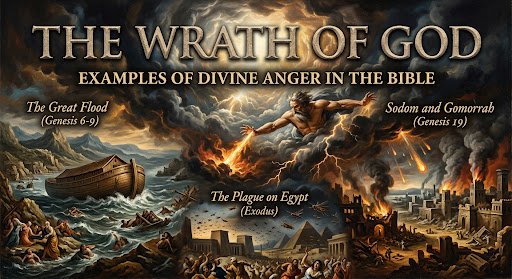
Modern Christianity often emphasizes God as loving, forgiving, patient and merciful.
Those themes are unquestionably present throughout the Bible.
But they are not the whole picture.
The biblical God is also repeatedly depicted as angry, jealous, wrathful and willing to punish individuals, nations and sometimes entire civilizations.
This creates one of the most difficult theological questions in Judaism and Christianity:
How can the God described as loving also become terrifyingly angry?
The Bible does not attempt to hide the tension.
Instead, divine anger appears from Genesis to Revelation.
Sometimes God’s wrath is directed against violence.
Sometimes against oppression.
Sometimes against idolatry.
Sometimes against betrayal of a covenant.
Sometimes against arrogance.
And sometimes the resulting punishment is so severe that modern readers struggle morally with the text.
To understand biblical spirituality honestly, it is therefore necessary to examine both sides:
the God who forgives
and
the God who judges.
The Flood: God’s Anger With Humanity
One of the earliest and most extreme examples appears in Genesis 6–9.
Human civilization has become deeply corrupt.
Genesis says that human wickedness had become great and that violence filled the Earth.
God decides to send a catastrophic flood.
Only Noah, his family and the animals aboard the ark survive.
Whatever theological interpretation one gives the story, its portrayal of divine judgment is unmistakable.
Human evil reaches a point where God essentially decides:
this civilization cannot continue in its present form.
The punishment is not directed against one individual.
It is almost universal.
That makes the Flood one of the most difficult examples of divine wrath in scripture.
Yet the Flood Also Ends With Restraint
Interestingly, the story does not end simply with destruction.
God establishes a covenant with Noah and promises never again to destroy the Earth through such a flood.
The rainbow becomes the sign of this covenant.
This produces a recurring biblical pattern:
judgment → destruction → covenant → restoration.
Divine anger is severe.
But it is not presented as God’s only characteristic.
Sodom and Gomorrah
Genesis gives another dramatic example with Sodom and Gomorrah.
The cities become symbols of extreme corruption.
Abraham famously bargains with God:
What if fifty righteous people live there?
What about forty-five?
Forty?
Thirty?
Twenty?
Ten?
God repeatedly agrees that the presence of even a small righteous population would spare the city.
But ultimately Sodom and Gomorrah are destroyed by fire and sulfur.
Again, the story presents God as capable of catastrophic judgment.
Yet Abraham’s negotiation introduces another biblical principle:
divine justice should distinguish the innocent from the guilty.
The story itself wrestles with that problem.
Pharaoh and the Ten Plagues
The Book of Exodus contains perhaps the Bible’s most famous sequence of divine judgments.
The Israelites are enslaved in Egypt.
Pharaoh refuses to release them.
God sends plague after plague:
water becomes blood,
frogs appear,
gnats or lice,
flies,
livestock disease,
boils,
hail,
locusts,
darkness,
and finally
the death of the firstborn.
This is divine wrath directed against an oppressive political system.
The biblical perspective is clear:
Egypt has enslaved God’s people.
God intervenes.
But the final plague remains morally troubling to many readers because Egyptian children and families suffer consequences associated with Pharaoh’s refusal.
That tension has produced centuries of theological interpretation.
God Hardens Pharaoh’s Heart
The story becomes even more complicated because Exodus sometimes says Pharaoh hardened his own heart, while other passages say God hardened Pharaoh’s heart.
That raises a difficult question.
If God contributes to Pharaoh’s stubbornness, how responsible is Pharaoh for continuing to resist?
Different Jewish and Christian traditions interpret these passages differently.
Some argue Pharaoh first repeatedly hardened himself and eventually God confirmed him in the path he had already chosen.
Others emphasize divine sovereignty.
But whichever interpretation one adopts, Exodus presents God as actively directing a confrontation that culminates in enormous destruction.
The Red Sea
After Pharaoh finally permits the Israelites to leave, the Egyptian army pursues them.
The Israelites cross the divided sea.
The Egyptians follow.
The waters return.
The army is destroyed.
Exodus celebrates this as liberation.
For Israel, the event demonstrates:
God defeats the oppressor.
For the Egyptian soldiers, the same event is catastrophic divine judgment.
This dual perspective appears repeatedly in scripture.
The same divine action can look like:
salvation from one side
and
wrath from the other.
The Golden Calf
One of the clearest descriptions of divine anger appears shortly afterward.
Moses is on Mount Sinai receiving the covenant.
Meanwhile, the Israelites construct a golden calf and worship it.
God’s response is furious.
In Exodus 32, God tells Moses that the people have corrupted themselves and speaks of destroying them.
Moses intervenes.
He pleads with God not to annihilate Israel.
This produces one of the strangest scenes in the Bible:
a human being appears to calm divine wrath.
Moses appeals to:
God’s promises,
God’s reputation,
and the covenant with Abraham, Isaac and Israel.
God relents from the threatened total destruction.
Moses as Intercessor
This becomes an important spiritual role.
Moses is not merely prophet.
He becomes intercessor.
He stands between:
an angry God
and
a sinful people.
The pattern later influences Christian theology, particularly ideas about Christ acting as mediator between God and humanity.
The implication is striking:
divine anger can be confronted by:
prayer,
intercession,
repentance,
and covenant.
Nadab and Abihu: Strange Fire
Leviticus contains one of the most unsettling examples.
Aaron’s sons Nadab and Abihu, both priests, offer what the text calls unauthorized or “strange” fire before God.
Fire comes from God’s presence and consumes them.
They die immediately.
The apparent offense can seem surprisingly small to a modern reader.
Why should an incorrect ritual produce death?
But within Leviticus, the lesson concerns holiness.
Approaching the sacred incorrectly is not treated casually.
God’s presence is depicted almost like an overwhelming power.
The closer one approaches, the greater the required discipline.
The Anger of God in the Wilderness
The Israelites repeatedly complain during their journey through the wilderness.
At several points God’s anger is described as being kindled against them.
Numbers 11 provides one example.
The people complain.
The text says the anger of the Lord is kindled, and fire burns among them.
Moses prays.
The fire stops.
Once again:
anger,
punishment,
intercession,
relief.
This becomes a repeated structure.
Miriam and Aaron Challenge Moses
Numbers 12 contains another example of divine anger.
Miriam and Aaron criticize Moses.
God summons them.
After defending Moses’ unique prophetic role, God’s anger is kindled against them.
Miriam is then afflicted with a skin condition traditionally translated as leprosy.
Moses immediately asks God to heal her.
Again the prophetic mediator intervenes.
The pattern reinforces the idea that divine wrath can be severe but not necessarily irreversible.
Korah’s Rebellion
Numbers 16 tells of Korah and others challenging Moses and Aaron.
The rebellion becomes a direct challenge to the religious order God established.
The punishment is dramatic.
The Earth opens and swallows some of the rebels.
Fire consumes others.
Later, a plague strikes the community.
From the biblical perspective, this demonstrates the seriousness of rebellion against divinely established authority.
From the modern perspective, the scale of punishment can appear frighteningly disproportionate.
That discomfort is part of seriously reading the text.
The God Who Commands War
Some of the most morally difficult passages occur in Deuteronomy and Joshua.
Israel is commanded to conquer parts of Canaan.
Certain passages describe cities being placed under herem, a form of total devotion to destruction.
In some narratives this includes:
men,
women,
children,
and animals.
These passages have created profound theological problems for both Jewish and Christian interpreters.
They cannot easily be reconciled with the simplified modern image of God as gentle and nonviolent.
Different interpretations have been proposed.
Some read them as historically conditioned ancient warfare rhetoric.
Some understand them within the theology of divine judgment against Canaanite societies.
Some question how literally the conquest narratives should be read historically.
Others treat them as morally troubling texts that should not be imitated.
But the biblical presentation itself clearly contains divine wrath operating through war.
The Amalekites
One of the strongest examples occurs in 1 Samuel 15.
King Saul receives a command concerning the Amalekites.
He is ordered to destroy them completely.
Instead, Saul spares King Agag and keeps some livestock.
Remarkably, Saul’s failure is not that he was too violent.
It is that he did not carry out the command completely.
Samuel tells him that obedience is better than sacrifice.
Saul subsequently loses divine approval as king.
For modern readers, this chapter is among the Bible’s hardest texts.
Its moral world is radically different from modern humanitarian ethics.
Uzzah Touches the Ark
Second Samuel contains another severe incident.
The Ark of the Covenant is being transported.
The oxen stumble.
A man named Uzzah reaches out and touches the Ark to steady it.
God’s anger burns against him.
He dies.
Even King David is disturbed by what happens.
Why would an apparently protective gesture result in death?
Again, the underlying ancient concept is holiness.
The Ark is not an ordinary object.
It represents God’s presence.
Certain boundaries surrounding sacred objects are absolute.
Modern readers may find the punishment excessive.
The biblical author portrays it as a warning about treating divine holiness casually.
David’s Census
One of the strangest episodes comes from 2 Samuel 24.
King David orders a census.
The act is portrayed as sinful, although the exact reason is debated.
God offers David a choice among several punishments.
David chooses to fall into God’s hands rather than human hands.
A plague then kills 70,000 people.
David himself eventually protests:
I am the one who sinned. What have these people done?
This is important because the Bible itself voices the moral problem.
The king commits the offense.
Thousands of subjects suffer.
The text does not completely resolve the ethical tension.
God’s Anger Against Israel’s Kings
The historical books repeatedly explain national catastrophe through divine wrath.
Kings permit idolatry.
Injustice spreads.
Prophets are ignored.
Eventually foreign empires conquer Israel or Judah.
The Assyrian destruction of the northern kingdom and Babylonian conquest of Jerusalem are interpreted not merely as geopolitical events but as divine judgment.
This creates a distinctive biblical understanding of history:
empires may function as instruments of God’s anger.
Jerusalem Is Destroyed
The Babylonian destruction of Jerusalem in 586 BCE becomes one of the defining catastrophes of Jewish history.
The Temple is destroyed.
The monarchy collapses.
People are killed.
Others are taken into exile.
Biblical prophets frequently interpret this catastrophe as the culmination of divine anger against:
idolatry,
violence,
corruption,
and covenant violation.
The Book of Lamentations is especially raw.
God is not portrayed simply as absent while disaster occurs.
At points, God appears as the one who has actively brought destruction.
That creates one of scripture’s darkest portraits of divine wrath.
Jeremiah’s God Is Often Furious
The prophet Jeremiah repeatedly warns that God’s anger is approaching.
Why?
Not simply because people fail to perform rituals.
Jeremiah attacks:
oppression,
false religion,
idolatry,
dishonesty,
and mistreatment of vulnerable people.
This is important.
Biblical divine anger is often moral anger.
God becomes angry because human beings harm one another.
The prophets repeatedly connect divine judgment with:
injustice,
exploitation,
bloodshed,
and hypocrisy.
So wrath is not always portrayed as divine temper.
It can function as outrage against evil.
Isaiah and the Day of the Lord
The prophetic books develop another major concept:
the Day of the Lord.
This is a coming time when God directly judges human arrogance and injustice.
Isaiah contains terrifying imagery.
Human pride is brought low.
Nations are shaken.
The Earth itself appears to convulse under divine judgment.
The image is apocalyptic:
human civilization believes itself powerful,
then encounters a power infinitely greater.
The theological lesson is humility.
The Cup of Wrath
Another repeated biblical image is the cup of God’s wrath.
A nation drinks from it and experiences judgment.
The metaphor becomes especially strong in the prophets and later Revelation.
Why a cup?
Because drinking is unavoidable once the cup is accepted.
Wrath becomes something swallowed.
Experienced internally.
The consequences of evil are consumed.
This eventually contributes to Christian interpretations of Jesus praying in Gethsemane for the “cup” to pass from him.
Nahum: God Is Jealous and Avenging
The Book of Nahum contains perhaps one of the clearest direct descriptions.
It portrays God as:
jealous,
avenging,
and
wrathful.
Nahum celebrates judgment against Nineveh, capital of the Assyrian Empire.
This context matters.
Assyria had been one of the ancient Near East’s most brutal imperial powers.
For the peoples it conquered, the destruction of Nineveh could look like justice.
Again the Bible’s wrathful God often appears where oppressed people are asking:
Will evil ever be punished?
The Problem With Wanting a God Who Never Gets Angry
This raises an important philosophical question.
Modern people often feel uncomfortable with an angry God.
But consider the opposite.
Would a perfectly loving God never become angry at:
genocide?
torture?
slavery?
rape?
child abuse?
corruption?
oppression?
If God observed enormous cruelty and felt absolutely nothing, would that actually be morally superior?
Perhaps not.
Love itself can produce anger when the beloved is harmed.
A parent who sees someone attacking their child may become furious precisely because they love the child.
Biblical theology frequently presents divine wrath in this way:
God’s anger is the shadow cast by God’s concern for justice.
But This Does Not Solve Every Problem
That explanation works well when God is angry at obvious oppression.
It becomes harder when biblical punishment appears:
collective,
extreme,
or directed at seemingly minor ritual violations.
The Flood.
The firstborn of Egypt.
Canaanite destruction.
Uzzah.
David’s census.
These remain genuinely difficult texts.
A mature reading should not pretend otherwise.
The Bible itself contains internal wrestling with divine justice.
Abraham asks:
Will not the Judge of all the Earth do what is just?
Moses argues with God.
Job protests his suffering.
Habakkuk asks why God tolerates violence.
The Psalms repeatedly question divine action.
Biblical faith often includes arguing with God.
Moses Repeatedly Talks God Down
One of the most fascinating themes in the Hebrew Bible is how often Moses intercedes when God becomes angry.
After the golden calf.
During rebellion.
During wilderness complaints.
God threatens judgment.
Moses pleads.
The punishment is reduced or halted.
This raises a profound theological question:
Did Moses literally change God’s mind?
Different traditions answer differently.
But narratively, Moses models a spirituality in which a righteous person does not simply stand back and cheer divine punishment.
He intercedes for people who have done wrong.
That becomes one of scripture’s strongest counterbalances to wrath.
Abraham Bargains With God
Abraham does something similar with Sodom.
He does not say:
“God has decided to destroy them, therefore destruction must automatically be good.”
He challenges the implications.
What if righteous people live there?
Would God destroy them too?
Abraham repeatedly pushes the number lower.
Fifty.
Forty-five.
Forty.
Thirty.
Twenty.
Ten.
The story almost invites the reader to think morally about divine judgment.
Faith does not necessarily mean shutting down ethical questioning.
Jonah Is Angry Because God Is Not Wrathful Enough
The Book of Jonah turns the theme upside down.
Jonah warns Nineveh that destruction is coming.
The city repents.
God does not destroy it.
Jonah becomes angry.
Why?
Because he suspected this would happen.
He complains that God is:
gracious,
merciful,
slow to anger,
and abundant in steadfast love.
This is extraordinary.
The prophet is angry because God’s wrath does not happen.
Jonah wants judgment.
God prefers mercy after repentance.
The story therefore critiques human desire for vengeance.
The Bible Says God Is Slow to Anger
This phrase appears repeatedly.
Perhaps the most important description comes from Exodus 34.
God describes himself as:
merciful,
gracious,
slow to anger,
abounding in steadfast love,
yet also unwilling simply to ignore guilt.
Both qualities appear together.
This may be the Bible’s central tension concerning divine wrath.
God is not presented as never angry.
God is presented as slow to anger.
Wrath exists.
But patience precedes it.
At least ideally.
The Psalms Contain Both Wrath and Mercy
The Psalms repeatedly describe God’s anger.
But they also ask God not to rebuke in anger.
Psalmists plead for mercy.
Others celebrate God for rescuing them from judgment.
Still others pray for God to become angry against oppressors.
This reveals something psychologically important.
People want divine wrath when someone else is committing injustice.
They want divine mercy when they themselves have failed.
The Bible contains both impulses.
Jesus Does Not Eliminate Divine Wrath
There is a popular misconception that:
Old Testament God = angry
while
New Testament Jesus = loving.
The actual Bible is much more complicated.
The Hebrew Bible contains enormous amounts of divine mercy.
The New Testament contains severe judgment.
Jesus himself speaks repeatedly about:
judgment,
Gehenna,
exclusion,
destruction,
and accountability.
The difference is not simply wrath versus love.
Both themes run through both Testaments.
Jesus Cleanses the Temple
Jesus himself displays anger.
In the Temple, he overturns tables and drives out money changers and merchants.
The exact details differ among the Gospels, but the scene is intentionally forceful.
Jesus does not respond to perceived corruption with detached calm.
He acts dramatically.
The episode shows that anger itself is not automatically treated as sinful.
The question becomes:
What is anger serving?
Ego?
Or justice?
Jesus and the Pharisees
Jesus also speaks harshly toward certain religious leaders.
He calls them:
hypocrites,
blind guides,
and whitewashed tombs.
These are not gentle phrases.
His anger is particularly directed against religious hypocrisy:
people appearing holy while neglecting justice, mercy and faithfulness.
That resembles the Hebrew prophets.
The wrath is not against religion.
It is against religion being used as a mask for moral corruption.
Ananias and Sapphira
Acts 5 contains a New Testament story as severe as many Old Testament episodes.
Ananias and Sapphira sell property.
They secretly keep part of the money while pretending they donated everything.
Peter confronts them.
Both collapse and die.
The story emphasizes dishonesty toward God and the early Christian community.
Again, a seemingly limited offense receives an extraordinarily severe consequence.
The New Testament therefore does not simply abandon the frightening holiness found in earlier scripture.
Herod Is Struck Down
Acts 12 describes King Herod accepting public praise comparing him to a god.
An angel strikes him.
He dies.
The theological theme is pride.
A human ruler accepts divine honours.
The biblical response is immediate judgment.
This continues a recurring theme:
God’s wrath is especially associated with creatures attempting to occupy God’s position.
Romans and the Wrath of God
Paul develops divine wrath as a major theological idea.
Romans speaks of the wrath of God against human ungodliness and injustice.
But Paul also transforms the concept.
Wrath is not always pictured as lightning coming from heaven.
Sometimes God’s judgment consists in allowing people to experience the consequences of what they insist upon choosing.
This is psychologically interesting.
Divine wrath can look like:
God letting human beings follow destructive desires to their natural outcome.
Punishment becomes consequence.
Revelation Brings Divine Wrath to Its Maximum Intensity
If someone thinks the New Testament removes the angry God, Revelation makes that impossible.
The book contains:
plagues,
war,
earthquakes,
fire,
judgment,
the destruction of Babylon,
the defeat of Satan,
and the final judgment.
The phrase wrath of God appears repeatedly.
Angels pour bowls of divine wrath upon the Earth.
Human powers collapse.
The imagery is intentionally terrifying.
Revelation presents history as moving toward a final confrontation where injustice cannot continue indefinitely.
The Wrath of the Lamb
One of Revelation’s strangest expressions is:
the wrath of the Lamb.
Jesus is represented as the Lamb.
A lamb normally symbolizes gentleness and sacrifice.
Yet the Lamb also judges.
The phrase combines two apparently contradictory images:
sacrificial love
and
divine wrath.
That may summarize the entire biblical tension.
The God who sacrifices also judges.
The God who forgives also demands accountability.
Hell and Final Judgment
Traditional Christianity takes divine judgment beyond temporal disasters.
The New Testament speaks about final judgment and punishment after death.
Interpretations differ enormously.
Some Christians teach eternal conscious punishment.
Others teach annihilation.
Others have understood judgment more restoratively.
But the concept remains:
human choices ultimately matter.
God’s forgiveness does not mean morality is meaningless.
There is an accounting.
Is God’s Anger Like Human Anger?
Most classical Jewish and Christian theology would say:
not exactly.
Human anger is often:
impulsive,
ego-driven,
vindictive,
irrational,
or disproportionate.
Divine wrath is traditionally understood as God’s response to evil and disorder.
Some theologians even resist thinking of God as emotionally losing his temper.
They interpret wrath as the human experience of divine justice.
Imagine sunlight striking healthy skin and diseased skin.
The sunlight is the same.
The reaction differs.
Similarly, divine holiness encountered by goodness feels like blessing.
The same holiness encountered by evil feels like judgment.
That is one theological interpretation.
Another Interpretation: Biblical Writers Used Human Emotional Language
Some modern theologians interpret divine anger more anthropomorphically.
The Bible speaks about God using human emotional language because human beings need understandable metaphors.
Thus:
God becomes angry.
God regrets.
God changes course.
God becomes jealous.
These may express real theological truths without requiring us to imagine God experiencing hormones and emotional dysregulation like a human being.
This approach treats wrath as language describing God’s opposition to evil.
Another View: The Biblical Portrait Develops Over Time
Historical-critical scholars also point out that the Bible was written over many centuries by different authors living in very different circumstances.
The portrayal of God is therefore not completely uniform.
An ancient warrior society may emphasize divine military power.
Exilic prophets emphasize judgment and restoration.
Wisdom literature asks philosophical questions.
Jesus emphasizes the kingdom of God while still warning about judgment.
Later Christian texts interpret divine justice through Christ.
From this perspective, the Bible contains an evolving conversation about how humans understand God.
The Wrathful God and the Problem of Evil
There is also a strange advantage to the concept of divine wrath.
It answers one version of the problem of evil.
People frequently ask:
Why doesn’t God do something about evil?
Biblical wrath answers:
Eventually, God does.
The uncomfortable part is that when God actually judges evil in biblical stories, modern readers often find the judgment too severe.
So humans appear to want two things simultaneously:
God must stop evil.
But God must never use frightening judgment.
The Bible refuses to make that tension easy.
Divine Anger Can Protect the Vulnerable
Many prophetic passages connect God’s anger specifically with mistreatment of vulnerable people.
Widows.
Orphans.
Foreigners.
The poor.
Workers.
Victims of violence.
This matters enormously.
The wrathful God is sometimes terrifying precisely because the Bible imagines a universe where the cries of powerless people eventually matter.
An oppressor may escape human courts.
A king may control the law.
A rich person may exploit workers.
An empire may crush weaker nations.
But none escape divine judgment forever.
For people without worldly power, that idea can be deeply comforting.
The Same Doctrine Can Also Become Dangerous
There is another side.
People can easily claim:
“God is angry with the people I dislike.”
Then divine wrath becomes justification for human hatred.
History contains many examples of religious communities interpreting:
war,
disease,
natural disaster,
or personal tragedy
as punishment against particular groups.
That can become cruel and irresponsible.
The Bible’s own complexity should make people cautious about confidently declaring why another person’s suffering occurred.
The Book of Job especially challenges the simplistic equation:
suffering = God is angry at you.
Job suffers tremendously despite being described as righteous.
Jesus Rejects Simplistic Disaster Theology
Luke 13 contains an important example.
People tell Jesus about Galileans killed by Pilate.
Jesus also refers to eighteen people killed when a tower collapsed.
He rejects the assumption that these victims were worse sinners than everyone else.
This is significant.
Biblical belief in divine judgment does not justify declaring every tragedy to be punishment.
Sometimes towers fall.
Sometimes innocent people suffer.
The Bible itself resists simplistic karmic thinking.
Anger Is Not God’s Entire Personality
The most distorted reading would take all these passages and conclude:
The Bible says God is basically furious all the time.
That is not accurate either.
The same Bible repeatedly describes God as:
merciful,
compassionate,
patient,
forgiving,
faithful,
and loving.
Psalm 103 says God is merciful and gracious, slow to anger.
The prophets repeatedly describe God as wanting people to turn back rather than be destroyed.
Ezekiel portrays God as taking no pleasure in the death of the wicked but wanting them to turn and live.
Jonah shows God refusing to destroy a repentant enemy city.
The wrath exists within a much larger theological portrait.
Anger and Love Are Not Necessarily Opposites
This may be the key spiritual concept.
Imagine someone who claims to love justice but feels no anger toward genocide.
Something seems missing.
Or someone who says they love children but feels absolutely no anger toward child abuse.
Again, something seems wrong.
Love can create anger because love recognizes that something precious has been violated.
Biblical theology often treats divine wrath this way.
God becomes angry because things matter.
Human beings matter.
Justice matters.
Truth matters.
Covenant matters.
The vulnerable matter.
But Divine Anger Raises the Question of Proportion
The difficult part is not simply:
Can a loving God become angry?
That seems fairly easy to answer.
The harder question is:
Can every biblical expression of divine punishment be morally justified?
That is where theologians disagree.
The death of entire populations.
Children suffering.
Severe punishment for ritual violations.
Collective consequences.
These cannot simply be waved away by saying:
God is just.
The texts require interpretation.
Some believers trust that divine knowledge makes judgments just even when humans do not understand them.
Others interpret some violent biblical descriptions as historically conditioned human perceptions of God.
Still others read them symbolically or theologically rather than literally.
The debate continues precisely because the problem is real.
The Angry God Is Also the God Who Can Be Appealed To
One of the strangest and perhaps most beautiful biblical themes is that humans sometimes confront God’s wrath directly.
Abraham argues.
Moses intercedes.
The prophets plead.
The Psalms protest.
Job demands answers.
This is not a religion in which humans always remain silent before divine authority.
Sometimes faith looks like:
“God, this seems wrong. Explain yourself.”
That tradition of argument became especially important in Judaism.
Wrestling with God is itself part of the biblical religious inheritance.
The Bible’s God Is Not Emotionally Simple
Perhaps this is why the biblical God remains such a powerful figure.
He is not presented merely as:
a cosmic grandfather,
a detached philosophical principle,
or a permanently smiling source of positive energy.
The biblical God:
creates.
loves.
commands.
forgives.
regrets.
judges.
becomes jealous.
shows mercy.
becomes angry.
relents.
punishes.
restores.
To modern philosophical theology, some of those descriptions require careful interpretation.
But as literature and religious experience, they portray a God deeply involved with human behavior.
Human actions matter enough to provoke a divine response.
The Most Important Examples of Biblical Wrath
Some of the clearest examples include:
The Flood — Genesis 6–9
Human violence and corruption lead to catastrophic judgment.
Sodom and Gomorrah — Genesis 18–19
The cities are destroyed, although Abraham first challenges God concerning innocent people.
The Egyptian plagues — Exodus 7–12
God judges Pharaoh and Egypt for enslaving Israel.
The Golden Calf — Exodus 32
God threatens to destroy Israel for idolatry until Moses intercedes.
Nadab and Abihu — Leviticus 10
Two priests die after offering unauthorized fire.
Wilderness rebellions — Numbers
Divine anger repeatedly follows rebellion and complaint.
Korah — Numbers 16
Rebellion against Moses and Aaron ends in catastrophic judgment.
Canaanite warfare — Deuteronomy and Joshua
Some of the Bible’s most difficult divine-war commands appear.
Uzzah — 2 Samuel 6
A man dies after touching the Ark.
David’s census — 2 Samuel 24
A plague kills thousands after David’s sin.
The fall of Israel and Judah — Kings and the Prophets
Foreign conquest is interpreted as divine judgment.
Ananias and Sapphira — Acts 5
Two early Christians die after deceiving the community.
Herod — Acts 12
A ruler who accepts divine praise is struck down.
Revelation
Divine wrath reaches its apocalyptic climax in final judgment.
Taken together, these passages make it impossible to reduce the biblical God to one emotional quality.
Why the Wrathful God Remains Spiritually Significant
For some people, these passages are among the strongest reasons to question biblical religion.
For others, they reveal a universe where morality ultimately matters.
The same doctrine can be frightening and comforting.
If you are Pharaoh:
divine judgment is terrifying.
If you are the enslaved Israelite:
it means Pharaoh does not rule forever.
If you are Babylon:
judgment means collapse.
If you are an exile:
it means empire does not have the final word.
That may be the deepest logic of divine wrath in the Bible.
Powerful humans are not ultimately untouchable.
There is an authority above kings.
Above armies.
Above wealth.
Above empires.
Above human courts.
The Biblical God Is Angry Because the World Matters
Perhaps the most charitable theological interpretation is therefore not:
God becomes angry because God is emotionally unstable.
It is:
God becomes angry because creation has moral significance.
Violence matters.
Betrayal matters.
Oppression matters.
Idolatry matters.
Cruelty matters.
What humans do to one another matters.
A universe in which nothing can provoke moral outrage might actually be more frightening.
But scripture simultaneously warns that judgment is not the only divine response.
God can relent.
Forgive.
Restore.
Show patience.
Listen to intercession.
Accept repentance.
And begin again.
So the Bible’s portrait is not simply of an angry God.
It is of a God whose anger exists beside mercy.
Sometimes uncomfortably.
Sometimes terrifyingly.
And often in ways that have kept theologians arguing for thousands of years.
That tension may ultimately be more faithful to the Bible than either simplified extreme:
“God is only wrath.”
or
“God is never angry.”
The biblical God is capable of both judgment and mercy.
And much of biblical spirituality consists of trying to understand how the two belong to the same divine reality.