
One of the more intriguing spiritual arguments for vegetarianism has little to do with nutrition.
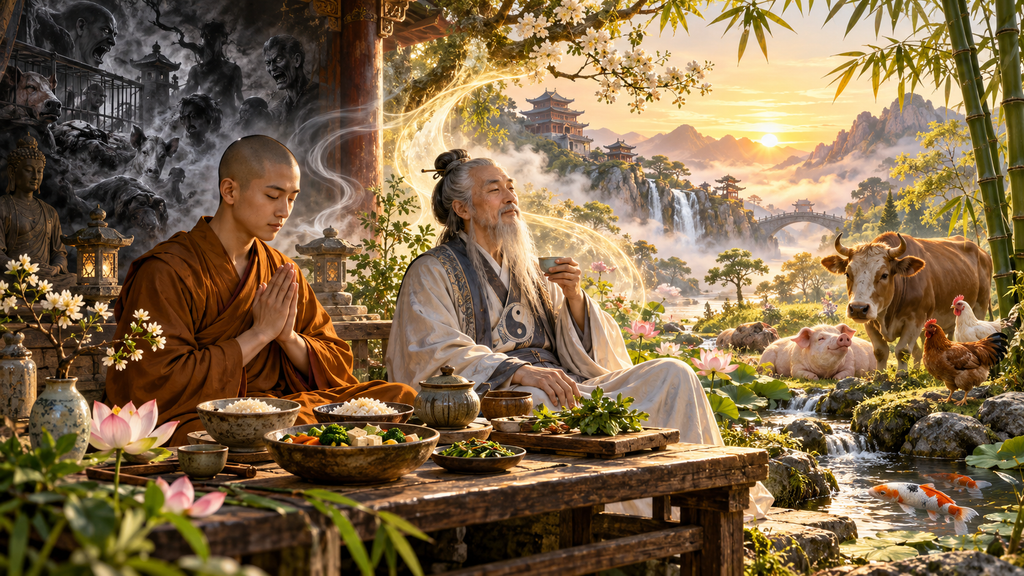
The argument is not simply:
meat is unhealthy.
Nor is it merely:
killing animals is morally wrong.
It is something more subtle.
The theory says that an animal is a conscious being.
During its life—and particularly during stressful farming, transportation and slaughter—it can experience:
fear,
anxiety,
pain,
confinement,
and extreme physiological stress.
Those experiences affect the animal’s body.
Stress hormones rise.
The nervous system changes.
Muscles change chemically.
And when a human being consumes that animal, some spiritual traditions ask whether the person is also consuming, in some sense, the energetic imprint of that state of consciousness.
In modern spiritual language, the idea might be expressed as:
If you want to cultivate a higher consciousness, why continually ingest the physical remains of beings that died in fear?
Buddhist and Daoist traditions do not express this argument in exactly those modern words.
Terms such as “lower vibration” and “fear frequency” are mostly modern spiritual vocabulary.
Yet older Asian religious traditions contain ideas surprisingly close to it:
food influences consciousness,
violence creates karmic consequences,
certain foods agitate the mind,
compassion toward animals assists spiritual development,
and dietary purification can make the practitioner more receptive to subtle spiritual states.
Modern science cannot verify that a frightened animal leaves behind a metaphysical vibration that enters the person eating it.
But science does verify something much narrower and fascinating:
an animal’s psychological state before slaughter physically changes its body and can measurably change the resulting meat.
So where does physiology end and spirituality begin?
That is where the subject becomes interesting.
Buddhism Does Not Universally Require Vegetarianism
The first misconception worth correcting is that Buddhism simply says:
“All Buddhists must be vegetarian.”
Historically, it is much more complicated.
Early Buddhist monks lived largely through alms.
They did not normally choose a menu.
They went from household to household and accepted food people offered.
This was itself a spiritual discipline.
The monk was supposed to become less concerned with:
personal preference,
luxury,
taste,
and attachment to food.
An important early rule therefore permitted monks to eat meat under certain circumstances.
The traditional rule is sometimes called the threefold purity of meat.
A monk could accept meat if he had not:
seen
the animal being killed specifically for him,
heard
that it had been killed specifically for him,
or
suspected
that it had been killed specifically for him.
This rule is preserved across Buddhist monastic traditions and is closely associated with the Jivaka discourse and the Vinaya.
The important ethical distinction was therefore:
Did my desire for this food cause the killing?
If the answer was no and the meat simply appeared among the donated food, early Buddhist monastic discipline did not universally require rejecting it.
Refusing the Food Could Itself Become Attachment
This makes sense when the alms tradition is understood properly.
Imagine a monk entering a poor village.
A family offers him part of the food they themselves prepared.
Perhaps it contains meat.
The monk responds:
“No. I only eat premium vegetarian food.”
That begins to undermine the purpose of the begging bowl.
The monk is now imposing his preferences upon the donor.
Food has again become:
identity,
preference,
and control.
A central part of mendicant life was precisely to weaken that attachment.
The 17th Karmapa’s historical discussion of early Buddhist monastic practice emphasizes that monks depended upon what was offered and were not supposed to discriminate between rich and poor households or demand preferred foods. Meat could therefore occasionally enter the alms bowl even though killing animals for the monk specifically was prohibited.
So early Buddhism created an interesting compromise:
Do not kill.
Do not order an animal killed for you.
But do not turn the begging bowl into a restaurant menu either.
This Is Why Buddhism and Vegetarianism Have Never Been Identical
Theravada Buddhist communities in countries such as:
Thailand,
Sri Lanka,
Myanmar,
and Cambodia
have historically allowed monks to consume permissible donated meat.
Tibetan Buddhism also developed in an environment where agriculture was difficult and meat sometimes formed an important part of the available diet.
By contrast, many forms of East Asian Mahayana Buddhism became strongly vegetarian.
Chinese Buddhist monasticism in particular developed powerful traditions of abstaining from meat.
Several later Mahayana scriptures criticize meat consumption much more strongly than the early Vinaya rules do.
So within Buddhism one can find both:
meat permitted under restricted circumstances
and
vegetarianism promoted as the more compassionate spiritual ideal.
Both have genuine historical Buddhist roots.
The Deeper Buddhist Argument Is Compassion
The strongest Buddhist argument for vegetarianism is probably not hormones.
It is karuna—compassion.
If another sentient being:
fears death,
experiences pain,
seeks safety,
and wishes to continue living,
then intentionally supporting its killing becomes increasingly difficult to reconcile with cultivating universal compassion.
The Buddhist spiritual project attempts to weaken the boundary:
my suffering matters, yours does not.
Compassion expands the circle of concern.
First perhaps toward family.
Then friends.
Then strangers.
Then enemies.
Eventually toward all sentient beings.
From this perspective, vegetarianism can become an extension of meditation.
The practitioner is essentially saying:
If I am training myself to recognize suffering everywhere, perhaps my diet should also reflect that recognition.
Some later Buddhist teachers therefore advocate vegetarianism precisely as a practice of compassion and non-killing, even where monastic law technically permits certain meat.
Vegetarianism Can Become a Consciousness Practice
This leads toward the idea of “higher consciousness.”
Classical Buddhism would more naturally talk about:
clarity,
compassion,
nonattachment,
wholesome mental states,
and purification of mind
rather than raising one’s vibration.
But the modern phrase can still capture part of the idea.
Consider what spiritual practice is attempting to do.
Move consciousness away from:
fear,
greed,
aggression,
compulsion,
and ignorance
toward:
awareness,
compassion,
equanimity,
wisdom,
and nonattachment.
Food then becomes relevant because food is something we incorporate physically into the body every day.
The question becomes:
What kind of relationship with life does my food embody?
The “Fear Energy” Theory
This is where the argument becomes more controversial.
The theory says that when an animal lives or dies in fear, that fear somehow becomes embedded within its flesh.
The human then eats the flesh and absorbs some part of that fearful energetic state.
In spiritual language:
fear becomes an energetic imprint.
In physiological language:
stress produces measurable biochemical changes.
The second statement is scientifically well established.
The first remains unproven.
But there is an interesting area where the two overlap.
Animals Really Do Produce Stress Hormones Before Slaughter
Animals under stress activate biological systems very similar in principle to the human stress response.
The hypothalamic-pituitary-adrenal axis activates.
Hormones such as cortisol rise.
The sympathetic nervous system releases catecholamines such as:
adrenaline,
and noradrenaline.
Researchers studying livestock routinely measure these substances precisely because they indicate physiological stress.
Transport,
rough handling,
mixing unfamiliar animals,
heat,
food deprivation,
fear,
fatigue,
and the slaughter environment
can all create significant pre-slaughter stress.
So the basic observation underlying the spiritual argument is not imaginary:
a frightened animal is physiologically different from a calm animal.
Stress Actually Changes the Meat
This goes further.
Pre-slaughter stress can alter:
muscle glycogen,
lactate,
postmortem pH,
water retention,
colour,
tenderness,
and overall meat quality.
Chronic stress can deplete muscle glycogen before death.
Acute stress can alter postmortem muscle metabolism.
These effects are sufficiently significant that the meat industry actively attempts to reduce pre-slaughter stress—not for spiritual reasons, but because stress can reduce product quality.
Studies in pigs have found that high pre-slaughter stress corresponds with higher cortisol and lactate concentrations and measurable differences in the resulting pork.
So there is a literal biochemical sense in which:
the animal’s final emotional and physiological state leaves traces in its body.
That is important.
Cortisol Can Even Be Measured in Muscle
Cortisol is not restricted exclusively to the bloodstream.
Researchers have measured cortisol concentrations within muscle tissue.
One study found correlations between muscle cortisol levels and characteristics of pork after slaughter.
This is probably the strongest scientific fact that resembles the popular spiritual claim.
A stressed animal produces cortisol.
Cortisol can be present in its tissues.
Its stress state affects muscle metabolism.
And those tissues subsequently become food.
But one must be careful about the next step.
Does Eating That Cortisol Make You Afraid?
There is currently no good evidence for that.
This is where physiology and spiritual theory separate.
The fact that cortisol exists in animal tissue does not demonstrate:
animal is afraid → person eats meat → animal’s fear enters person’s consciousness.
The human digestive system breaks food apart chemically.
Hormones contained in food are present in very different quantities from hormones deliberately produced within one’s own endocrine system.
Although residual cortisol in animal-derived foods can be measured and researchers have investigated its biological significance, that is still very different from demonstrating that eating meat from a frightened animal transfers its emotional state into a human being.
There is currently no established scientific phenomenon called:
ingested fear energy.
But Science Does Confirm an “Imprint” in a Narrow Sense
The strongest scientifically defensible version of the idea is therefore:
Stress leaves biochemical consequences in an animal’s tissues.
That is real.
The stronger claim:
Those biochemical consequences lower the spiritual vibration of the human consumer
has not been demonstrated.
A spiritual practitioner can still believe the second claim.
But it should be labeled correctly:
metaphysical interpretation, not established physiology.
That distinction allows the idea to be explored without pretending science has proven something it has not.
Do Farm Animals “Know They’re Going to Die”?
This statement also needs refinement.
It is difficult to establish that livestock possesses the abstract conceptual thought:
I will be slaughtered tomorrow.
Different animals have different cognitive abilities, and science cannot simply ask a cow or pig whether it conceptually understands its future death.
But animals certainly can experience:
fear,
novelty,
separation,
rough handling,
crowding,
transport,
unfamiliar environments,
pain,
and distress.
They can perceive frightened behavior from other animals.
So the spiritually relevant fact does not require the animal to possess a human philosophical understanding of mortality.
A pig does not need to think:
“I am entering an industrial slaughter system.”
Its nervous system only needs to perceive:
danger.
That alone can activate substantial stress responses.
Chronic Farming Conditions Matter Too
The issue is not limited to the final minutes.
Depending upon the farming system, an animal may experience:
restricted movement,
social stress,
injury,
crowding,
poor handling,
thermal stress,
and other welfare problems.
Again, conditions vary enormously.
It would be inaccurate to claim that every farm animal spends its whole life terrified.
Some farming systems produce substantially better welfare than others.
But from the spiritual perspective, the important question becomes broader:
What kind of life produced this food?
That may matter more than simply:
Was the animal frightened for thirty seconds before death?
Is Wild Meat Spiritually “Cleaner”?
This produces an interesting comparison.
Suppose a wild deer lives:
freely,
in its natural environment,
without confinement,
and is killed almost instantly by a hunter.
Would its meat contain less “fear energy”?
Within the spiritual theory, one could make that argument.
The animal did not spend months inside an industrial system.
Its final distress might also be short if death were genuinely instantaneous.
But this is not automatically true.
A hunted animal may:
detect the hunter,
run,
experience intense fear,
be wounded,
or suffer before dying.
So wild meat is not inherently stress-free.
The important variable would be the actual experience of the animal, not merely whether it lived on a farm or in a forest.
What About Fish?
Fish are sometimes imagined as spiritually or physiologically different because the death appears simple:
pull fish from water,
fish dies,
minimal fear.
Modern welfare research challenges that assumption.
Air exposure is a major stressor for fish.
Fish removed from water can experience severe physiological stress as their gills cease functioning normally.
Depending upon species and method, death through air asphyxiation may take minutes rather than seconds.
Recent research on trout estimated substantial periods of distress and pain during air-asphyxiation slaughter.
Studies of wild-caught fish also note that many commercially captured fish die through asphyxiation or evisceration rather than immediate unconsciousness.
So from either an animal-welfare or spiritual perspective:
fish is not automatically “fear-free meat.”
A Truly Immediate Kill Would Be Different
If an animal loses consciousness almost instantly without prior chase, confinement or distress, the final stress response would obviously be different from prolonged fear.
That much is physiologically reasonable.
Whether this also changes some metaphysical “energy” of the meat remains a spiritual belief.
But even within the energetic theory, one could imagine a spectrum:
long-term confinement + stressful transport + prolonged slaughter
versus
natural life + immediate death
versus
plant food involving no animal nervous system at all.
A spiritual vegetarian would generally choose the third not because every alternative is equally horrifying, but because it avoids the animal-death question almost completely.
The Buddhist Issue Is Also Karmic Participation
There is another reason vegetarianism matters beyond hormones.
Suppose someone buys meat.
They did not personally kill the animal.
But economically they participate in a system in which animals are killed because consumers purchase the resulting product.
Modern food markets complicate the early Buddhist threefold purity model.
An ancient monk receiving leftover meat from a household did not necessarily create additional demand.
A modern customer ordering a steak is participating in a commercial supply system.
Some modern Buddhist teachers therefore argue that the old rule cannot simply be applied mechanically without considering modern economics.
If consumers purchase meat, producers eventually respond by producing more.
The causal relationship is indirect.
But it exists.
This Is Why Mahayana Vegetarianism Became Powerful
Mahayana Buddhism puts enormous emphasis on the bodhisattva ideal.
A bodhisattva attempts to develop compassion toward all sentient beings.
Within that worldview, deliberately eating animals becomes spiritually uncomfortable.
An animal is not merely:
protein.
It is a sentient being moving through samsara.
Under reincarnation, that being may even have occupied countless relationships with oneself across previous lives.
Some Mahayana traditions therefore make a much stronger argument:
How can someone vow to liberate sentient beings while casually consuming them?
That logic contributed to the strong vegetarian culture of Chinese and other East Asian Buddhist institutions.
Vegetarian Food Can Become a Training in Compassion
This is perhaps the deepest Buddhist interpretation.
The value of vegetarian food does not necessarily reside in some invisible property inside broccoli.
The practice transforms the person choosing the food.
Each meal can reinforce:
non-harming,
restraint,
awareness,
and compassion.
The karmic effect therefore may not simply be:
plant carries good vibration.
It may be:
choosing the plant strengthens a compassionate mental tendency.
That interpretation fits Buddhist psychology extremely well.
Actions become habits.
Habits become character.
Character shapes consciousness.
Daoism Approaches Food Differently
Daoist dietary traditions overlap with Buddhism but do not arise from exactly the same philosophy.
Daoism often focuses upon:
qi,
balance,
purification,
simplicity,
longevity,
and refining the body-mind.
Different Daoist schools have held very different dietary rules.
So there is no single universal Taoist diet.
However, vegetarianism and temporary abstinence from meat became important in several Daoist contexts.
Zhai: Purifying Before Approaching the Sacred
A key concept is zhai.
The word has several related meanings involving:
fasting,
abstinence,
purification,
retreat,
and ritual preparation.
Before important rituals, practitioners might abstain from:
meat,
alcohol,
sexual activity,
and sometimes strong or pungent foods.
The goal was not necessarily modern animal-rights ethics.
It was purification of body and mind before approaching sacred powers.
In later Daoist traditions, zhai developed into sophisticated ritual systems.
Here the connection with “higher consciousness” becomes more direct.
Certain foods were thought to create states incompatible with spiritual refinement.
Food Changes Qi
Traditional Chinese thought does not sharply divide:
body,
mind,
and energy
the way modern Western categories often do.
Food becomes qi.
Qi affects body.
Body affects emotion.
Emotion affects consciousness.
So the question:
“Does what I eat affect my spiritual state?”
would not appear strange.
The answer would almost obviously be yes.
Different foods were believed to generate different qualities within the body-mind.
Strong foods could stimulate.
Heavy foods could obstruct.
Simple foods could support clarity.
From this perspective, vegetarianism can become part of energetic refinement.
Meat as Heavy or Coarse Energy
Some Daoist and later Chinese spiritual traditions interpret animal foods as producing relatively dense, heavy or impure qi.
Again, modern science does not measure “dense qi.”
But within the traditional energetic system the logic is coherent.
The spiritual practitioner wants consciousness to become:
quiet,
subtle,
clear,
and sensitive.
A diet emphasizing heavy stimulation is considered counterproductive.
This resembles the later yogic distinction between foods associated with:
sattva,
rajas,
and tamas.
Different traditions use different vocabulary.
The shared intuition is:
food influences the quality of consciousness.
Daoist Monastic Vegetarianism
Later Daoist monastic traditions, particularly Quanzhen, institutionalized vegetarianism and prohibitions against harming animals more strongly.
Historical evidence also shows that Buddhist vegetarian culture influenced Chinese Daoism over centuries, so the two traditions cannot be understood as completely isolated dietary systems.
This is typical of Chinese religion.
Buddhism influenced Daoism.
Daoism influenced Buddhism.
Both interacted with older Chinese ritual traditions and Confucian practices.
The resulting vegetarian culture became deeply interwoven.
Did Daoists Invent Tofu for Spiritual Reasons?
This is a fascinating story, but it should be treated cautiously.
A popular Chinese legend credits Liu An, the second-century BCE King of Huainan, with inventing tofu.
Liu An was associated with Daoist and alchemical intellectual circles.
One version of the legend says experiments involving soybeans and mineral substances while pursuing longevity or an elixir accidentally produced tofu.
That would make tofu, amusingly, an accidental byproduct of Daoist alchemy.
But historians do not regard the Liu An story as securely established fact.
A detailed modern historical study notes that the attribution of tofu to Liu An is based substantially on later legend rather than contemporary evidence and proposes a much later development of tofu technology.
The earliest secure written evidence for tofu appears much later, around the tenth century.
So it would be too strong to say:
Daoists invented tofu specifically to avoid the low vibration of meat.
There is no solid historical evidence for that.
Buddhism Did, However, Help Spread Tofu
This part of the story is much better supported.
As tofu developed, it became extremely useful within East Asian Buddhist vegetarian cuisine.
It offered:
protein,
texture,
versatility,
and a useful substitute for animal food.
A 2022 historical study argues that Buddhism became a crucial force in tofu’s dissemination across East Asia, particularly where religious meat abstention encouraged alternative foods.
So the more defensible historical statement is:
Daoist alchemical tradition became connected with legends about tofu’s origin, while Buddhist vegetarian culture strongly helped popularize and spread tofu.
That is much more interesting than forcing the food into only one tradition.
Why Tofu Became Spiritually Important Anyway
Imagine a monastery attempting to avoid animal killing.
It still needs:
protein,
nourishment,
and satisfying food.
Soybeans provide an extraordinary solution.
Ferment them.
Curdle them.
Press them.
Transform them into:
tofu,
tempeh-like products,
soy sauces,
fermented pastes,
and eventually elaborate mock meats.
East Asian vegetarian cuisine therefore became an example of spiritual ethics driving culinary innovation.
The monk does not simply remove meat.
A new cuisine develops.
Can Food Really Affect Consciousness?
In the broad sense:
absolutely.
Science already knows that diet affects:
blood glucose,
hormonal signaling,
inflammation,
gut microbiota,
nutrient availability,
brain function,
and long-term health.
Different meals can influence:
energy,
sleepiness,
alertness,
and mood.
So the spiritual intuition:
food influences the mind
is hardly controversial.
What remains controversial is how far the connection extends.
Does vegetarian food specifically create a higher spiritual consciousness?
Science cannot currently demonstrate that.
Plant-Based Diets and Brain Health
Some contemporary studies associate healthy plant-based dietary patterns with favorable cognitive and mental-health outcomes.
A recent meta-analysis found associations between higher-quality plant-based diets and lower risks of several adverse mental or neurocognitive outcomes, although results across studies vary and causality is not simple.
But this should not be translated into:
vegetarians are more spiritually evolved.
That conclusion would go far beyond the evidence.
An unhealthy plant-based diet containing mostly:
refined carbohydrates,
sugar,
fried foods,
and highly processed products
is not automatically superior to a balanced omnivorous diet.
Diet quality matters.
Vegetarianism Does Not Automatically Produce Higher Consciousness
This is spiritually important too.
A person could eat nothing but vegetables and remain:
angry,
greedy,
dishonest,
cruel,
and narcissistic.
Another person could eat meat and be extraordinarily:
compassionate,
generous,
disciplined,
and spiritually aware.
Food is one influence.
It is not the whole spiritual path.
Buddhism repeatedly emphasizes that liberation requires transformation of:
greed,
hatred,
and delusion.
Removing meat while leaving those untouched would accomplish very little.
The Vegetarian Ego Is Still Ego
There is even a spiritual trap.
Someone adopts vegetarianism.
Then begins thinking:
I am purer than those people.
My vibration is higher.
Meat eaters are spiritually inferior.
Now a practice intended to reduce ego has become fuel for ego.
That would be deeply ironic.
From a Buddhist perspective, the purpose of vegetarianism should be:
greater compassion,
not greater superiority.
The Same Warning Applies to “High-Vibration Food”
Modern spiritual language can easily turn diet into a purity hierarchy.
This food is:
high vibration.
That person is:
low vibration.
This meal is:
pure.
Those people are:
dense.
At that point, spiritual vocabulary can become another system of judgment.
A more useful principle is:
Does this diet make the mind more compassionate, clear and disciplined?
That is something a practitioner can actually observe.
Perhaps the Energy Is Primarily Psychological
There is another possibility worth considering.
Suppose someone knows that an animal suffered intensely.
They then eat it.
That knowledge itself may affect consciousness.
A sensitive person may experience:
guilt,
discomfort,
or disconnection.
By contrast, eating a meal that feels aligned with one’s ethical commitments may produce:
peace,
gratitude,
and coherence.
This is not mysterious energy traveling through the meat.
It is psychological congruence.
But psychologically mediated spiritual effects are still real experiences.
Ritual Changes the Experience of Food
Traditional cultures rarely treated food merely as macronutrients.
Food could be:
offered,
blessed,
shared,
received as alms,
eaten mindfully,
or sacrificed.
The meaning surrounding food changes the experience of eating it.
The early Buddhist monk sees food as medicine maintaining the body.
The Daoist practitioner treats dietary abstinence as purification.
The Mahayana vegetarian sees food as an opportunity to reduce harm.
These mental frameworks themselves influence consciousness.
What About “You Are What You Eat”?
Spiritually, the phrase can be understood at several levels.
Physical
Food literally becomes:
blood,
muscle,
fat,
neurotransmitter precursors,
and cellular material.
Psychological
Eating habits shape:
desire,
discipline,
identity,
and emotional relationships with consumption.
Ethical
Food connects the eater with:
farmers,
animals,
ecosystems,
workers,
and economic systems.
Spiritual
Traditions may interpret food as carrying:
qi,
karma,
purity,
or subtle energetic qualities.
The first three are easy to observe.
The fourth depends upon one’s metaphysical framework.
The Strongest Version of the “Fear in Meat” Argument
A responsible version of the theory might therefore say:
Animals clearly experience physiological stress.
Industrial handling and slaughter can elevate cortisol and catecholamines.
Those stress responses change muscle chemistry and meat quality.
Cortisol can be detected in muscle.
Therefore the animal’s pre-death state is not completely disconnected from the food produced from its body.
What science does not establish is that the person’s consciousness becomes fearful because the animal’s emotional vibration is absorbed.
That remains a spiritual interpretation.
But it is an interpretation built upon a genuine biological observation:
fear is embodied.
Fear Happens in the Body
This may be the philosophical bridge.
When a human feels fear, it is not merely an abstract thought.
Heart rate changes.
Hormones change.
Muscles change.
Breathing changes.
Digestion changes.
The entire organism participates.
Animals are similar.
So when spiritual traditions say:
emotion affects energy and body,
modern biology agrees in a broad sense.
The disagreement begins only when “energy” is interpreted as an invisible transferable metaphysical substance.
Perhaps “Lower Vibration” Means Greater Reactivity
The idea can also be translated psychologically.
What is lower consciousness?
Perhaps:
automatic reaction,
fear,
aggression,
compulsion,
and survival fixation.
What is higher consciousness?
Perhaps:
awareness,
compassion,
reflection,
and equanimity.
An animal in terror is operating predominantly through survival physiology.
A meditation practitioner is intentionally cultivating the opposite:
calm awareness.
So the spiritual vegetarian asks:
Why make the product of intense survival fear part of the body I am using for meditation?
Science cannot confirm the metaphysical implication.
But as a spiritual metaphor, the reasoning is coherent.
The Argument Becomes Stronger Without Pseudoscience
Ironically, this philosophy does not need exaggerated scientific claims.
There is no need to say:
Cortisol survives cooking and enters your chakras.
There is no evidence for that.
The spiritual argument is already substantial:
A sentient being suffered.
Its suffering had physical consequences.
My consumption participates in the economic system producing that suffering.
I am trying to cultivate compassion and awareness.
Therefore reducing my participation may support my spiritual discipline.
That argument stands perfectly well without inventing biochemistry.
Buddhism’s Most Powerful Question Is Not “What’s in the Meat?”
It may be:
What happens in my mind when I choose it?
Am I acting from:
habit?
craving?
convenience?
compassion?
necessity?
gratitude?
indifference?
That is extremely Buddhist.
Karma depends profoundly on intention.
Two people can perform apparently identical actions while cultivating completely different states of consciousness.
Food becomes another opportunity to observe mind.
The Begging-Bowl Example Prevents Fanaticism
This is why the early monastic rule remains so interesting.
It stops compassion from turning into rigid purity obsession.
The monk should not cause killing.
But the monk should also not become obsessed with:
personal dietary identity.
If offered permissible food, the monk traditionally received it without turning the encounter into:
My diet is superior to yours.
The deeper discipline was humility.
This remains relevant today.
Vegetarianism can be practiced strongly without becoming self-righteous.
Buddhism Gives Us Two Complementary Lessons
The early tradition says:
Do not create unnecessary attachment around food.
The later vegetarian tradition says:
Do not create unnecessary suffering through food.
Those principles are not necessarily enemies.
Together they produce a mature approach:
eat simply,
reduce harm,
remain grateful,
and do not build ego around the menu.
Daoism Adds Another Layer
Daoism asks:
What state does the food create in the body-mind?
Does it make consciousness:
agitated?
heavy?
clear?
balanced?
Does it support cultivation?
Does it interfere with ritual purification?
Here food becomes part of energetic hygiene.
Even if modern science does not recognize qi as a measurable substance, the practical question remains useful.
Anyone who meditates deeply can observe that:
overeating,
alcohol,
stimulants,
hunger,
and different foods
can change the subjective quality of meditation.
The body and consciousness are obviously connected.
Vegetarianism as Subtraction
Both Buddhist and Daoist traditions contain a powerful spiritual idea:
sometimes growth occurs through removing things.
Less killing.
Less stimulation.
Less craving.
Less heaviness.
Less indulgence.
Less complexity.
The modern consumer asks:
What can I add to become healthier?
The contemplative sometimes asks:
What can I remove so consciousness becomes quieter?
Vegetarianism can fit naturally into that approach.
Does One Need to Become Vegetarian to Reach Enlightenment?
Buddhist history strongly suggests the answer cannot simply be:
yes.
Many respected Buddhist practitioners have eaten meat.
Early monastic rules permitted it under conditions.
Tibetan environments historically made strict vegetarianism difficult.
Therefore it would be historically inaccurate to claim:
meat prevents enlightenment.
But it is equally inaccurate to say Buddhism has no strong vegetarian current.
For many Buddhists, reducing or eliminating meat becomes a meaningful expression of:
compassion,
nonviolence,
and bodhisattva practice.
The tradition contains both perspectives.
A Spectrum May Be More Useful Than an Absolute Rule
The spiritual question does not necessarily have to be:
vegetarian or failure.
Someone may begin by:
reducing meat,
choosing higher-welfare sources,
avoiding animals killed specifically for them,
eliminating the most intensive farming products,
eating vegetarian on practice days,
or gradually transitioning.
Many Asian religious traditions historically used particular vegetarian days rather than requiring every layperson to abstain permanently.
Spiritual discipline can develop incrementally.
The Consciousness of the Meal May Matter Too
There is another variable often ignored.
A vegetarian meal eaten while:
angry,
distracted,
scrolling through outrage,
and complaining
may create a very different mental state from a modest meal eaten with:
gratitude,
attention,
and compassion.
Likewise, traditional Buddhists sometimes offer food mentally before eating.
The point is not magical food purification.
It is transformation of the eater’s relationship to consumption.
Instead of:
I want. Give me.
the meal becomes:
This food sustains a temporary body so that practice can continue.
That alone changes consciousness.
Science and Spirituality Meet Halfway Here
Science can currently say:
animals experience stress;
stress produces hormones;
pre-slaughter conditions affect physiology;
that physiology alters muscle and resulting meat;
diet influences human physiology and brain health.
Science cannot currently say:
fear possesses a spiritual frequency;
that frequency remains trapped inside flesh;
and a person who eats that flesh absorbs the animal’s consciousness.
That second set of claims belongs to metaphysics.
But this does not mean the entire spiritual intuition is worthless.
It may be describing something broader:
food carries consequences.
Biological consequences.
Ethical consequences.
Environmental consequences.
Psychological consequences.
Perhaps, depending upon one’s worldview, energetic consequences too.
Perhaps “Eating Fear” Is Best Understood on Several Levels
When someone says:
“You are eating the animal’s fear,”
there may be four possible meanings.
Literally hormonal
Stress hormones and biochemical changes exist in stressed animal tissues.
There is scientific support for this narrow claim.
Physiologically systemic
Stress alters metabolism and the qualities of meat.
This is well established.
Psychologically
Knowing one’s food came through suffering can affect one’s emotional relationship with eating.
This is entirely plausible.
Metaphysically
Fear leaves a subtle energetic imprint that lowers the consumer’s spiritual vibration.
This remains unproven.
Keeping these levels distinct prevents confusion.
The Spiritual Argument Does Not Depend on Proving the Fourth
Even if future science never discovers a measurable “fear vibration,” vegetarianism can still make spiritual sense.
It can:
reduce intentional participation in killing,
cultivate compassion,
increase awareness of interdependence,
simplify consumption,
support certain contemplative traditions,
and bring daily behavior into closer alignment with nonviolence.
Those are genuine spiritual effects.
The Animal Is No Longer an Object
Perhaps this is the deepest transformation.
Before spiritual awareness:
steak.
After deeper reflection:
an animal lived.
It breathed.
Experienced its environment.
Avoided danger.
Sought food.
Possibly formed social bonds.
Experienced fear and pain.
Then its body became food.
A person may still decide to eat it.
But the act can no longer be completely unconscious.
Buddhist spirituality repeatedly attempts precisely this transformation:
turn automatic behavior into conscious behavior.
Vegetarianism as Mindfulness
Seen this way, vegetarianism is not merely a dietary rule.
It can become an extension of mindfulness.
Where did this meal come from?
What lives were involved?
What suffering occurred?
What ecological consequences followed?
What state does this food create in my body?
What desire is driving my choice?
Those questions slow consumption down.
And slowing automatic consumption down is itself a consciousness practice.
Daoist Purification and Buddhist Compassion Meet
The Buddhist and Daoist traditions arrive from somewhat different directions.
Buddhism emphasizes:
reduce suffering and karmic entanglement.
Daoist purification traditions emphasize:
refine the body-mind and maintain harmonious qi.
Yet the practical result can converge:
simpler food,
less meat,
less stimulation,
more awareness.
One tradition approaches the meal through compassion.
Another through energetic refinement.
Both say:
what enters the body matters.
Perhaps That Is the Most Durable Spiritual Idea
The claim that animal fear literally enters human consciousness cannot presently be proven.
But the larger idea remains surprisingly difficult to dismiss:
Food is not spiritually neutral simply because it is chemically edible.
Every food has a history.
Every meal connects the eater to a chain of:
life,
death,
agriculture,
labour,
desire,
and ecology.
The spiritual practitioner becomes increasingly conscious of those connections.
Vegetarianism is one possible response.
Not the only one.
Not universally mandatory in Buddhism.
Not universally practiced in Daoism.
Not scientifically demonstrated to increase a measurable “vibration.”
But it can represent something spiritually coherent:
reducing the amount of fear, killing and suffering required to maintain one’s own body while trying to cultivate a mind based upon compassion.
And perhaps the most useful question is therefore not:
“Can science prove that meat contains low vibration?”
It is:
“What kind of consciousness does my way of eating cultivate?”
Does it make a person:
more compassionate?
more aware?
less attached?
less destructive?
more grateful?
If it does, then food has already become part of spiritual practice—whether one describes that transformation through:
karma,
qi,
psychology,
biology,
or simply conscience.