
Just as the Bible contains passages portraying God as wrathful, the Quran also presents Allah as capable of intense anger, judgment and punishment.
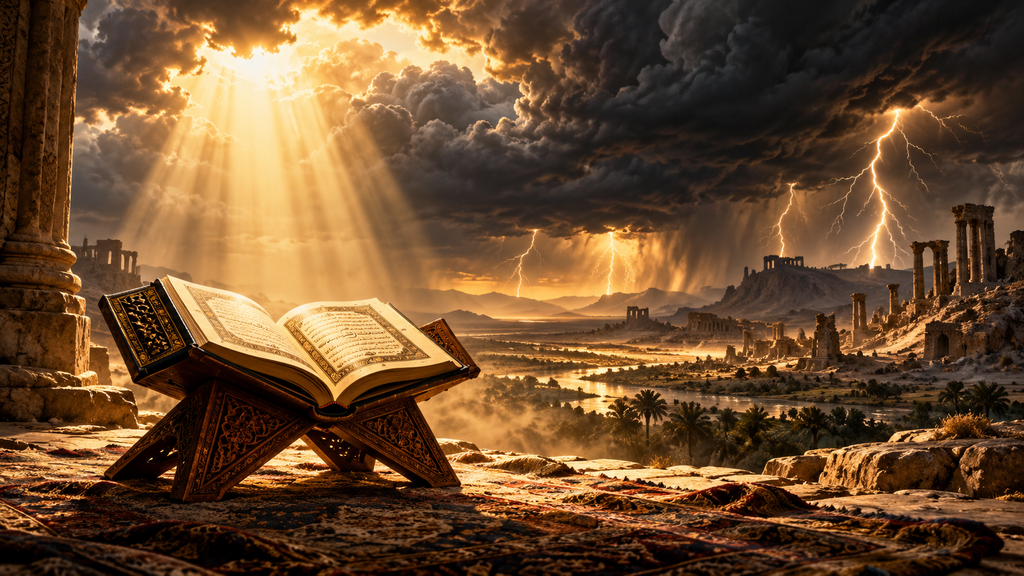
Islam strongly emphasizes that Allah is:
al-Rahman — the Most Compassionate,
and
al-Rahim — the Most Merciful.
Almost every surah begins by invoking God’s mercy.
Yet the same Quran repeatedly warns of:
divine wrath,
destruction,
Hell,
judgment,
and punishment for people and civilizations that persist in oppression, arrogance, idolatry and rejection of prophetic warnings.
This produces a theological tension similar to the one found in Judaism and Christianity:
How can the God who is described as infinitely merciful also punish with extraordinary severity?
The Quran’s general answer is that divine wrath is not random rage.
It is associated with persistent rebellion, injustice and rejection after warning.
The Quran repeatedly presents a pattern:
a people becomes corrupt → a messenger warns them → they refuse → judgment comes.
That cycle appears again and again.
The Quran Explicitly Speaks of God’s Wrath
The Arabic concept commonly translated as divine anger or wrath is ghadab.
One of the most familiar references appears in the opening chapter of the Quran, al-Fatihah.
Muslims ask God to guide them upon the straight path:
not the path of those who have incurred divine anger,
and not the path of those who have gone astray.
So divine wrath appears almost immediately in the Quranic spiritual worldview.
Human beings are not simply seeking blessings.
They are trying to avoid becoming the kind of people whose actions alienate them from God.
God’s Anger Is Not Supposed to Resemble Human Temper
Classical Islamic theology generally treats God’s attributes carefully.
When the Quran speaks of Allah’s wrath, Muslims do not necessarily imagine God becoming emotionally unstable in the human sense.
Human anger can arise from:
ego,
frustration,
fear,
jealousy,
loss of control,
or wounded pride.
Divine wrath is traditionally understood as perfectly connected with:
justice,
knowledge,
and God’s judgment.
God does not discover something unexpectedly and lose His temper.
Nothing surprises Allah.
The language of wrath therefore expresses God’s absolute rejection of evil and the consequences that follow from it.
Pharaoh: One of the Quran’s Greatest Examples of Divine Judgment
Perhaps the strongest recurring example is Pharaoh.
The Quran tells the story of Moses and Pharaoh repeatedly across many surahs.
Pharaoh represents:
arrogance,
tyranny,
oppression,
and the human attempt to make oneself almost divine.
He enslaves and persecutes the Children of Israel.
He rejects Moses despite receiving signs.
At one point Pharaoh even declares his own exalted authority.
The Quran therefore presents his downfall as more than political defeat.
It is a spiritual judgment against arrogance elevated into tyranny.
Eventually Pharaoh pursues Moses and the Israelites toward the sea.
The waters close over Pharaoh and his army.
Only when death becomes unavoidable does Pharaoh declare belief.
But the Quran portrays this repentance as coming too late.
The message is severe:
a person cannot spend a lifetime rejecting truth and expect last-second submission forced by terror to erase everything automatically.
Pharaoh’s Body Becomes a Sign
Surah Yunus, 10:90–92, gives the story an especially striking conclusion.
Pharaoh declares belief as he is drowning.
Allah responds that he had previously rebelled and spread corruption.
The Quran then says Pharaoh’s body will be preserved as a sign for later generations.
The ruler who wanted divine status becomes an object lesson.
His body survives.
His empire does not.
Spiritually, the message is about the limits of worldly power.
A king can dominate human beings.
He cannot dominate death or divine judgment.
The Plagues and Signs Against Egypt
The Quran also mentions punishments sent against Pharaoh’s people before their final destruction.
Surah al-A’raf, 7:133, refers to:
the flood,
locusts,
lice or pests,
frogs,
and blood
as distinct signs.
The narrative closely parallels themes familiar from Exodus.
But the Quran emphasizes the repeated cycle:
a punishment comes,
the people ask for relief,
relief comes,
then they break their promise.
The problem is therefore not ignorance.
They are shown signs repeatedly.
They repeatedly refuse to change.
This makes divine punishment appear as the culmination of persistent resistance rather than an immediate reaction to a single mistake.
The People of Noah
The Quran frequently recalls the people of Nuh — Noah.
Noah warns his people for an extraordinarily long period.
They reject him.
Mock him.
Refuse his message.
Eventually the Flood comes.
The disbelieving population is overwhelmed by water while Noah and those with him are saved.
Again, the structure is:
warning,
patience,
rejection,
judgment.
The Flood therefore becomes one of the Quran’s major historical examples of what happens when a civilization continually refuses moral and spiritual correction.
Even Noah’s Son Is Not Automatically Saved
One particularly powerful Quranic addition to the Noah story concerns his son.
In Surah Hud, Noah calls to a son who refuses to board the ark.
The son believes he can climb a mountain and escape the water.
Noah tells him there is no protection that day except God’s mercy.
A wave separates them.
The son dies.
Noah appeals to God because the young man belongs to his family.
Allah responds that biological family alone does not guarantee salvation.
This is a severe spiritual lesson:
lineage does not override moral responsibility.
Even the son of a prophet is not automatically protected.
The People of ‘Ad
The Quran repeatedly mentions the ancient people called ‘Ad.
They are portrayed as powerful, prosperous and physically impressive.
But their strength produces arrogance.
They reject the prophet Hud.
They effectively ask:
Who is stronger than us?
The Quran responds that the God who created them is obviously greater.
Their punishment comes through a devastating wind.
Surah al-Haqqah describes a furious wind imposed upon them for seven nights and eight days.
Their strength does not save them.
This becomes one of the Quran’s recurring moral themes:
material power easily produces spiritual blindness.
Civilizations begin to mistake strength for invulnerability.
Then they discover the difference.
The People of Thamud
Another frequently mentioned people are Thamud.
The prophet Salih is sent to them.
They receive the sign of the she-camel.
They are instructed not to harm her.
They kill her anyway.
Judgment follows.
Different Quranic passages describe the destruction through:
a mighty blast,
an earthquake,
or an overwhelming cry.
The people who had carved impressive homes into mountains are left powerless.
Again, physical security proves temporary.
You can carve houses into stone.
You cannot carve yourself outside divine judgment.
The She-Camel and Deliberate Defiance
The story is important because the forbidden act is very specific.
The people are given a visible sign.
They understand the instruction.
They violate it intentionally.
The destruction therefore follows a deliberate act of defiance after warning.
This fits the larger Quranic framework:
Allah’s punishment generally does not arrive without signs, warnings or opportunities to turn back.
The People of Lot
The people associated with Lut — Lot also become an example of divine wrath.
The Quran portrays them as engaged in grave sexual and social wrongdoing and as rejecting Lot’s warnings.
Angelic messengers arrive.
Lot and his household, except for his wife, are instructed to leave.
The settlement is overturned and struck with stones.
The story appears in several surahs.
Within Islamic interpretation, it becomes one of the classic examples of a society reaching the point where repeated warning no longer changes behavior.
As with biblical Sodom, the passage has generated extensive theological and ethical discussion, especially regarding what specific forms of wrongdoing the story emphasizes.
But the Quran’s presentation of divine judgment is unmistakable.
Lot’s Wife
Like Noah’s son, Lot’s wife illustrates another Quranic principle.
Relationship to a righteous person does not automatically save someone.
The Quran later mentions both:
the wife of Noah
and
the wife of Lot
as examples of people married to righteous servants of God who nevertheless were not spiritually saved by proximity alone.
This reinforces the Quran’s strong emphasis on individual responsibility.
No one inherits righteousness automatically.
Qarun: Wealth as a Cause of Divine Anger
The story of Qarun—often identified with the biblical Korah—is particularly relevant to material wealth.
Qarun possesses extraordinary riches.
The Quran describes his treasure keys as heavy even for a group of strong men.
His people advise him:
do not become arrogant,
do good,
do not spread corruption,
and remember that worldly wealth is not everything.
Qarun responds by attributing his success to his own knowledge.
Then the Earth swallows him and his home.
The spiritual symbolism is obvious.
He believes wealth demonstrates personal superiority.
Instead, the very ground beneath his wealth disappears.
Wealth Does Not Prove Divine Approval
This story challenges a spiritual mistake found in many cultures:
rich = blessed.
Qarun is rich.
But his wealth becomes part of his downfall.
The Quran repeatedly warns that:
wealth,
children,
power,
and status
are not reliable indicators of God’s approval.
They can be tests.
What matters is what a person becomes through possessing them.
The Owners of the Garden
Surah al-Qalam contains another smaller story.
A group of garden owners decide to harvest their crops secretly so poor people cannot receive anything.
During the night, the garden is destroyed.
When they arrive, they initially think they are lost.
Then they realize the garden itself is ruined.
One member had warned them to remember God.
The others finally recognize their wrongdoing.
This is not the destruction of an entire civilization.
It is almost a parable of divine punishment against greed and deliberate refusal to share.
The lesson is:
wealth creates responsibility.
The Sabbath-Breakers
The Quran refers to a community that violated the Sabbath.
In Surah al-A’raf, a group living by the sea is tested when fish appear abundantly on the Sabbath but not on other days.
Some people devise ways around the prohibition.
The Quran describes severe punishment following persistent disobedience.
Another passage uses the striking phrase:
“Be apes, despised.”
Interpretations have differed over whether this transformation should be understood literally or in some other way.
Regardless, the passage clearly depicts divine anger against people attempting to technically circumvent God’s command.
The Golden Calf
Like the Bible, the Quran recounts the Israelites worshipping the golden calf while Moses is absent.
The episode appears in several surahs.
The wrongdoing is especially serious because the people have recently witnessed divine deliverance.
Yet they quickly turn toward an idol.
Moses returns angry and grieving.
The story emphasizes the instability of human faith.
People can witness extraordinary events and still return quickly to familiar desires.
The Quran repeatedly treats shirk—associating partners with God—as the most serious theological violation.
Why Idolatry Provokes Such Strong Divine Anger
From a secular perspective, worshipping the wrong deity may appear much less harmful than murder or oppression.
Why then does the Quran treat idolatry so seriously?
Because Islamic theology begins with tawhid:
the absolute oneness of God.
God is not simply one being among many.
God is the source of existence.
Therefore worshipping something created as though it were ultimate represents a fundamental distortion of reality.
It moves creation into the place of the Creator.
From an Islamic perspective, this error can then produce further corruption because people begin giving ultimate loyalty to:
rulers,
idols,
spirits,
wealth,
or social power.
Shirk and Divine Wrath
The Quran repeatedly warns that knowingly associating partners with Allah is an exceptionally grave offense.
But another important nuance exists.
The Quran also emphasizes repentance.
Before death, a person can turn back.
The problem is not that someone once made a mistake.
The problem is persistent refusal to repent.
This distinction appears constantly:
sin + repentance → mercy
versus
sin + arrogance + persistence → judgment.
The People Who Mock the Prophets
One of the most repeated Quranic themes is the mocking of prophets.
Noah is mocked.
Hud is rejected.
Salih is rejected.
Moses is opposed.
Muhammad is mocked by opponents.
The Quran repeatedly tells Muhammad that previous messengers experienced the same hostility.
This creates a historical pattern:
God sends a warning.
Powerful people laugh.
The warning appears weak.
Then judgment reverses the situation.
The mockers discover that social dominance did not establish truth.
Arrogance Is One of the Greatest Triggers of Divine Wrath
Across these stories, one sin appears again and again:
kibr — arrogance.
Pharaoh:
I am supreme.
Qarun:
I obtained this wealth through my own knowledge.
‘Ad:
Who is stronger than us?
Iblis:
I am better than Adam.
The recurring mistake is the same.
A created being mistakes relative power for ultimate importance.
The Quran seems particularly hostile to this spiritual posture.
Why?
Because arrogance prevents repentance.
A person who knows they are imperfect can change.
A person convinced of their own superiority cannot easily hear correction.
Iblis: The Original Arrogance
The story of Iblis makes this especially clear.
God commands the angels to bow before Adam.
Iblis refuses.
His argument is essentially:
I am better than him.
I was created from fire.
He was created from clay.
The problem is not simply disobedience.
It is arrogance based upon perceived superiority.
Iblis then becomes Satan, the tempter.
The Quran therefore connects evil at its root with:
ego comparing itself and declaring itself superior.
This is one reason arrogance becomes such a spiritually dangerous trait in Islam.
Divine Anger Toward Hypocrisy
The Quran also speaks severely about munafiqun — hypocrites.
These are not simply people who openly reject Islam.
They outwardly claim belief while inwardly undermining the community.
The Quran often treats hypocrisy as particularly dangerous because it combines:
deception,
social manipulation,
and spiritual dishonesty.
Open disagreement can at least be recognized.
Hypocrisy hides behind apparent loyalty.
Some of the Quran’s most severe warnings concern this group.
Hell as the Ultimate Expression of Divine Wrath
The most intense Quranic image of judgment is Jahannam — Hell.
It is described through images of:
fire,
burning,
boiling water,
chains,
smoke,
regret,
and exclusion from divine mercy.
The Quran uses these descriptions repeatedly.
The purpose is clearly moral and spiritual warning.
Human choices are not treated as meaningless.
Eventually there is accountability.
The Day of Judgment
The Quran is saturated with the idea of Yawm al-Qiyamah — the Day of Resurrection.
Mountains collapse.
The Earth shakes.
The dead rise.
Records of deeds are revealed.
Human beings cannot hide.
Social hierarchy disappears.
A king and a servant stand before the same God.
That makes final judgment profoundly egalitarian.
Worldly privilege becomes irrelevant.
Money cannot purchase escape.
Family connections cannot save someone.
Power cannot intimidate God.
Each person faces what they have become.
Scales of Judgment
The Quran uses the imagery of scales.
Deeds are weighed.
Those whose scales are heavy prosper.
Those whose scales are light face loss.
This imagery reinforces moral accountability.
Nothing disappears simply because no human being noticed it.
A hidden act remains part of the moral reality of the person who performed it.
The idea can be comforting or frightening depending on one’s position.
Records of Deeds
The Quran also repeatedly describes individuals receiving a record of what they have done.
Some receive it in the right hand.
Others receive it differently and react with terror.
People are astonished that the record leaves nothing out.
The spiritual purpose is obvious:
there is no truly private wrongdoing before God.
A human court can be deceived.
God cannot.
Divine Wrath Against Oppression
One of the strongest Quranic themes is God’s opposition to zulm.
The Arabic term can mean wrongdoing, injustice or oppression.
The Quran repeatedly states that Allah does not love wrongdoers.
This is important because it prevents divine anger from being understood only as theological jealousy.
Wrath is repeatedly directed toward:
tyrants,
oppressors,
exploiters,
and corrupt societies.
Pharaoh becomes the supreme example precisely because he combines spiritual arrogance with political oppression.
The Wrathful God Can Be Comforting to the Oppressed
Imagine being enslaved under Pharaoh.
A God who never becomes angry at Pharaoh may not feel especially loving.
Divine wrath can therefore be understood as the other side of divine justice.
If God cares about the oppressed, eventually oppression must matter.
For the oppressor:
judgment is frightening.
For the victim:
judgment means injustice is not permanent.
This same tension appears throughout Abrahamic religion.
But Divine Punishment Raises Moral Questions Too
The Quranic stories also raise difficult questions.
Why destroy an entire society?
What happens to children?
How literally should stories of ancient destruction be understood?
How should modern believers interpret divine violence without using it to justify human violence?
Islamic scholars have debated such questions in different ways.
Traditional interpretation generally emphasizes God’s perfect knowledge and justice.
Modern readers may also examine:
genre,
historical context,
and the rhetorical purpose of warning narratives.
But the difficulty should not simply be ignored.
The Quran intends some of these stories to be frightening.
Divine Wrath Is Usually Preceded by Warning
One major difference between divine wrath and uncontrolled human anger is the Quran’s repeated emphasis on warning first.
Noah warns.
Hud warns.
Salih warns.
Lot warns.
Moses warns Pharaoh.
Muhammad warns his audience.
The Quran repeatedly insists that God does not punish a people without first establishing responsibility through guidance or warning.
This supports the Islamic idea that divine judgment is not arbitrary.
People are given opportunities to change.
God Can Delay Punishment
The Quran repeatedly asks why wrongdoing people are not punished immediately.
The answer is often that Allah gives them time.
This delay is significant.
A person may mistake patience for approval.
They continue:
oppressing,
cheating,
boasting,
or rejecting correction
because nothing happens immediately.
The Quran warns that delayed judgment is not necessarily absent judgment.
Divine patience can be misread.
Mercy Usually Comes Before Wrath
The famous Islamic formula:
Bismillah al-Rahman al-Rahim
— in the name of Allah, the Most Compassionate, the Most Merciful —
appears continually.
The Quran also tells sinners not to despair of God’s mercy.
One of its most hopeful passages is Surah al-Zumar 39:53:
people who have wronged themselves are told not to despair of Allah’s mercy because God can forgive sins.
This is crucial.
The Quran does not teach:
one mistake and God destroys you.
Its repeated message is:
return.
Repent.
Correct yourself.
Ask forgiveness.
Divine wrath becomes most severe where arrogance refuses those possibilities.
Repentance Can Completely Reverse the Situation
The Quranic concept of tawbah — repentance or returning to God—is therefore essential.
A person can have a sinful past and still become spiritually transformed.
This prevents the wrathful-God theme from becoming fatalistic.
The point of warning is not:
you are doomed.
It is:
change while change is still possible.
A warning that cannot lead to repentance would have little spiritual purpose.
The People of Jonah Are an Important Exception
The people of Yunus — Jonah provide one of the most interesting examples.
Unlike many other communities in Quranic warning stories, they respond before destruction becomes final.
Surah Yunus notes that Jonah’s people believed and were spared the punishment.
This proves an important point:
divine judgment is not the objective.
Repentance is.
If people genuinely change, the threatened wrath can be removed.
Allah Is “Severe in Punishment”
The Quran repeatedly uses the phrase that Allah is severe in punishment.
But the same passages frequently place this near descriptions of:
forgiveness,
mercy,
or acceptance of repentance.
This creates deliberate theological tension.
God is not:
only merciful,
or
only punitive.
Islamic spirituality asks the believer to maintain both:
hope
and
fear.
Hope without fear may become complacency.
Fear without hope becomes despair.
Khawf and Raja’: Fear and Hope
Classical Islamic spirituality often emphasizes a balance between:
khawf — fear or reverent fear of God,
and
raja’ — hope in God’s mercy.
Imagine a bird.
One wing is fear.
The other is hope.
With only one wing, it cannot fly properly.
Too much fear produces despair.
Too much confidence produces arrogance.
The spiritual ideal is balance.
This makes the wrathful passages psychologically important.
They prevent the believer from turning divine mercy into:
nothing I do really matters.
God’s Mercy Is Said to Encompass Everything
Surah al-A’raf 7:156 contains one of the Quran’s most important statements:
God’s mercy encompasses all things.
This creates the theological backdrop against which wrath must be understood.
Wrath is real.
But mercy is treated as fundamental and extraordinarily expansive.
Islamic tradition also contains the famous teaching that God’s mercy surpasses or prevails over His wrath.
That concept becomes central to Muslim spirituality.
Does Allah “Hate” People?
The Quran more commonly expresses God’s disapproval through formulations such as:
Allah does not love:
the unjust,
the arrogant,
the corrupt,
the transgressors.
Conversely, Allah loves:
those who repent,
those who act justly,
those who do good,
those who are patient.
The emphasis is often behavioral.
Human beings move toward or away from divine approval through what they become and do.
God’s Wrath Is Closely Connected With Moral Order
Looking across the Quran’s stories, divine anger repeatedly centers on several patterns:
Arrogance
Pharaoh, Iblis, Qarun and ‘Ad.
Oppression
Pharaoh and other tyrants.
Idolatry
The golden calf and rejection of tawhid.
Corruption
Communities knowingly persisting in wrongdoing.
Hypocrisy
Pretending faith while undermining it.
Greed
The owners of the garden and Qarun.
Rejection after repeated warning
Noah’s people, ‘Ad, Thamud and others.
These themes show that Quranic wrath is rarely portrayed as random emotional volatility.
It expresses a universe with moral boundaries.
The Quran Sometimes Invites People to Look at Ruins
Another powerful theme involves destroyed civilizations.
The Quran tells people to travel through the Earth and observe what happened to earlier peoples.
Ruins become spiritual teachings.
Civilizations believed they would last forever.
They built.
Accumulated.
Conquered.
Boasted.
Then disappeared.
The traveler sees stone.
The Quran asks:
What did power ultimately accomplish?
History becomes a spiritual teacher.
The Greatest Sin May Be Forgetting One’s Scale
Many Quranic stories of divine wrath share one psychological error:
human beings forget what they are.
Pharaoh forgets he is mortal.
Qarun forgets his wealth is temporary.
Iblis becomes obsessed with superiority.
‘Ad believes no one is stronger.
The spiritual problem is not confidence.
It is forgetting scale.
A finite creature begins behaving as though it were ultimate.
Divine wrath then functions almost as forced remembrance:
you are not God.
Wrath and Tawhid Are Closely Connected
This is why divine anger in the Quran cannot be separated from tawhid, the unity of God.
Everything else is:
created,
dependent,
temporary.
Allah alone is ultimate.
Whenever something created claims God’s place—
a ruler,
wealth,
an idol,
the ego—
the entire spiritual order becomes distorted.
From an Islamic perspective, divine judgment restores the proper hierarchy.
The Creator remains Creator.
The creation remains creation.
The Quranic God Is Both Merciful and Dangerous
Modern spirituality sometimes prefers a God who never threatens.
The Quran does not present such a God.
Allah is:
merciful,
forgiving,
patient,
generous,
but also
powerful,
just,
and capable of severe punishment.
This makes the divine encounter spiritually serious.
God is not merely a source of emotional comfort.
Human behavior matters.
Societies can become corrupt.
Power can become oppressive.
Individuals can destroy themselves spiritually.
The universe contains consequences.
The Wrathful God and Human Violence Are Not the Same Thing
One important distinction is necessary.
A believer cannot simply say:
“God becomes angry, therefore my anger is automatically righteous.”
Human beings possess:
limited knowledge,
ego,
bias,
and personal interests.
God, within Islamic theology, possesses perfect knowledge.
Therefore divine judgment cannot automatically be used as a model for private vengeance.
The Quran repeatedly commands justice and warns against allowing hatred to cause injustice.
This is crucial.
Divine wrath does not give human beings permission to become wrathful gods themselves.
Islam Also Strongly Values Forgiveness
Although judgment is prominent, Islam repeatedly encourages:
forgiveness,
patience,
charity,
reconciliation,
and restraint.
The spiritually powerful person is not the person constantly seeking revenge.
Controlling anger is itself treated as virtuous.
This creates another important distinction:
Allah’s wrath represents divine justice.
Human anger must be disciplined.
The Quran’s Most Important Examples of Divine Wrath
Some of the clearest examples include:
Pharaoh
Tyranny, arrogance and rejection of Moses culminate in drowning.
The people of Noah
Persistent rejection of Noah culminates in the Flood.
‘Ad
Arrogant confidence in their own strength ends in destruction by violent wind.
Thamud
Defiance surrounding the she-camel is followed by catastrophic punishment.
The people of Lot
Persistent wrongdoing and rejection of Lot lead to the destruction of their settlement.
Qarun
Arrogance based on wealth ends when the Earth swallows him and his possessions.
The golden calf
Idolatry after divine deliverance brings severe condemnation.
The Sabbath-breakers
Deliberate violation of divine command results in extraordinary punishment.
Hypocrites
The Quran repeatedly warns of severe consequences for religious deception.
Jahannam
Hell represents the ultimate form of divine judgment.
The Day of Resurrection
Every human being faces final accountability before God.
Why the Quranic God Becomes Angry
The Quranic portrait of divine anger is perhaps best understood through one central idea:
human actions matter because creation has moral meaning.
Oppression matters.
Arrogance matters.
Greed matters.
Lying matters.
Exploitation matters.
Idolatry matters.
Rejecting repeated correction matters.
A God who never reacts to any of this would not be the God the Quran describes.
But wrath is not presented as the first response.
Warnings come.
Prophets come.
Signs come.
Time passes.
Repentance remains possible.
Mercy remains available.
Only persistent rebellion turns warning into judgment.
The Quran’s God Is Not Simply an Angry God
Just as it would be inaccurate to reduce the biblical God entirely to wrath, it would be inaccurate to portray Allah as primarily furious.
The Quran begins almost every chapter by emphasizing divine mercy.
It repeatedly invites sinners to repent.
It tells people not to despair.
It describes Allah as forgiving again and again.
Yet it refuses to separate mercy from accountability.
A spirituality containing only punishment becomes terror.
A spirituality containing only forgiveness can become moral complacency.
The Quran insists upon both.
God is merciful enough to forgive.
God is just enough to judge.
And human beings live between those two possibilities.
The Deeper Spiritual Message
Perhaps the most important point is that Quranic wrath is usually directed against consciousness becoming hardened.
A person makes a mistake.
That can be forgiven.
They make another.
Still possible to return.
But eventually a pattern can emerge:
warning is mocked.
Pride deepens.
Power increases.
Compassion disappears.
The ego becomes convinced it cannot be wrong.
That is when Pharaoh emerges.
The Quran’s terrifying stories therefore function partly as psychological warnings.
Every human being contains a smaller possibility of Pharaoh.
The voice that says:
I answer to nobody.
My power proves I am right.
I do not need correction.
Others exist beneath me.
The Quran says that consciousness eventually destroys itself.
Divine wrath is the cosmic expression of that collapse.
Fear Is Supposed to Produce Transformation, Not Despair
The purpose of these stories is not merely to terrify.
The warning is useful only if it changes behavior.
The Quran repeatedly returns the listener to the same possibility:
repent.
Become humble.
Act justly.
Share wealth.
Stop oppressing others.
Remember God.
The door remains open until it does not.
That is why divine wrath and mercy cannot be separated.
Wrath says:
your choices matter.
Mercy says:
your worst choices do not necessarily have to define you forever.
Between them lies the Quranic path of responsibility.
And that may be the deepest similarity between the Quran’s portrayal of divine judgment and the biblical one:
God’s anger is not presented as the opposite of moral concern.
It is presented as one consequence of a universe in which human behavior matters enough to receive a divine response.