
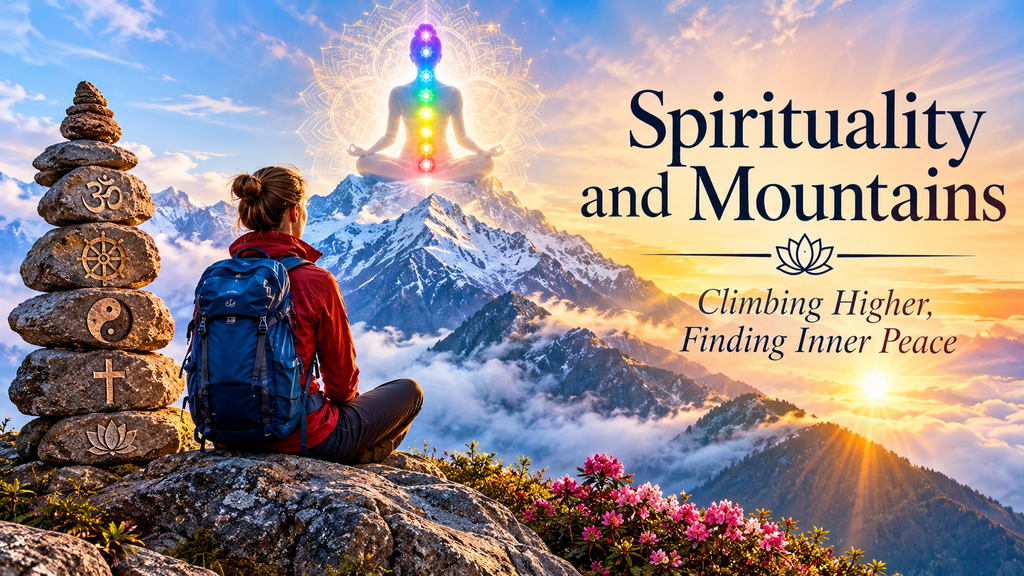
From Buddhist monasteries in the Himalayas to Taoist sages in China’s sacred mountains, discover why ascending into the mountains has long symbolized purification, solitude, enlightenment, and a closer relationship with the divine.
Introduction: Why Do We Look Toward the Mountains?
There is something almost instinctive about the way human beings look toward mountains when searching for spiritual meaning.
Across continents and throughout history, mountains have been associated with gods, prophets, hermits, monks, sages, and people seeking answers to questions that ordinary life cannot easily resolve. They appear in religious stories as places where heaven and earth meet, where divine revelations occur, and where individuals withdraw from society to discover a deeper understanding of existence.
Moses receives the Ten Commandments on Mount Sinai. Jesus retreats into the wilderness and mountains to pray. Buddhist monks establish monasteries in remote Himalayan valleys. Taoist practitioners seek spiritual cultivation in China’s sacred mountain ranges. Hindu sages meditate in the Himalayas, while Japanese ascetics undertake demanding mountain pilgrimages as a means of spiritual purification.
Why has this particular landscape become so closely connected with spiritual transformation?
Perhaps it is because mountains physically remove us from the environment in which our ordinary identities are formed. The noise of cities becomes distant. Social expectations lose some of their importance. The routines of work, entertainment, relationships, and consumption are replaced by walking, breathing, observing, and confronting the natural world.
A mountain journey also requires effort. You cannot simply arrive at the summit without passing through the climb. The physical experience becomes a metaphor for the inner journey: overcoming resistance, leaving unnecessary burdens behind, and gradually developing a different perspective.
In this sense, climbing a mountain can become more than exercise or sightseeing. It can become a spiritual practice.
But the deeper question is whether the mountain itself possesses something sacred, or whether it is the transformation that occurs within us when we enter such an environment.
1. The Mountain as a Meeting Place Between Heaven and Earth
Throughout religious history, mountains have frequently represented a connection between the earthly and the heavenly realms.
Their enormous height makes them appear to rise toward the sky. Their summits are often surrounded by clouds, hidden from ordinary view, and separated from the settlements below.
For ancient civilizations, this physical separation could easily become a spiritual metaphor.
The mountain was not simply another geographical feature. It represented a place closer to the heavens, a location where the human world seemed to approach something greater than itself.
In Hindu traditions, Mount Meru is described in cosmological accounts as a sacred cosmic mountain associated with the structure of the universe. It is not simply a geographical destination but a symbolic centre of cosmic order.
In Tibetan Buddhist traditions, Mount Kailash is revered as an extraordinarily sacred mountain. It is associated with several religious traditions, including Tibetan Buddhism, Hinduism, Jainism, and the Bön tradition. Pilgrims undertake the demanding journey around it as an act of devotion and spiritual purification.
In ancient Greek religion, Mount Olympus was regarded as the home of the gods.
In the Abrahamic traditions, mountains also provide settings for encounters with the divine. Mount Sinai is associated with Moses receiving God’s commandments, while the Mount of Olives and other elevated locations appear in the religious narratives surrounding Jesus.
The recurring theme is striking.
When human beings imagine approaching the sacred, they frequently imagine ascending.
Perhaps the mountain represents the movement from ordinary consciousness toward a greater perspective. At its base, we are surrounded by familiar concerns. At its summit, we experience the world from a position that makes those concerns appear smaller.
The mountain becomes a symbol of transcendence: rising above the ordinary without necessarily abandoning the world below.
2. Why Solitude in the Mountains Can Transform the Mind
One of the most important reasons mountains are associated with spiritual retreats is their ability to provide solitude.
Modern life is filled with stimulation. We receive messages, notifications, advertisements, conversations, news, and entertainment throughout the day. Even when we are physically alone, our minds may remain occupied by social relationships, responsibilities, financial concerns, and imagined conversations.
The mountain offers a different environment.
There may be no immediate demands on your attention. You might hear only wind, birds, flowing water, or your own footsteps. The absence of constant stimulation can create an opportunity to observe thoughts that normally disappear beneath the noise of everyday activity.
This is particularly relevant to Buddhist meditation.
Buddhist traditions have long valued periods of retreat, including residence in monasteries, forest dwellings, caves, and remote mountain environments. Such places can provide favourable conditions for mindfulness, concentration, and contemplation.
However, the mountain is not automatically a place of enlightenment. A person can carry all their anxieties, ambitions, and resentments up the mountain with them.
The difference is that solitude may make those internal experiences more visible.
Without constant distraction, you may begin to recognize how often your mind returns to the same concerns. You may notice how much emotional energy is spent anticipating the future or replaying the past.
The retreat creates an opportunity to observe these patterns rather than immediately react to them.
In this way, solitude is not necessarily an escape from life. It can be a way of understanding the mind that participates in everyday life.
3. The Buddhist Connection: Mountains, Impermanence, and Equanimity
Buddhism has a particularly interesting relationship with mountains.
Although the Buddha’s own life was not defined by permanent residence in the mountains, the Buddhist tradition has developed extensive cultures of forest, cave, and mountain meditation.
Monks and contemplatives have sought remote environments where they can devote themselves to meditation and spiritual development.
Why?
Because the mountain can make several Buddhist teachings easier to contemplate.
Impermanence — Anicca
Mountains appear permanent when compared with human life.
A mountain may have existed for millions of years. Generations of people may be born, live, and die while its peaks remain visible on the horizon.
Yet mountains are not truly permanent. They are shaped by erosion, earthquakes, glaciers, volcanic activity, and the gradual movement of geological structures.
What appears eternal is also changing.
This provides a powerful metaphor for anicca, the Buddhist teaching of impermanence.
Our bodies change. Our relationships change. Our emotions change. Our possessions deteriorate. Even the landscapes that seem timeless are subject to transformation.
Contemplating a mountain can therefore remind us that permanence is often an illusion created by the limited scale of human perception.
Equanimity — Upekkhā
A mountain does not become disturbed because clouds cover its summit. It does not become excited when sunlight reaches its slopes. It remains part of the landscape through changing weather.
This makes the mountain a natural metaphor for upekkhā, or equanimity.
Equanimity does not mean becoming emotionally numb. It means learning to maintain balance amid changing circumstances.
Imagine experiencing disappointment in a relationship. You may feel sadness, longing, or frustration. But rather than allowing those feelings to control every action, you learn to observe them.
You recognize that people have their own choices, that circumstances change, and that not everything can be controlled.
The mountain becomes a reminder to remain grounded while emotional weather passes through the mind.
Nonattachment — Letting Go
A climb also involves deciding what to carry.
If you take unnecessary possessions, the journey becomes more difficult. The higher you climb, the more you appreciate the value of travelling lightly.
This can become a metaphor for Buddhist nonattachment.
We often carry psychological burdens that make life heavier: expectations, grudges, jealousy, pride, and the need to control outcomes.
A mountain retreat can provide an opportunity to examine which burdens are genuinely necessary.
The objective is not to stop caring about people or responsibilities. It is to release the unnecessary suffering created by clinging to what cannot remain fixed.
4. Taoism: The Mountain as a Place to Return to the Natural Way
If Buddhism provides one interpretation of mountain spirituality, Taoism offers another.
In Taoist philosophy, mountains are frequently associated with harmony, naturalness, longevity, and spiritual cultivation.
The central concept of the Tao refers to the Way: the underlying principle or natural order through which existence unfolds.
Rather than constantly trying to control life, Taoist philosophy encourages us to understand the natural patterns of the world and live in greater harmony with them.
The principle of wu wei, often translated as non-forcing or effortless action, is especially relevant.
Consider the difference between a person struggling against the mountain and someone learning to move with it.
The first person may rush, become frustrated, and exhaust themselves trying to force progress. The second person adjusts their pace, observes the terrain, conserves energy, and responds to the conditions of the climb.
The second approach resembles wu wei.
It does not mean doing nothing. It means acting without unnecessary force, resistance, or artificial struggle.
Taoist mountain traditions also include practices involving meditation, breathing, internal cultivation, and contemplative engagement with nature. Historically, some Taoist practitioners established communities and temples in remote mountain environments.
The mountain becomes a place where one can withdraw from excessive social demands and rediscover a more natural rhythm.
There is also an important contrast with modern life.
Urban environments often reward speed, productivity, competition, and constant activity. A mountain environment operates according to different rhythms. Trees grow slowly. Rivers follow the contours of the land. Clouds move without concern for human schedules.
Observing these processes can encourage a different understanding of existence.
Perhaps we do not always need to push harder. Sometimes we need to become more receptive to the natural movement of life.
5. Christianity and the Mountain as a Place of Prayer
Mountains also hold a central place in Christianity.
The Bible contains several important moments in which individuals ascend mountains to encounter God, receive guidance, or withdraw from ordinary life.
One of the most significant is Moses’ encounter with God on Mount Sinai.
In the Book of Exodus, Moses ascends the mountain and receives the Ten Commandments. The mountain becomes a place of revelation, where the relationship between humanity and divine law is established.
Jesus also frequently retreats to isolated locations for prayer.
In the Gospel narratives, mountains are associated with important moments in his ministry, including the Sermon on the Mount and the Transfiguration.
The Transfiguration is particularly significant. Jesus ascends a mountain with several disciples, and the experience is described as a revelation of his divine glory.
Why a mountain?
The physical ascent provides a setting for spiritual separation from ordinary activity. It creates a sense of sacred distance, allowing the encounter to take place away from the distractions of daily life.
Christian spirituality also contains a long tradition of retreat and contemplation. Monastic communities, hermits, and religious pilgrims have sought remote places to pray, reflect, and deepen their relationship with God.
For a Christian, the mountain may represent a place where one becomes more receptive to divine presence.
For a Buddhist, it may represent an environment in which the mind can become more peaceful and aware.
The underlying experience of solitude may be similar, even though the theological interpretations differ.
6. Hinduism: The Himalayas and the Search for Liberation
Few geographical regions have a stronger association with spiritual retreat than the Himalayas.
For centuries, the Himalayan region has been connected with Hindu sages, yogis, ascetics, and seekers of liberation.
The mountains are associated with sacred rivers, pilgrimage sites, temples, and places of meditation.
The Ganges, one of Hinduism’s most sacred rivers, originates in the Himalayan region. Its waters have become deeply connected with purification, devotion, and liberation.
Many Hindu traditions associate the Himalayas with Lord Shiva, who is often depicted as a great yogi dwelling in the mountains. Mount Kailash is particularly sacred in this context.
The image of Shiva meditating in the Himalayas represents a profound spiritual ideal: the ability to remain inwardly still while the universe continues to move around you.
Hindu spiritual traditions also include the concept of moksha, liberation from the cycle of rebirth.
For some practitioners, withdrawing from worldly attachments and devoting themselves to spiritual knowledge, meditation, and self-discipline is an important part of this journey.
The mountain offers an environment that symbolically and practically supports such a commitment.
Its remoteness encourages simplicity. Its physical challenges test discipline. Its vastness can make personal ambitions seem less important.
Yet the ultimate goal is not simply to live in the mountains. It is to realize a deeper truth about existence.
7. The Physical Climb as a Metaphor for Spiritual Development
There is another reason climbing mountains can feel spiritual: the journey itself demands qualities that are also important in spiritual development.
A climb requires patience.
You cannot always reach the summit as quickly as you would like. You must accept your physical limitations, adjust your pace, and continue step by step.
It requires humility.
The mountain does not care about your ambitions. It will not become easier because you are impatient or confident. Weather, terrain, altitude, and fatigue impose conditions that must be respected.
It requires discipline.
There may be moments when you want to stop. Your legs become tired, the trail becomes difficult, and the summit appears farther away than expected.
You must decide whether to continue, rest, or turn back.
These experiences resemble the challenges encountered in meditation.
At first, sitting quietly may seem easy. But soon the mind becomes restless. Thoughts appear. Old memories return. The body becomes uncomfortable. You may feel impatient or discouraged.
The spiritual practitioner learns not to demand immediate results.
Instead, they return to the practice.
The mountain climb teaches something similar: progress is often gradual, and meaningful transformation cannot always be rushed.
However, there is an important lesson in knowing when to stop. Spiritual discipline should not become reckless self-punishment. A wise climber recognizes dangerous conditions and turns back when necessary.
Likewise, a wise spiritual practitioner understands the difference between perseverance and unnecessary suffering.
8. The Psychology of Elevation: Why We Feel Different at Higher Altitudes
There may also be psychological reasons why mountain environments encourage reflection.
When we move away from familiar surroundings, we interrupt habitual patterns.
A person who normally spends the day working, checking messages, managing relationships, and attending to responsibilities may experience a noticeable shift when spending several hours in a forest or mountain environment.
There are fewer familiar cues demanding the same responses.
Natural environments can also encourage what psychologists sometimes describe as soft fascination: attention is gently drawn toward clouds, trees, water, wildlife, and changing light without requiring the same intense concentration demanded by work or digital activity.
This can provide a restorative experience.
Physical activity may also contribute. Walking, climbing, and spending time outdoors can influence mood and stress levels. Exercise, exposure to natural light, and temporary distance from everyday pressures may all play a role.
The feeling of spiritual elevation may therefore emerge from a combination of physical, psychological, and cultural influences.
There is also the experience of perspective.
Standing above a valley and looking across an enormous landscape can make ordinary problems appear smaller. A disagreement, financial concern, or personal disappointment may still matter, but it no longer occupies the entire field of attention.
You see more than the immediate problem.
This does not mean that the problem has disappeared. It means your relationship with it may have changed.
9. The Mountain and the Ego: Learning to Become Smaller
One of the most interesting spiritual experiences associated with mountains is the feeling of becoming small.
In ordinary social life, people often spend considerable energy maintaining an identity.
We may be concerned with our careers, reputation, appearance, relationships, achievements, and how others perceive us.
These concerns can become so dominant that we begin to mistake our social identity for the entirety of our existence.
A mountain can challenge that perception.
Standing before a vast range of peaks, you may realize that your personal achievements and disappointments occupy only a tiny part of an enormous natural world.
The mountain does not recognize your professional status. It does not know your relationship history. It does not care whether you are admired or ignored.
You are simply another human being standing within nature.
For someone exploring Buddhist teachings, this experience can be connected with the contemplation of non-self.
The sense of a fixed, independent identity becomes less convincing when we recognize how deeply our existence depends on conditions beyond our control.
We depend on the atmosphere, water, food, other living beings, and countless natural processes.
We are not separate from the world around us.
This recognition can encourage humility.
It can also reduce the pressure to constantly defend an identity or prove personal importance.
Perhaps part of spiritual freedom comes from realizing that we do not need to be the centre of everything.
10. Sacred Mountains and the Power of Pilgrimage
A mountain retreat is not always about reaching a summit and returning home.
In many traditions, the journey itself is a pilgrimage.
Pilgrimage transforms ordinary movement into an intentional spiritual act. The destination matters, but so does the process of travelling toward it.
In Japan, the tradition of Shugendō is particularly fascinating.
Shugendō developed as a mountain-centred ascetic tradition incorporating elements of esoteric Buddhism, Shinto-related practices, and other religious influences.
Its practitioners, known as yamabushi, undertake demanding mountain training involving prayer, meditation, ritual, and physical discipline.
Mountains are understood not simply as scenery but as places of spiritual power and transformation.
Practitioners may engage in waterfall purification, fasting, chanting, and arduous mountain journeys.
These practices are intended to cultivate discipline, spiritual insight, and a transformed relationship with the natural world.
In Tibetan Buddhism, pilgrims may undertake kora, the ritual circumambulation of sacred mountains, monasteries, or other holy sites.
One of the most famous examples is the pilgrimage around Mount Kailash.
The journey can take several days and involves significant physical effort, particularly at high altitude.
The act of walking around the sacred mountain becomes an expression of devotion, humility, and spiritual purification.
These traditions reveal something important: the spiritual significance of a mountain does not necessarily depend on conquering its summit.
Sometimes the purpose is to walk around it, remain in its presence, or allow the journey to become a form of meditation.
11. Why Retreating From Society Can Help Us Return to It
There is a potential misunderstanding in the idea of spiritual retreat.
If mountains offer peace, solitude, and freedom from social pressures, does that mean spiritual development requires abandoning ordinary life?
Not necessarily.
Buddhist teachings emphasize the Middle Way, avoiding extremes of indulgence and self-mortification. While monastic life and extended retreat can be valuable, Buddhist practice is not limited to remote mountain environments.
The same is true of many other religious traditions.
A person may retreat to a mountain for a period of reflection and then return to their family, community, and responsibilities with a renewed perspective.
The purpose of solitude is not necessarily to escape humanity. It may be to become better equipped to live among other people.
Imagine returning from several days of meditation in the mountains.
You may find that you are less interested in unnecessary arguments. You may become more patient with other people’s imperfections. You may feel less compelled to respond immediately to every message or social situation.
You might recognize that many of the concerns occupying your mind were intensified by constant attention rather than by their actual importance.
The mountain has not changed your responsibilities.
It has changed how you relate to them.
This is perhaps the most valuable purpose of a spiritual retreat: to return to ordinary life with a little more awareness, patience, and freedom.
12. A Simple Mountain Meditation: Learning to Leave Things Behind
You do not need to undertake an elaborate pilgrimage or climb a dangerous peak to experience the contemplative value of mountains.
Even a modest hike can become a spiritual practice.
The following exercise combines elements of Buddhist mindfulness, Taoist observation of nature, and the symbolism of the mountain journey.
Before the climb: Set an intention.
Ask yourself what you hope to gain from the experience.
Perhaps you want to release resentment, find clarity about a decision, or simply spend time away from constant stimulation.
Choose an intention without demanding that the mountain provide a particular answer.
During the climb: Return to the present.
Pay attention to your footsteps, breathing, and surroundings.
When thoughts arise about work, relationships, or personal problems, notice them without immediately following them.
Return your attention to the physical experience of walking.
At a resting point: Practise acceptance.
Look across the landscape.
Consider the things in your life that you cannot control: the past, other people’s feelings, changing circumstances, and the passage of time.
Rather than fighting these realities, acknowledge them.
You can still decide what actions are appropriate. Acceptance simply means recognizing the conditions from which you must act.
At the summit or destination: Practise gratitude.
Notice the landscape and the effort that brought you there.
Reflect on the fact that you are part of a much larger natural world.
You do not need to achieve anything further in that moment.
During the descent: Bring the lesson home.
As you return, consider what you might leave behind psychologically.
Perhaps it is the need to win every disagreement, the desire to control a relationship, or the habit of measuring your worth through other people’s opinions.
The mountain journey becomes meaningful when its lessons continue after you have returned.
Always choose a route appropriate to your fitness and experience, check weather and trail conditions, and carry sufficient water, food, clothing, and navigation equipment. Spiritual exploration should not come at the expense of basic safety.
Conclusion: The Summit Is Not Always the Destination
Why do human beings repeatedly turn toward mountains when searching for spiritual meaning?
Perhaps because mountains represent several things we instinctively associate with spiritual development: solitude, endurance, humility, perspective, and the possibility of encountering something greater than ourselves.
For Buddhists, the mountain can become a setting for contemplating impermanence, nonattachment, and equanimity. For Taoists, it can represent harmony with the natural order and the wisdom of non-forcing. For Hindus, it may be associated with sacred geography, asceticism, and liberation. For Christians, it can become a place of prayer and divine revelation.
The interpretations differ, but the attraction is remarkably widespread.
There is also something meaningful about the physical act of ascending.
With every step, we temporarily leave behind the familiar environment. The distractions of ordinary life become more distant. Our attention returns to the body, the breath, and the immediate challenge before us.
We discover that progress requires patience. That strength requires humility. That not everything can be controlled. And that sometimes the greatest achievement is not reaching the summit but learning something about ourselves along the way.
Perhaps the mountain does not make us spiritually greater.
Perhaps it simply gives us the space to recognize how much unnecessary weight we have been carrying.
The ultimate lesson may be that spiritual elevation is not measured by how high we climb, how remote our retreat becomes, or how many days we spend away from civilization.
It is measured by what happens when we return.
Can we become more peaceful? More compassionate? Less attached to what cannot be controlled? More accepting of the changing nature of life?
If so, the mountain has served its purpose.
We climb toward the summit, but the deeper journey is inward. And sometimes, the greatest spiritual retreat is simply stepping away from the noise long enough to hear what our own lives have been trying to tell us.