
One of Humanity’s Oldest Questions
For thousands of years, humans have asked:
What exactly are we beyond the physical body?
Almost every civilization developed some concept of:
- soul
- spirit
- consciousness
- essence
- life force
- inner self
The soul has been described as:
- immortal consciousness
- divine spark
- true identity
- energetic essence
- the observer behind thought itself.
Yet despite centuries of philosophy, religion, and science:
→ nobody fully agrees on what the soul actually is.
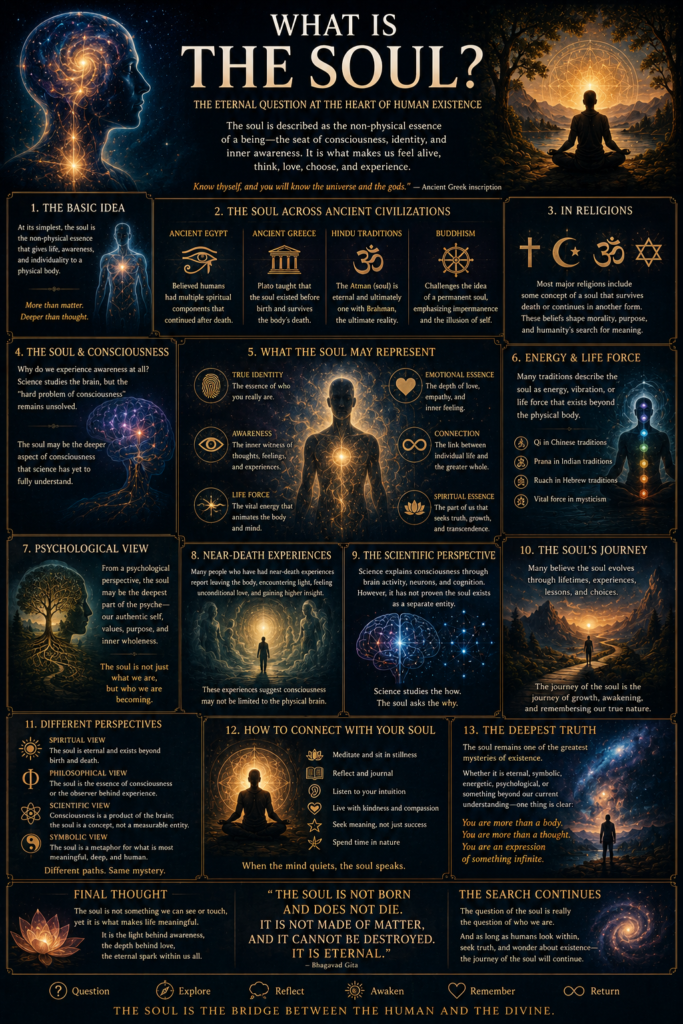
The Basic Idea of the Soul
At its simplest, the soul is often understood as:
the non-physical essence of a person.
Something believed to exist beyond:
- flesh
- brain chemistry
- physical matter.
Different traditions describe it differently, but many share the idea that:
- the soul contains identity or consciousness at a deeper level than the body alone.
Ancient Civilizations and the Soul


Belief in the soul appears almost universally throughout history.
Ancient Egypt
The Egyptians believed humans possessed multiple spiritual components connected to:
- personality
- life force
- afterlife existence.
Ancient Greece
Philosophers like Plato believed the soul existed before birth and survived death.
Hindu Traditions
The soul (Atman) is viewed as:
- eternal consciousness
- connected to ultimate reality (Brahman).
Buddhism
Some Buddhist systems challenge the idea of a permanent soul entirely, emphasizing:
- impermanence
- non-self
- flowing consciousness.
The Soul in Religion
Most major religions contain some concept of:
→ spiritual essence beyond physical death.
These ideas often relate to:
- morality
- afterlife
- reincarnation
- salvation
- spiritual evolution.
Different systems disagree on:
- what survives death
- whether individuality continues
- how consciousness transforms.
The Soul and Consciousness


One reason the soul concept persists is because:
→ consciousness itself remains mysterious.
Science can study:
- brain activity
- neurons
- cognition
But philosophers still debate:
Why does subjective experience exist at all?
This is sometimes called:
→ the “hard problem of consciousness.”
Some people therefore believe:
- consciousness may not be entirely reducible to physical matter.
The Psychological Interpretation
Not everyone interprets the soul literally.
Psychological perspectives may describe the soul as:
- the deepest part of the psyche
- authentic selfhood
- emotional essence
- symbolic inner identity.
In this interpretation:
“soul” becomes less about:
- supernatural substance
and more about:
- inner depth and meaning.
Carl Jung and the Deep Self
Carl Jung explored ideas similar to the soul through concepts such as:
- the Self
- archetypes
- the unconscious mind.
Jung believed humans possess:
- deep symbolic layers of identity beyond ordinary ego awareness.
While not always using religious language, his work influenced many modern spiritual interpretations of:
→ the inner self.
The Soul as Energy or Life Force


Many spiritual traditions describe the soul as:
- energy
- vibration
- life force.
Examples include:
- Qi in Chinese traditions
- Prana in Indian systems
- spiritual vitality in mystical traditions.
These systems often connect the soul to:
- breath
- vitality
- awareness
- subtle energy.
Near-Death Experiences and Soul Beliefs
Modern interest in the soul is often linked to:
- near-death experiences (NDEs)
- out-of-body experiences
- mystical states
- profound meditation experiences.
People reporting these experiences sometimes describe:
- separation from the body
- expanded awareness
- timelessness
- intense peace.
Interpretations vary between:
- spiritual explanations
and - neurological theories.
The Scientific Perspective


Modern science has not proven:
- the existence of a soul as a measurable entity.
Neuroscience generally explains consciousness through:
- brain processes
- neural networks
- cognitive systems.
However:
many philosophers argue consciousness itself remains:
→ deeply unresolved scientifically.
This leaves ongoing debate about whether:
- consciousness is entirely physical
or - something more fundamental.
Why Humans Keep Believing in the Soul
The soul concept may persist because humans intuitively feel:
there is something deeper behind identity than biology alone.
People often sense:
- inner continuity
- witnessing awareness
- emotional depth
- existential presence.
The soul becomes a way of describing:
- what feels most essential and alive within us.
The Soul and Personal Transformation


Many traditions believe the soul evolves through:
- experience
- suffering
- learning
- love
- self-awareness.
This idea appears in:
- reincarnation systems
- mystical traditions
- spiritual psychology.
The “journey of the soul” often symbolizes:
→ inner transformation.
Could the Soul Be Symbolic Rather Than Literal?
Some thinkers suggest:
the soul may function as:
- a symbolic language for consciousness itself.
In this interpretation:
the soul represents:
- meaning
- humanity
- depth
- subjective experience
rather than:
- a detectable supernatural object.
The Deepest Mystery
The soul remains difficult to define because it touches:
- identity
- death
- consciousness
- meaning
- existence itself.
And these are questions humanity still cannot fully answer.
Final Thought
The soul has been understood as:
- immortal consciousness
- divine spark
- inner self
- life force
- symbolic essence
- deepest identity.
Science has not conclusively proven the soul exists as an independent entity.
Yet the idea continues to endure across cultures and centuries because humans consistently feel:
there is something profoundly mysterious about conscious existence itself.
Perhaps the soul is:
- literal
- symbolic
- psychological
- spiritual
or - something beyond current human understanding.
But the question persists because every human eventually confronts the same mystery:
What is the “I” behind experience itself?
And so the search for the soul continues.