
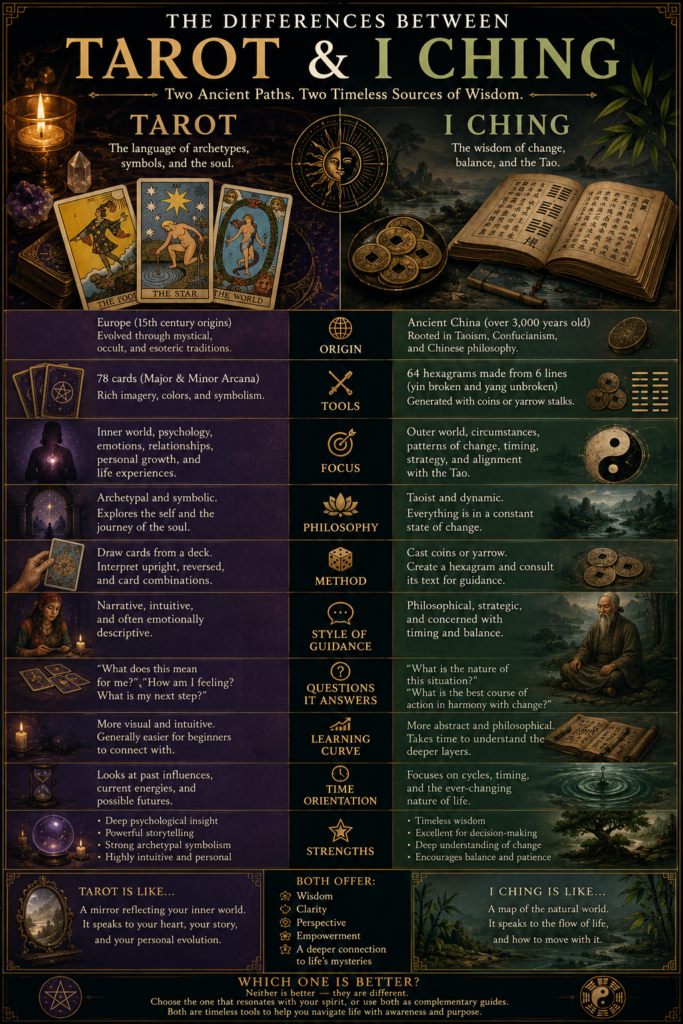
Two Ancient Systems for Guidance
Both Tarot and the I Ching are systems people use for:
- insight
- reflection
- decision-making
- symbolic guidance
- spiritual exploration
At first glance, they may seem similar because both involve:
- divination
- symbolism
- interpreting patterns
- asking questions about life.
But beneath the surface, Tarot and the I Ching come from:
- completely different cultures
- different philosophies
- different methods of thinking about reality itself.
Understanding the differences helps explain why the two systems often feel very different in practice.
What Is Tarot?


Tarot is a symbolic card system most commonly consisting of:
→ 78 cards.
The deck includes:
- Major Arcana
- Minor Arcana
Tarot developed primarily in Europe and later evolved into:
- mystical
- psychological
- spiritual
- intuitive systems.
Modern Tarot often emphasizes:
- archetypes
- emotional dynamics
- inner psychology
- narrative symbolism.
What Is the I Ching?


The I Ching—also called:
→ The Book of Changes
is one of the oldest Chinese philosophical and divination texts in existence.
Instead of cards, it uses:
- hexagrams
made from: - broken and unbroken lines.
Traditionally, people generated hexagrams using:
- coins
or - yarrow stalks.
The I Ching is deeply connected to:
- Taoism
- yin-yang philosophy
- cycles of change
- balance and transformation.
Tarot Feels More Psychological
One major difference:
Tarot
Often focuses on:
- emotions
- personality
- relationships
- internal struggles
- archetypal themes.
Modern Tarot readers frequently interpret cards psychologically.
For example:
- The Tower may symbolize:
- upheaval
- ego collapse
- sudden transformation.
Tarot often feels:
→ personal and emotionally expressive.
The I Ching Feels More Philosophical


The I Ching tends to feel:
- more abstract
- strategic
- philosophical
- process-oriented.
Instead of describing personality directly, it often discusses:
- timing
- balance
- proper action
- cycles of change
- harmony with circumstances.
The tone can feel more like:
→ wisdom literature
than emotional storytelling.
Tarot Uses Imagery — The I Ching Uses Structure
Tarot relies heavily on:
→ visual symbolism.
The cards contain:
- characters
- scenes
- colors
- symbols
- emotional imagery.
This makes Tarot highly:
- intuitive
- imaginative
- emotionally evocative.
The I Ching, by contrast, is built from:
→ patterns of lines.
Its symbolism is more:
- mathematical
- structural
- conceptual.
This creates a very different experience.
Tarot Often Feels Narrative


Tarot readings often unfold like:
- a symbolic story.
Cards interact dramatically:
- conflict
- romance
- endings
- growth
- tension
- transformation.
The spread can feel cinematic or psychological.
The I Ching Feels Cyclical
The I Ching focuses strongly on:
→ change itself.
Its worldview assumes:
- all conditions transform over time.
The goal is often not:
- controlling events
but:
→ understanding the natural flow of change.
This reflects Taoist philosophy:
- flexibility
- harmony
- timing
- adaptation.
Tarot and Free Will
Tarot readers often emphasize:
- psychological awareness
- conscious choice
- emotional insight.
The cards may suggest:
- possible trajectories
rather than fixed destiny.
Tarot therefore feels:
→ interactive and exploratory.
The I Ching and Alignment


The I Ching often asks:
Are you aligned with the natural movement of events?
Its advice frequently centers on:
- patience
- humility
- strategic timing
- balance
- non-forceful action.
The emphasis is less:
- “What do you desire?”
and more: - “What is the correct relationship to this moment?”
Tarot Is Easier for Beginners Visually
Because Tarot uses vivid imagery, many people find it:
- emotionally accessible
- intuitive to learn.
Even without deep study, people can often:
- emotionally respond to the symbols.
The I Ching Requires More Philosophical Reflection
The I Ching can initially feel:
- cryptic
- abstract
- paradoxical.
Its wisdom emerges gradually through:
- contemplation
- repeated study
- understanding Taoist concepts.
It often rewards:
→ patience and philosophical thinking.
Similarities Between Tarot and the I Ching


Despite their differences, both systems:
- use symbolism
- encourage reflection
- help explore uncertainty
- reveal hidden patterns
- function as mirrors for consciousness.
Both may stimulate:
- intuition
- introspection
- emotional insight
- philosophical awareness.
Psychological vs Supernatural Interpretations
Some people believe:
- Tarot and the I Ching connect to spiritual forces or synchronicity.
Others interpret them psychologically as:
- symbolic reflection systems
- subconscious projection tools
- structured introspection methods.
There is no universal agreement.
Which One Is Better?
The answer depends on:
- personality
- thinking style
- goals.
Tarot Often Appeals To:
- emotionally intuitive people
- visual thinkers
- archetypal psychology lovers.
The I Ching Often Appeals To:
- philosophical minds
- strategic thinkers
- people drawn to Taoist ideas of flow and balance.
Some people use:
→ both together.
Final Thought
Tarot and the I Ching are both ancient systems designed to help humans navigate:
- uncertainty
- emotion
- change
- meaning.
But they approach these questions differently.
Tarot often speaks through:
- symbols
- archetypes
- emotional narratives.
The I Ching speaks through:
- cycles
- balance
- philosophical transformation.
One feels like:
→ a symbolic mirror of the psyche.
The other feels like:
→ a conversation with the flow of change itself.
And perhaps that is why both systems continue to survive across centuries:
Because humans have always searched for ways to better understand:
themselves, destiny, and the mysterious patterns of life.