
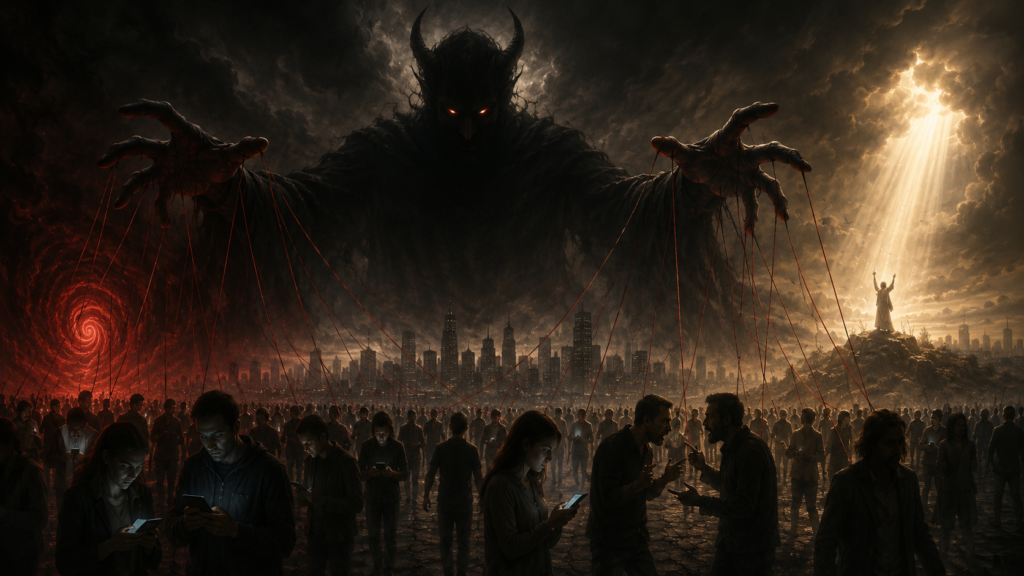
In many religious traditions, Satan is portrayed as an enemy of humanity—but this raises an important question: Why would a powerful spiritual being care so much about controlling human beings?
Why tempt them, deceive them, divide them, frighten them, and encourage them to turn against one another? Why not simply ignore humanity altogether?
Within Christian theology and broader spiritual interpretations, the answer is not merely that Satan enjoys evil. Control over humanity would serve several deeper purposes: rebellion against God, corruption of human potential, the harvesting of attention and devotion, and the transformation of free individuals into spiritually unconscious servants.
Humanity Represents Something Satan Cannot Possess
According to the biblical creation story, human beings were made in the image of God. This does not necessarily mean that humans physically resemble God. It suggests that humanity possesses qualities such as consciousness, creativity, moral choice, love, reason, and the ability to participate in spiritual growth.
Human beings can create civilizations, develop compassion, sacrifice themselves for others, forgive enemies, produce art, contemplate eternity, and consciously seek union with the divine.
If Satan represents separation from God, then humanity’s divine potential would naturally be offensive to him. Every person who awakens spiritually becomes evidence that creation can still return to its source.
Therefore, the battle is not simply over human behaviour. It is over what humanity may eventually become.
A spiritually mature humanity might be extremely difficult to control. People who understand themselves, discipline their desires, overcome fear, and recognize the sacredness of others are less vulnerable to manipulation.
From this perspective, Satan would not merely fear humanity as it currently exists. He would fear humanity’s unrealized potential.
Controlling Humanity Is a Way of Attacking God
If Satan cannot directly overthrow God, corrupting what God loves becomes an alternative form of rebellion.
This pattern can be understood through ordinary human psychology. Someone who hates another person may deliberately damage something that person treasures. The object itself may not be the true target. The goal is to cause pain to its owner.
Likewise, if humanity is loved by God, then degrading humanity becomes an indirect attack against the divine order.
Every war, betrayal, addiction, act of cruelty, and destruction of innocence can be interpreted as an attempt to vandalize creation. Satan’s victory would not necessarily require destroying the planet in one dramatic event. It could occur gradually by persuading human beings to destroy one another.
The most effective form of evil may therefore be one in which humanity performs the destruction itself while believing it is acting freely.
Free Will Makes Human Beings Valuable
Human beings are not portrayed as simple machines. They possess free will, which makes their choices spiritually meaningful.
Forced obedience has little moral value. Love only becomes meaningful when rejection is also possible. Courage matters because fear exists. Compassion matters because selfishness is an available choice.
For this reason, Satanic control is often depicted as temptation rather than direct physical domination. The goal is not merely to force a person into wrongdoing. It is to persuade the person to choose separation, selfishness, hatred, or spiritual blindness.
A human being who willingly betrays truth becomes more valuable to evil than someone who acts under obvious compulsion. Voluntary corruption turns the human will itself into an instrument of darkness.
This may explain why deception is such a central Satanic weapon. People are rarely tempted by something presented honestly as destruction. Evil must first be disguised as pleasure, justice, freedom, necessity, revenge, ambition, or self-expression.
The person must be made to believe that enslavement is liberation.
Satanic Control Works Through Desire
Traditional images show Satan offering wealth, power, pleasure, status, and forbidden knowledge. These temptations have one quality in common: they place the individual ego at the centre of existence.
Desire itself is not necessarily evil. People need food, companionship, achievement, and security. The danger appears when desire loses all boundaries and begins to control the person.
A person may initially use money, sexuality, technology, substances, ideology, or social status. Eventually, however, these things may begin using the person.
This reversal is one of the most effective forms of control because it feels voluntary. The individual continues pursuing the object while gradually sacrificing health, relationships, conscience, dignity, and freedom.
The chains remain invisible because they are decorated with pleasure.
From a spiritual perspective, Satan does not always need people to worship him consciously. It may be enough for them to worship appetite, attention, wealth, power, resentment, or the approval of strangers.
Whatever occupies the centre of a person’s consciousness can begin functioning as that person’s god.
Fear Makes Populations Easier to Control
Fear narrows perception. When people are frightened, they become more reactive, tribal, suspicious, and willing to surrender freedom in exchange for protection.
A fearful population is easier to divide and direct than a calm, spiritually grounded one.
This is why stories of evil frequently involve fear, paranoia, accusation, and the creation of enemies. Fear encourages people to stop seeing others as human beings and begin seeing them as threats, categories, or obstacles.
Once this occurs, cruelty becomes easier to justify.
Fear also disconnects individuals from their inner moral compass. Rather than acting from wisdom, they begin reacting to whatever authority, crowd, media source, or ideology promises safety.
If Satan seeks control, fear would be one of his most useful tools—not simply because suffering is produced, but because frightened people may willingly participate in systems that produce even more suffering.
Division Prevents Humanity From Recognizing Its Strength
Humanity possesses enormous collective power. People build cities, create technologies, establish cultures, share knowledge, and transform the planet through cooperation.
For a controlling force, this unity would present a threat.
Division therefore becomes essential. Humanity can be separated by nationality, race, religion, class, political identity, gender, generation, and countless other categories. Differences that could enrich civilization are instead turned into reasons for hatred.
The strategy is simple: convince people that their neighbour is the enemy while the true source of manipulation remains unseen.
A divided humanity wastes its energy fighting itself. Rather than confronting corruption, ignorance, poverty, or spiritual emptiness, people become consumed by symbolic conflicts and personal hostility.
Satanic intelligence, understood either literally or metaphorically, would not need to invent every conflict. It would only need to exaggerate existing wounds until reconciliation becomes impossible.
Attention May Function Like Spiritual Energy
Many spiritual traditions teach that attention has power. What people repeatedly think about begins shaping their inner world.
Attention strengthens emotions, beliefs, habits, and identities. A person who continuously feeds fear becomes more fearful. A person who continually feeds resentment becomes increasingly defined by resentment.
In this sense, control over human attention may be more important than control over the physical body.
If billions of people spend their lives focused on outrage, envy, humiliation, violence, anxiety, and endless comparison, then human consciousness becomes saturated with those energies.
This does not require formal devil worship. It only requires humanity to continually direct its mental and emotional power toward lower states of consciousness.
The struggle for humanity may therefore be, at least partly, a struggle for attention.
Whatever controls attention can influence thought. Whatever influences thought can shape behaviour. Whatever shapes behaviour can gradually shape civilization.
Satan Would Prefer Unconscious Servants
The most useful servant is one who does not know he is serving.
Few people consciously wake up and decide to promote evil. Most harmful systems are maintained by ordinary individuals who believe they are simply following rules, protecting their interests, obeying authority, doing their jobs, or acting like everyone else.
This is why spiritual sleep is so dangerous.
An unconscious person can be manipulated through pride, fear, lust, anger, insecurity, and group identity. Because the person does not recognize these forces within himself, he assumes his impulses are entirely rational and self-generated.
The individual may even believe he is morally superior while behaving destructively.
Satanic control would therefore depend less on dramatic possession and more on unconsciousness. A humanity that never examines its motives can be guided without realizing it.
Corrupting the Powerful Creates Wider Influence
Controlling every individual separately would be inefficient. It would be far more effective to influence people who already command institutions, governments, financial systems, religious organizations, media networks, or technologies.
When a powerful individual becomes consumed by greed, narcissism, paranoia, or domination, the consequences can spread through entire societies.
One corrupted ruler can send thousands to war. One dishonest institution can mislead millions. One destructive ideology can survive for generations.
This may explain why spiritual traditions repeatedly warn leaders about pride. Power magnifies both virtue and corruption.
The temptation of Christ in the wilderness includes an offer of worldly kingdoms. Symbolically, this suggests that political and social power can become a major channel of spiritual compromise.
Control the throne, and the influence reaches far beyond the person sitting upon it.
Satan Wants Humanity to Forget Its Spiritual Nature
Perhaps the deepest form of control is convincing people that they are nothing more than material organisms seeking temporary pleasure before death.
A person who believes life has no spiritual meaning may become easier to manipulate through consumption, status, fear of death, and immediate gratification.
Such a person may never ask whether the soul is being damaged, whether a choice serves a higher purpose, or whether consciousness continues beyond the body.
This does not mean that materialism automatically makes someone evil. Rather, a civilization that completely forgets the spiritual dimension may become vulnerable to treating people as products, statistics, labour units, consumers, or biological machines.
Once humanity forgets its sacred nature, exploitation becomes easier.
The person who knows he possesses spiritual dignity is less likely to accept total domination. The person who sees the divine spark in others is less likely to dehumanize them.
Spiritual memory is therefore a form of resistance.
Is Satan a Literal Being or a Symbol?
Different readers will interpret Satan differently.
Some understand Satan as a real spiritual intelligence actively opposing God and influencing humanity. Others interpret Satan psychologically, representing the ego, destructive desire, resentment, narcissism, and the human capacity for self-deception.
Others see Satan socially, as a symbol of systems that survive by exploiting fear, division, addiction, and unconscious obedience.
These interpretations do not necessarily cancel one another out. A spiritual force, psychological pattern, and social structure could reinforce each other.
Even for someone who does not believe in a literal devil, the concept remains useful. Humanity clearly faces forces that encourage domination, deception, cruelty, addiction, and the destruction of meaning.
The practical question becomes not merely whether Satan exists, but whether people can recognize the patterns traditionally associated with him.
How Humanity Resists Control
Resistance does not begin with obsession over demons. Constant fear of Satan can itself become another form of captivity.
The stronger response is spiritual clarity.
People resist manipulation when they cultivate self-awareness, discipline, compassion, courage, truthfulness, and control over their own attention. Prayer, meditation, ethical living, community, forgiveness, and honest self-examination can all reduce the influence of fear and unconscious desire.
The person who understands his own shadow is harder to tempt through it.
The person who can tolerate discomfort is harder to control through pleasure.
The person who accepts mortality is harder to control through fear.
The person who does not crave approval is harder to control through shame.
The person who recognizes the humanity of opponents is harder to recruit into hatred.
This may be why so many spiritual teachings emphasize mastery of the self. The greatest battlefield is not a distant supernatural realm. It is the human mind and heart.
Conclusion
Satan’s interest in humanity can be understood as a struggle over divine potential, free will, attention, and the direction of civilization.
Human beings are valuable precisely because they can choose. They can descend into cruelty, but they can also rise into wisdom. They can become servants of appetite and fear, or they can consciously align themselves with truth, love, and spiritual freedom.
From this perspective, Satan does not need every person to become openly evil. He only needs humanity to remain divided, distracted, frightened, addicted, and unaware of its own sacred potential.
The ultimate form of rebellion against such control is not merely condemning evil outside ourselves. It is recognizing the places where fear, pride, resentment, and unconscious desire already operate within us.
Humanity becomes difficult to control when it awakens.