
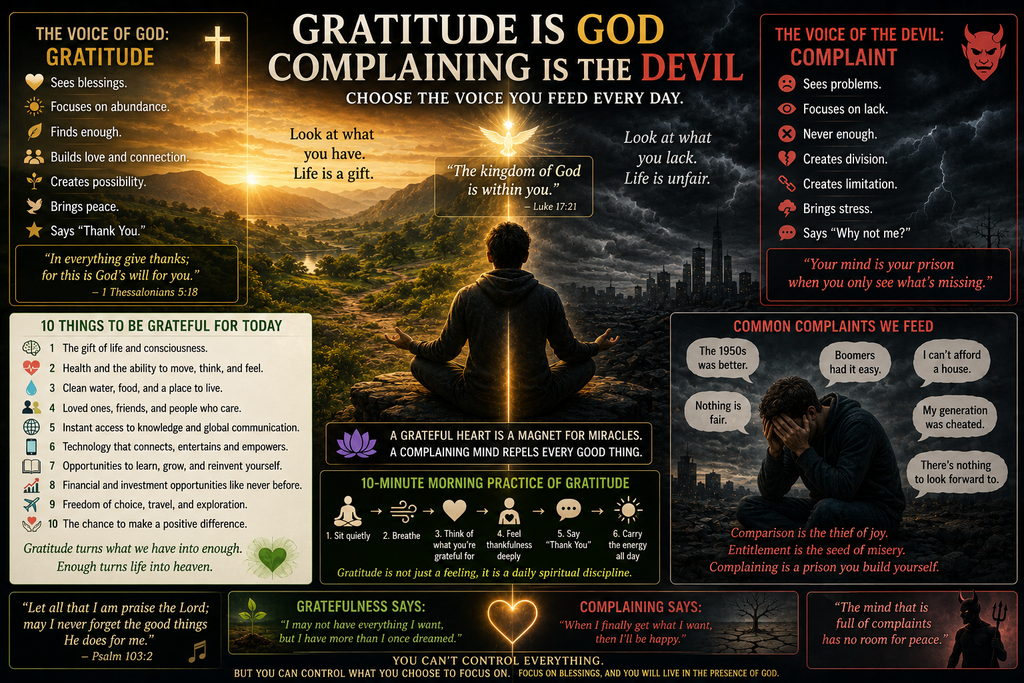
What if one of the simplest ways to understand the spiritual battle between God and the Devil is not through complicated theology, but through two everyday states of mind?
Gratitude and complaint.
Gratitude says:
“Look at everything I have been given.”
The darker voice says:
“Look at everything you are still missing.”
Gratitude notices existence itself.
Complaint notices the gap between reality and desire.
Gratitude says life contains gifts before we have accomplished anything.
The complaining mind says life owes us something more before we can finally be satisfied.
This distinction crosses religious boundaries.
A Christian may call gratitude thanksgiving to God.
A Muslim may understand it through shukr—gratitude toward Allah.
A Hindu may see existence as divine manifestation.
A Buddhist may not necessarily speak of a creator God at all, yet still recognize that craving and dissatisfaction keep human beings trapped in suffering.
Different metaphysical systems can therefore arrive at a remarkably similar practical insight:
A mind that continually recognizes what is present becomes peaceful. A mind that continually searches for what is missing can remain miserable no matter how much it receives.
Perhaps gratitude itself is one of humanity’s most universal forms of worship.
Before You Ask God for Anything, Notice What Has Already Been Given
Prayer often begins with requests.
Help me.
Give me.
Protect me.
Fix this.
Make this happen.
There is nothing inherently wrong with asking for help. Human beings naturally turn toward the divine in moments of uncertainty.
But imagine beginning somewhere deeper.
Before asking God for another thing, notice what already had to occur for you to make the request.
You are conscious.
You can think.
You can form concepts.
You can evaluate your life.
You can remember the past.
You can imagine the future.
You can experience beauty.
You can ask whether God exists.
Even the ability to doubt God is dependent upon the extraordinary gift of consciousness.
That fact alone can become an object of gratitude.
The person praying:
“God, why haven’t you given me more?”
is already using an astonishing mind with which to make the complaint.
Perhaps one of the strangest characteristics of human beings is that we can receive consciousness itself and immediately use that consciousness to catalogue everything else we believe we should have received.
Gratitude May Be the Simplest Way to Touch God
Suppose someone sits quietly each morning for ten minutes and deliberately thinks about what they are grateful for.
Not because their life is perfect.
Not because they have no problems.
But simply because they decide to notice.
A warm home.
Clean water.
Food.
A functioning body.
A friend.
A family member.
A sunrise.
Music.
A computer.
The ability to read.
A peaceful morning.
Another twenty-four hours of life.
Something interesting begins to happen.
Attention moves away from scarcity.
The mind stops asking:
“What is missing?”
and begins asking:
“What has been given?”
If you believe in God, that shift can become prayer without words.
You do not have to ask for anything.
You simply notice creation and say internally:
Thank you.
That may be one of the purest religious acts possible.
Gratitude Is Worship Without a Building
Religions create temples, churches, mosques, shrines, monasteries, rituals, songs and prayers.
These structures can be beautiful.
But gratitude requires none of them.
You can practise it:
In bed.
On the subway.
Walking outside.
While eating breakfast.
During a difficult day.
You can have no formal theological education whatsoever and still experience the sacredness of being alive.
Perhaps that makes gratitude a kind of universal religion.
Its scripture is experience.
Its prayer is thankfulness.
Its temple is consciousness.
Its ritual is noticing.
Its offering is appreciation.
What Would the Devil Want?
If we use Satan or the Devil symbolically as the force that separates human beings from peace, God, truth and appreciation, then his strategy would be remarkably simple.
He would not necessarily have to take everything away from you.
He would merely have to convince you that whatever you have is insufficient.
You receive something.
Immediately compare it with something better.
You earn more money.
Notice the person earning twice as much.
You buy a home.
Notice the larger home.
You find a partner.
Notice someone more attractive.
You become healthy.
Fear aging.
You gain free time.
Become bored.
You have hundreds of entertainment choices.
Complain that nothing is interesting.
The Devil does not always need to create misery directly.
He can teach the mind to manufacture misery from abundance.
Satan’s Favorite Sentence Might Be: “Not Enough”
Not attractive enough.
Not wealthy enough.
Not respected enough.
Not successful enough.
Not young enough.
Not popular enough.
Not loved enough.
Not entertained enough.
Not free enough.
The object continually changes.
The structure remains identical.
Something is missing, and until you obtain it, you cannot be at peace.
Then you obtain it.
For a few days or months there is satisfaction.
Soon the mind adapts.
A new deficiency appears.
The cycle restarts.
This resembles the Buddhist analysis of craving remarkably well.
Buddhism Calls the Problem Craving
Buddhism does not need a Devil to explain this pattern.
It describes tanha—craving—as one of the central mechanisms producing suffering.
The mind says:
I want this.
I don’t want that.
I want more.
I want this experience to continue.
I want that uncomfortable experience to disappear.
The problem is not simply having preferences.
The problem is when peace becomes conditional upon reality satisfying the endless demands of desire.
This is why Buddhist liberation can sound surprisingly similar to radical gratitude.
Nirvana is not merely receiving everything you ever wanted.
It represents release from the compulsive mechanism that keeps generating new wants.
The ordinary mind says:
“When I finally get enough, I will become satisfied.”
Spiritual wisdom asks:
“What if satisfaction begins when the demand for ‘enough’ loosens?”
Life May Already Contain More Than the Mind Notices
This does not mean life is objectively perfect.
War exists.
Poverty exists.
Loneliness exists.
Housing costs can be difficult.
People become sick.
Relationships fail.
Some generations genuinely face different economic circumstances than earlier generations did.
Gratitude should not become denial.
But there is an enormous difference between acknowledging a problem and constructing an identity around dissatisfaction.
You can say:
“Housing is less affordable for many people than it was for some previous generations.”
That is an observation.
Then another thought can appear:
“Therefore my entire generation has been cheated, modern life is terrible, and there is almost nothing to appreciate.”
That conclusion is much larger than the original fact.
The first statement may encourage adaptation.
The second can become a worldview.
Complaint Can Become a Religion Too
People can practise complaining the same way another person practises meditation.
Every morning:
What’s wrong?
Who’s responsible?
Who had it easier?
What am I missing?
Why is society unfair?
Why doesn’t anyone understand?
Why can’t I have what previous generations had?
Repeat this every day and the mind becomes extremely skilled at finding evidence of deficiency.
The person may eventually receive ten good things and one bad thing.
Attention immediately moves toward the bad thing.
That is not necessarily because life is terrible.
It may be because the mind has been trained.
Complaint has become its meditation practice.
The Boomer Comparison
One common modern complaint is that previous generations supposedly received an easier economic deal.
A person might say:
“My grandparents could buy a house on one income. I can’t.”
In some places and circumstances, housing affordability really has deteriorated dramatically.
That deserves serious discussion.
But historical comparison becomes distorted when we imagine the past only through the advantages it possessed.
Previous generations also lived without many things modern people consider normal.
No smartphones.
No video calling.
No streaming libraries.
No instant access to global knowledge.
No modern online banking.
No remote digital work.
No inexpensive communication with people around the world.
Far fewer medical treatments.
Far less convenient international travel.
No GPS navigation.
No search engines.
No global online marketplaces.
No VR social worlds.
Very limited access to entertainment compared with today.
The correct question is therefore not:
“Was the past better or worse?”
It is:
“What advantages did they have, what advantages do we have, and how can I intelligently use the conditions available to me?”
That is a much more empowered question.
A House Is Not the Only Form of Wealth
Modern societies often inherited an older definition of adulthood:
Get a job.
Buy a house.
Marry.
Accumulate possessions.
Retire.
There is nothing wrong with this path.
But technology has created entirely new forms of wealth that are less visible.
Access.
Mobility.
Information.
Entertainment.
Connection.
Education.
Investment tools.
Creative tools.
Software.
Global markets.
A person who cannot yet purchase a detached house may nevertheless possess forms of power that a wealthy person in 1950 could barely imagine.
A phone in your pocket can provide:
A global library.
A camera.
Navigation.
International communication.
A brokerage account.
Language learning.
A music studio.
A video-editing system.
A marketplace.
A business platform.
Entertainment.
Dating.
Education.
Artificial intelligence.
A person from the past might interpret this single device as almost supernatural.
Yet after owning it for six months, we complain that the battery does not last long enough.
That is hedonic adaptation in miniature.
We Are Surrounded by Miracles That Became Appliances
Human beings adapt quickly to extraordinary things.
Electricity was miraculous.
Now we become irritated when the Wi-Fi takes five seconds to reconnect.
Air conditioning would have been extraordinary luxury throughout most of human history.
Now people complain that the room is two degrees too warm.
Running hot water is one of civilization’s greatest conveniences.
We barely notice it.
Refrigeration radically transformed food preservation.
We treat the refrigerator as background furniture.
Commercial aviation allows ordinary people to cross an ocean in hours.
We complain about legroom.
The problem is not that these complaints are always illegitimate.
The problem is that familiarity can erase wonder.
Gratitude restores it.
Virtual Reality Is an Extraordinary Example
Consider virtual reality.
You can put on a headset in your home and suddenly enter a shared three-dimensional environment with someone living thousands of kilometres away.
You can:
Play pool.
Talk.
Explore imaginary worlds.
Practise a foreign language.
Watch movies together.
Attend events.
Meet people from countries you have never visited.
Twenty or thirty years ago, this would have sounded like science fiction.
Today someone can spend an evening in VRChat and think:
“There’s nothing to do.”
That sentence demonstrates how quickly consciousness adapts.
Technology cannot permanently defeat loneliness by itself.
But it can radically increase the opportunities available for human connection.
The grateful mind notices the opportunity.
The complaining mind notices the limitation.
Loneliness Has Changed
Previous generations often had stronger local communities in certain respects.
Modern digital life can also create isolation.
Both are true.
But technology has simultaneously made it possible to find people based upon incredibly specific interests.
Imagine someone living in a small town fifty years ago who loved:
A rare language.
A niche philosophy.
An obscure game.
A specialized musical genre.
A particular spiritual tradition.
They might know nobody locally who shared the interest.
Today they can find an entire community in minutes.
The internet did not eliminate loneliness.
It created tools through which we can potentially fight it.
The difference often lies in how consciously those tools are used.
Modern Life Gives Us New Ways to Create Opportunity
Financial opportunity has also changed.
Owning a house was historically one of the most important wealth-building mechanisms for ordinary families.
It remains important.
But today people can also access markets directly from their phones.
Stocks.
ETFs.
Bonds.
Businesses.
Crowdfunding.
Digital assets such as Bitcoin.
Online marketplaces.
Affiliate businesses.
Remote businesses.
Digital products.
A person should obviously understand risk before investing, and none of these guarantees wealth.
The important point is access.
Investment tools once available primarily through specialized intermediaries are now accessible to ordinary people almost instantly.
That is a form of economic power previous generations generally did not possess in the same way.
Gratitude does not say:
“Everything about the economy is wonderful.”
It says:
“Given the economy I actually inhabit, what opportunities exist that I might be overlooking?”
That is an entirely different mental orientation.
Gratitude Creates Agency
This is where gratitude connects with karma and personal responsibility.
The complaining mind sees only constraints.
The grateful mind notices resources.
Suppose two people face exactly the same difficulty.
One says:
“This is unfair. Someone should have made this easier.”
The other says:
“This is difficult. What do I still have available?”
The second person may notice:
A skill.
A friend.
Internet access.
Time.
A small amount of savings.
A free course.
AI tools.
A marketplace.
An unused room.
A language ability.
A community.
A contact.
None of these automatically solves the problem.
But gratitude makes resources visible.
Complaint can make them psychologically invisible.
The Devil Wants You Looking at the Empty Space
Imagine a page that is 95 percent full.
The complaining mind finds the empty five percent.
Then it zooms in until that empty space fills consciousness.
You forget the rest of the page exists.
This is how someone can be:
Healthy.
Safe.
Fed.
Educated.
Connected.
Entertained.
Free to travel.
Able to communicate globally.
And still wake up feeling fundamentally deprived.
The deprivation may exist almost entirely inside comparison.
Someone else has more.
Therefore what I have becomes worthless.
This is one reason envy is so destructive spiritually.
It converts another person’s blessing into evidence against your own.
Social Media Industrialized Comparison
Human beings have always compared themselves.
Social media changed the scale.
Previously, you might compare yourself with:
A sibling.
A neighbour.
A coworker.
Someone at school.
Now you can compare yourself with the most beautiful, wealthy, athletic, successful and interesting people among billions.
Your ordinary Tuesday afternoon competes against everybody else’s highlight reel.
The result can be manufactured insufficiency.
Your apartment seems small.
Your vacation seems boring.
Your relationship seems ordinary.
Your career seems unimpressive.
Your face seems imperfect.
Your life seems slow.
Nothing changed physically.
The comparison changed.
This is almost perfectly aligned with the spiritual principle of temptation:
You were content until someone showed you something you did not have.
The Garden of Eden Is Almost a Story About This
Consider the symbolic structure of the Garden of Eden.
Adam and Eve already inhabit paradise.
They possess abundance.
Yet attention becomes fixated upon one prohibited thing.
Everything available becomes psychologically less important than the single thing missing.
That is an extraordinary metaphor for human dissatisfaction.
The serpent does not need to destroy paradise.
It only needs to redirect attention.
Look here.
Look at what you cannot have.
Wouldn’t you be better if you had this too?
Suddenly abundance feels like deprivation.
Whether interpreted literally or symbolically, the story captures something fundamental about human psychology.
The Devil’s great trick may be making paradise feel incomplete.
Ten Things Modern People Can Be Grateful For
1. Instant Access to Human Knowledge
A person with an internet connection can study almost any subject:
Programming.
History.
Languages.
Religion.
Mathematics.
Car repair.
Music.
Psychology.
Investing.
Meditation.
For most of history, knowledge was limited by geography, wealth, literacy and access to institutions.
Today extraordinary amounts are immediately available.
2. Global Communication
You can communicate almost instantly with someone across the planet.
Video.
Voice.
Text.
Photos.
Group conversations.
Humanity has never possessed this degree of ordinary interpersonal reach before the modern telecommunications era.
3. Modern Medicine
Many illnesses and injuries that once killed or permanently disabled people can now be treated.
Antibiotics.
Vaccines.
Emergency surgery.
Imaging.
Anaesthesia.
Trauma care.
Modern dentistry.
Even routine medical interventions represent an enormous historical privilege.
4. Endless Affordable Entertainment
Music libraries.
Movies.
Television.
Games.
Books.
Podcasts.
YouTube.
Virtual worlds.
A modern person can access more entertainment from a bedroom than many historical kings could experience in an entire lifetime.
Whether that entertainment is used wisely is another question.
But the abundance itself is remarkable.
5. Virtual Social Worlds
VRChat and other online spaces allow people to interact with others around the world as though sharing a social environment.
You can play games together, explore virtual places, attend gatherings and practise languages.
The technology remains imperfect.
Its existence is still extraordinary.
6. Language Learning
Translation tools, language apps, video calls and international communities make foreign-language practice dramatically easier.
A motivated person can regularly speak with native speakers without leaving home.
For someone living several generations ago, this might have required international travel or access to rare teachers.
7. Investment Access
Ordinary people can open brokerage accounts and access financial markets with unprecedented convenience.
This comes with risk and requires knowledge.
But the barrier to participation has changed enormously.
8. Creative Power
One person with a laptop can now produce:
Music.
Films.
Books.
Video games.
Websites.
Illustrations.
Software.
Podcasts.
Businesses.
Previous generations often required studios, publishers, factories or expensive equipment to accomplish similar things.
9. Geographic Freedom
Modern transportation allows people to move between cities and countries with speed that would have been unimaginable through most of history.
A trip that once required months can now occur in hours.
10. The Ability to Build Your Own Community
If you cannot find people who understand you locally, you can search globally.
Spiritual communities.
Gaming groups.
Professional networks.
Language exchanges.
Car communities.
Creative circles.
Support groups.
Friendships.
The opportunity to find “your people” has expanded dramatically.
Again, opportunity is not the same as guaranteed connection.
But opportunity matters.
Gratitude Does Not Mean Settling for Less
A common objection is:
“If I’m grateful, won’t I become complacent?”
No.
Gratitude and ambition can coexist.
You can say:
“I appreciate my current home, and I want a larger one.”
“I appreciate my income, and I want to build more wealth.”
“I appreciate my health, and I want to become stronger.”
“I appreciate my relationships, and I want deeper connections.”
The difference is psychological.
Ungrateful ambition says:
“My current life is unacceptable until I achieve the next goal.”
Grateful ambition says:
“Life is already meaningful, and I am excited to improve it.”
One creates desperation.
The other creates growth.
Gratitude Is Not Passivity
There are times when complaint is necessary.
Workers should be able to identify unfair conditions.
Citizens should criticize corruption.
People should speak about unaffordable housing.
Patients should report mistreatment.
Partners should communicate dissatisfaction.
Silence is not always spiritual.
The important distinction is between constructive complaint and habitual complaining.
Constructive complaint says:
“There is a problem. What action could improve it?”
Habitual complaint says:
“There is a problem, and repeatedly describing how bad it is has become my identity.”
One generates action.
The other often generates emotional stagnation.
The Devil Is Not Criticism
If we use the Devil metaphorically, we should not confuse darkness with recognizing reality.
Sometimes gratitude culture becomes toxic:
“You should be grateful you have a job.”
“You should be grateful your relationship isn’t worse.”
“You should be grateful you have anything.”
This can be used to prevent legitimate change.
That is not healthy gratitude.
Gratitude should expand awareness, not suppress it.
You can be grateful and demand improvement.
The spiritual danger begins when dissatisfaction becomes endless even after circumstances improve.
Complaining Can Become Addictive
Complaining provides psychological rewards.
Attention.
Agreement.
Social bonding.
Moral superiority.
Excitement.
A sense of identity.
Two strangers can become friends rapidly by discovering something they both hate.
Complaining therefore creates its own community.
But there is a price.
When complaining becomes a primary bonding mechanism, negativity becomes socially useful.
If you become happier, you may even feel disconnected from the group.
The grievance has become the glue.
This is why some communities appear almost invested in remaining angry.
Without the anger, what would they talk about?
Gratitude Changes What You Notice
Suppose you begin each morning with ten minutes of gratitude.
At first you may list obvious things.
Family.
Health.
Home.
Food.
Then, over time, attention becomes more sensitive.
You notice:
The temperature of the shower.
The coffee.
A song.
Morning sunlight.
Your legs carrying you.
A funny conversation.
A useful piece of software.
The ability to breathe comfortably.
A comfortable chair.
The quietness of your home.
The practice changes perception.
You are not artificially inventing positive things.
You are noticing things that were already there but previously invisible to attention.
This is why gratitude resembles meditation.
Both train awareness.
Gratitude Is a Rebellion Against Hedonic Adaptation
Human beings adapt rapidly to improvements.
You get the thing you wanted.
For a while it feels wonderful.
Then it becomes normal.
The miracle becomes furniture.
Gratitude deliberately reverses this process.
It takes the familiar and makes it visible again.
A bed.
A refrigerator.
A phone.
A friend.
A functioning hand.
The ability to read this sentence.
You look again.
The ordinary becomes extraordinary.
Perhaps spirituality itself is partly the ability to see ordinary existence without becoming numb to it.
The Eucharist Literally Means Thanksgiving
There is an interesting Christian connection.
The word Eucharist derives from Greek terminology connected with thanksgiving.
At the heart of Christian worship is therefore an act of gratitude.
Christ takes bread and gives thanks.
The spiritual movement begins not with:
“Why is this not better?”
but with:
“Thank you for what has been given.”
Christianity at its healthiest contains gratitude at its centre.
Islam Makes Gratitude a Spiritual Obligation
Islam similarly places enormous emphasis on gratitude to Allah.
The believer is repeatedly encouraged to recognize blessings rather than treat them as personally manufactured entitlements.
Life.
Provision.
Knowledge.
Family.
Guidance.
The ability to worship.
The spiritual principle is the same:
Recognize the source of what you have.
Entitlement says:
“Of course I deserve this.”
Gratitude says:
“This could have been otherwise.”
That single realization changes the emotional texture of life.
Buddhism Removes God but Keeps the Practice
Buddhism provides an interesting comparison because gratitude does not need to depend on a creator.
A Buddhist can be grateful for:
Human birth.
Teachers.
The Dharma.
Health.
Food.
Friendship.
Opportunities for practice.
The temporary conditions making awakening possible.
The emphasis remains on seeing what is actually present rather than endlessly feeding craving.
This suggests gratitude may be deeper than any single theology.
Perhaps it is a fundamental orientation of consciousness.
Gratitude and the Heart Chakra
In chakra symbolism, gratitude is naturally associated with the heart chakra, Anahata.
The heart opens when we appreciate.
Resentment contracts.
Envy contracts.
Entitlement contracts.
Gratitude expands.
This does not mean the physical heart chakra has been scientifically measured as an energy organ.
But the symbolism captures subjective experience well.
Think of something you sincerely appreciate.
Notice the body.
The chest may soften.
Breathing changes.
The face relaxes.
Attention becomes less defensive.
Gratitude feels expansive.
That is one reason gratitude can feel like contact with God.
The Devil Lives in Comparison
Perhaps there is an easy formula:
Gratitude compares reality with nothing.
Complaint compares reality with an imagined alternative.
“I have a home.”
becomes:
“My home is smaller than theirs.”
“I have food.”
becomes:
“This meal isn’t as good as the restaurant.”
“I have friends.”
becomes:
“They have more friends.”
“I can travel.”
becomes:
“I can’t travel business class.”
Every blessing can be destroyed psychologically through comparison.
The object did not change.
Attention did.
A Daily Ten-Minute Religion of Gratitude
A simple morning practice could become a complete spiritual exercise.
For ten minutes, think of things you are grateful for.
But go beyond obvious items.
Minute 1: The Body
Thank your eyes.
Hands.
Legs.
Heart.
Lungs.
Brain.
Even imperfect functioning deserves recognition.
Minute 2: Consciousness
You can think.
Remember.
Imagine.
Create.
Reflect.
Minute 3: Basic Comfort
Shelter.
Water.
Food.
Heat.
Electricity.
Safety.
Minute 4: Relationships
Family.
Friends.
Teachers.
People who helped you.
Minute 5: Modern Civilization
Medicine.
Internet.
Transportation.
Technology.
Libraries.
Minute 6: Opportunities
Work.
Investments.
Learning.
Creativity.
Travel.
Minute 7: Entertainment and Beauty
Music.
Games.
Films.
Nature.
Art.
Minute 8: Difficult Experiences
What suffering taught you.
What mistakes revealed.
What losses strengthened.
Minute 9: Today
What can happen today that could not happen if you had not awakened this morning?
Minute 10: Silence
Stop listing.
Simply feel:
Thank you.
Whether that gratitude is directed toward God, Allah, the universe, life itself, or simply existence depends upon your spiritual framework.
The inner movement remains similar.
Gratitude Can Turn Ordinary Life Into Heaven
People often imagine heaven as a place where nothing is missing.
But suppose the fundamental problem is not the world.
Suppose it is the mind’s capacity to continually invent something missing.
Then even heaven could become boring after enough time.
The human mind would eventually ask:
Is there another section?
Can I upgrade?
Why is their cloud larger?
That sounds humorous, but it reveals something serious.
If dissatisfaction is internal, changing circumstances will never permanently solve it.
Gratitude therefore becomes training for heaven.
It teaches consciousness how to experience sufficiency.
Complaint Can Turn Heaven Into Hell
The opposite is equally true.
Give someone almost everything.
If they continually compare upward, their consciousness can still become hellish.
A wealthy person can live in envy.
A beautiful person can obsess over flaws.
A popular person can fear losing relevance.
A healthy person can fear disease.
A free person can focus entirely upon inconvenience.
This is why spiritual traditions repeatedly insist that paradise and hell have internal dimensions.
Circumstances matter.
But consciousness interprets circumstances.
Creating Your Own Luck Through Gratitude
Gratitude can even have practical consequences.
A grateful person often notices opportunity because they are not mentally paralysed by resentment.
They ask:
What can I use?
Who can I learn from?
What resources exist?
What is going well?
What can I build from here?
That mindset produces action.
Action produces different probabilities.
Eventually outsiders may call the result luck.
The person says:
“I simply kept using what was available.”
This is where gratitude connects with karma.
Gratitude sees the seeds.
Karma plants them.
The Devil Wants Helplessness
The complaining worldview often leads toward helplessness:
The economy ruined everything.
My generation was cheated.
Technology destroyed relationships.
Dating is impossible.
Housing is impossible.
Nobody can get ahead.
Everything used to be better.
Some of these complaints can contain partial truths.
But when they become absolutes, they remove agency.
The grateful approach asks:
Given the world as it actually exists, what can I do?
Can I live differently?
Invest differently?
Work remotely?
Build online?
Move?
Learn something?
Use AI?
Find community internationally?
Create instead of consume?
The answer will not always be easy.
But gratitude keeps the door of possibility open.
Gratitude Is Not Ignorance of Suffering
A person can be grateful and still mourn.
Grateful and angry about injustice.
Grateful and financially stressed.
Grateful and lonely.
Grateful and sick.
The practice does not require pretending pain is absent.
It prevents pain from becoming the only thing visible.
Imagine standing in a dark room with one candle.
Gratitude does not claim the darkness disappeared.
It says:
There is also light here.
That may be enough to help you find the door.
Perhaps God and the Devil Compete for Attention
One way to interpret spiritual warfare is as a battle over what consciousness continually notices.
God says:
Look at existence.
Look at love.
Look at beauty.
Look at possibility.
Look at what you can give.
Look at what you have received.
The Devil says:
Look at what is missing.
Look at what they have.
Look at what you deserve.
Look at how you were cheated.
Look at why you should be angry.
Look at why nothing is enough.
Both voices can operate inside the same human mind.
Which one becomes louder depends partly upon which one is practised.
Conclusion: Gratitude May Be One of the Purest Forms of Religion
Perhaps religion does not begin with doctrine.
Perhaps it begins with a response to existence.
You wake up.
You become conscious.
You breathe.
You see light.
You remember who you are.
Another day exists.
Before theology, before ambition, before complaints, there is one astonishing fact:
You are here.
Gratitude looks at that fact and says:
Thank you.
The darker mind responds:
Yes, but what else am I getting?
That may be one of the simplest ways to understand the spiritual distinction between God and the Devil.
God represents abundance, connection, love, creation and recognition of the gift.
The Devil represents endless insufficiency:
More.
More.
More.
Never enough.
This does not mean we should stop improving society.
It does not mean housing affordability does not matter.
It does not mean suffering should be ignored.
It means improvement should begin from consciousness rather than resentment.
You can want a better future while remaining grateful for the present.
You can acknowledge the advantages previous generations possessed while recognizing extraordinary advantages available today.
You can build wealth while enjoying what you already own.
You can seek deeper relationships while appreciating the people already present.
You can improve your life without declaring your current life a failure.
And perhaps that is the deepest spiritual lesson.
Heaven is not necessarily the moment when God finally gives you everything you desire.
Heaven may begin when you recognize how much has already been given.
Hell may not begin when everything is taken away.
It may begin when the mind becomes incapable of experiencing anything as enough.
So every morning, before asking what the world owes you, ask something simpler:
What has life already given me that I forgot to notice?
Spend ten minutes answering that question.
Do it every day.
Over time, you may discover that gratitude does more than improve your mood.
It changes which spiritual voice you hear.