
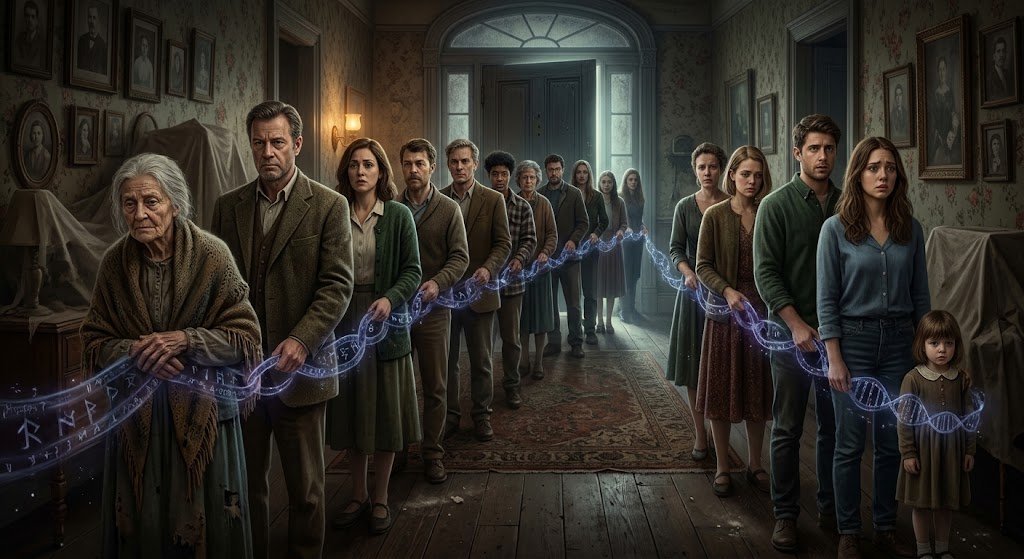
Across cultures, people have noticed something disturbing about families:
The same problems sometimes seem to repeat.
A grandfather was alcoholic.
His son becomes alcoholic.
A granddaughter avoids alcohol completely—but repeatedly enters relationships with addicted partners.
One generation loses everything through reckless financial decisions.
The next rebuilds wealth, only for another generation to repeat the same impulsive behaviour.
A grandmother endured an abusive marriage.
Her daughter enters another controlling relationship.
The granddaughter promises herself she will never tolerate such treatment—yet somehow finds herself recreating a different version of the same dynamic.
Families may repeatedly experience:
Addiction.
Abandonment.
Violence.
Debt.
Broken marriages.
Estrangement.
Fear.
Anger.
Infidelity.
Self-sabotage.
Unexplained shame.
Conflict around money.
Parents emotionally abandoning children.
Children eventually abandoning parents.
The pattern can become so repetitive that people begin saying:
“Our family is cursed.”
But what exactly would a family curse mean?
Is an invisible spiritual force literally following a bloodline?
Is God punishing descendants for something their ancestors did?
Is negative karma moving through generations?
Are ancestral spirits involved?
Or are apparently supernatural family curses often understandable through psychology, learned behaviour, trauma, culture, biology and repeated choices?
Perhaps the most useful answer is that a family curse can operate on several levels simultaneously.
There may or may not be a supernatural component—we do not currently have scientific evidence capable of establishing that.
But families unquestionably transmit patterns across generations.
They transmit genes.
Beliefs.
Trauma.
Money habits.
Relationship models.
Secrets.
Fear.
Religion.
Coping strategies.
Expectations.
Attachment styles.
Social environments.
Definitions of masculinity and femininity.
Ideas about what people like “us” deserve.
Even when nobody deliberately teaches these things, children absorb them.
A family curse may therefore be understood spiritually as unresolved energy repeating through a lineage until someone becomes conscious enough to interrupt it.
Psychology might use different language.
But sometimes it describes something remarkably similar.
The Family Is an Energy System
A child is not born into an empty environment.
They enter a system that already existed before them.
Perhaps their father distrusts everyone.
Why?
His father betrayed him repeatedly.
The child does not know that history.
They simply grow up around a father who teaches:
“Never depend on anybody.”
The child absorbs the rule.
Thirty years later they struggle to build intimacy.
They believe:
“That’s just my personality.”
But the pattern may have begun before they were born.
This is one reason family curses can feel mysterious.
The visible behaviour exists in the present.
The original cause may belong to someone who died decades ago.
The Curse Often Begins as Survival
One of the most important ideas in understanding generational patterns is this:
Many family curses begin as adaptations that originally made sense.
Imagine a family surviving severe poverty.
The grandparents learn:
Never waste food.
Never spend unnecessarily.
Never trust financial institutions.
Save everything.
Work constantly.
Those habits may have helped them survive.
Their children inherit the same mentality.
But the circumstances change.
Now the family has enough money.
Yet anxiety remains.
The next generation may experience:
Extreme scarcity thinking.
Fear of spending.
Guilt when enjoying anything.
Workaholism.
Conflict around money.
The original behaviour was not irrational.
It was adaptive.
The problem is that the adaptation survived longer than the environment that created it.
The protection became the curse.
Trauma Can Travel Through Behaviour
Suppose a man grows up with an emotionally unavailable father.
He experiences:
Little affection.
No emotional conversations.
Constant criticism.
High expectations.
He decides:
“I will never be like my father.”
Then he has children.
He provides materially.
Never hits them.
Works extremely hard.
Yet when his child begins crying, he feels uncomfortable.
Nobody taught him how to respond emotionally.
So he says:
“Stop crying.”
“Be strong.”
“There’s nothing wrong.”
The behaviour is less severe than what he experienced.
But part of the original wound still travels forward.
The child grows up feeling emotionally unseen.
Nobody consciously chose to transmit the trauma.
It moved through the family because unhealed people tend to reproduce what has become normal to their nervous system.
This is one of the clearest non-supernatural mechanisms behind a generational curse.
Science Recognizes Intergenerational Trauma
Modern psychology increasingly recognizes that the effects of trauma can extend beyond the person who directly experienced the original event.
Children can be affected by parental trauma through caregiving, family dynamics, stress, attachment, emotional availability and the broader environment created around the traumatic experience.
Recent research describes intergenerational trauma as involving interacting psychological, social and biological pathways rather than one simple mechanism.
For example, parents carrying severe unresolved trauma may become:
Hypervigilant.
Emotionally withdrawn.
Overprotective.
Explosive.
Inconsistent.
Fearful.
Controlling.
Unable to discuss particular subjects.
Their children then develop in response to that environment.
The children may never experience the original war, abuse, displacement or catastrophe.
Yet they grow up inside the emotional aftershock.
That is strikingly similar to the traditional idea that something can continue moving through a bloodline after the original event has passed.
What About Epigenetics?
This is where discussion of “ancestral trauma” sometimes becomes exaggerated.
Epigenetics studies biological processes that affect how genes are regulated without changing the underlying DNA sequence.
Researchers have found evidence that severe stress and trauma can be associated with epigenetic changes.
Animal research provides particularly strong evidence for some intergenerational biological effects.
Human evidence is much more complicated.
Researchers have warned that although parental trauma clearly can affect children, scientists cannot yet confidently attribute human intergenerational trauma to a single inherited epigenetic mechanism.
A 2026 review similarly concludes that multigenerational trauma appears to involve interacting biological and psychosocial processes—including stress regulation, caregiving environments and epigenetic variation—but significant limitations remain in the evidence.
So it would be inaccurate to say:
“Your ancestor’s trauma permanently rewrote your DNA and that is your family curse.”
Science does not support such a simple claim.
But it is increasingly clear that the boundary between family experience and biology is more complicated than people once assumed.
The environment gets under the skin.
Family Curses Can Move Through Stories
Families continually tell stories about themselves.
“We’re unlucky.”
“Men in this family always leave.”
“Women in this family always choose bad men.”
“Nobody in our family can keep money.”
“We have terrible tempers.”
“Our family is cursed in relationships.”
“We always get betrayed.”
“We’re not business people.”
“People like us don’t become wealthy.”
These statements appear descriptive.
But they can become instructions.
A child hears them repeatedly.
Eventually they become part of identity.
Then something subtle happens.
The person begins noticing experiences that confirm the story.
Contradictory evidence receives less attention.
The family mythology becomes self-reinforcing.
This is one way a curse can operate almost like a spell.
Not because words magically force reality to obey them.
But because repeated language shapes perception, expectation and behaviour.
Expectations Can Become Self-Fulfilling
Imagine a teenager repeatedly hearing:
“All men cheat.”
She enters adulthood already expecting betrayal.
This expectation may cause her to:
Distrust.
Monitor.
Test partners.
Choose emotionally unavailable people because they feel familiar.
Interpret ambiguity as betrayal.
Stay attracted to high-drama relationships.
Perhaps she eventually experiences infidelity.
Now the family belief seems confirmed.
She tells her daughter:
“See? Men always cheat.”
The curse moves another generation.
The original statement may have contained genuine family experience.
But the belief itself became part of the mechanism reproducing the pattern.
Children Learn What Love Looks Like Before They Can Define Love
This is particularly important in romantic relationships.
Children do not learn love first from books.
They observe it.
Does love look like:
Respect?
Fear?
Silence?
Jealousy?
Sacrifice?
Control?
Warmth?
Fighting?
Avoidance?
Criticism?
Loyalty?
Emotional unpredictability?
If chaos is normal during childhood, calm relationships may later feel strangely empty.
If emotional distance is normal, unavailable partners may feel attractive.
If love was repeatedly mixed with fear, intensity may be mistaken for passion.
Then someone may consciously say:
“Why do I keep choosing the same person in a different body?”
That can feel like a curse.
In one sense, it is.
The nervous system is repeatedly searching for what it recognizes.
The Curse Can Skip a Generation
This is another reason family patterns appear supernatural.
A father is alcoholic.
His son becomes intensely disciplined and refuses to drink.
The curse appears broken.
Then the grandson develops another compulsive behaviour.
Why?
Because the middle generation may have stopped the substance without healing the emotional system underneath it.
Perhaps the father survived his childhood by becoming:
Controlling.
Hyper-responsible.
Emotionally rigid.
Work-obsessed.
His child then grows up under a different expression of the same unresolved fear.
The symptom changed.
The underlying energy remained.
Family curses do not always repeat literally.
Sometimes they change costumes.
Addiction Is One Example
An alcoholic grandfather.
A workaholic father.
A grandson addicted to gaming.
A great-granddaughter addicted to social media.
The objects differ.
But the underlying pattern may be:
I cannot comfortably remain present with my internal state, so I need something external to regulate me.
That is the deeper curse.
If someone only attacks the surface behaviour, the pattern can migrate.
Money Curses Work Similarly
Some families repeatedly lose wealth.
This may be interpreted spiritually as:
“Our family cannot hold abundance.”
Psychologically, several mechanisms could be operating:
Poor financial education.
Gambling.
Status spending.
Fear of investing.
Excessive risk-taking.
Distrust of institutions.
Family members repeatedly rescuing irresponsible relatives.
Inheritance conflicts.
Believing wealth makes someone immoral.
Feeling guilty about becoming more successful than one’s parents.
Each generation experiences the final outcome:
Money appears.
Money disappears.
Eventually:
“Our family is cursed financially.”
Yet changing several behavioural rules may dramatically alter the supposed curse.
This is why investigating a curse can be empowering.
If the pattern has mechanisms, some of those mechanisms may be interruptible.
Shame Is One of the Strongest Family Curses
Families often transmit shame through silence.
Something happened.
Nobody discusses it.
Addiction.
Abuse.
Infidelity.
Bankruptcy.
Suicide.
Violence.
Abandonment.
Pregnancy.
Crime.
Mental illness.
A family member disappears from the story.
Children sense that something is wrong.
They hear fragments.
Adults become tense when a particular name appears.
The event becomes emotionally powerful precisely because nobody can speak about it.
Secrets produce strange gravitational fields inside families.
Everyone organizes themselves around something officially nonexistent.
Bringing the event into language can weaken its power.
This is why confession appears in so many spiritual traditions.
What is hidden often gains power.
What is consciously acknowledged becomes workable.
Christianity and Generational Curses
Christianity contains passages that have sometimes been interpreted as describing consequences moving across generations.
The Hebrew Bible contains language about the effects of parental wrongdoing reaching descendants.
Yet biblical tradition also contains a strong counter-principle: individuals are morally responsible for their own conduct.
The Book of Ezekiel explicitly rejects the idea that a child should simply bear guilt because of the parent’s wrongdoing.
This creates an important distinction:
Consequences can travel across generations without moral guilt automatically travelling with them.
Your grandfather’s behaviour may shape the conditions into which you are born.
That does not mean you personally committed his sin.
This is an important spiritual principle because otherwise generational-curses theology can become cruel.
A child should not be told:
“Something terrible happened to you because your ancestors were evil.”
We generally cannot know that.
Buddhism Has a Different Version: Family Karma
Buddhism does not usually describe inherited guilt in the Christian sense.
Karma belongs fundamentally to intentional action.
You inherit conditions.
You then create new karma through how you respond to those conditions.
This provides an interesting way of understanding family curses.
You may inherit:
A dysfunctional family.
Poverty.
Bad relationship models.
Trauma.
Fear.
Anger.
A difficult culture.
Those are conditions.
Your present actions begin determining what happens next.
In this framework, you are neither completely responsible for what you inherited nor completely powerless before it.
You become the point at which the karmic chain can change direction.
The Ancestor-Curse Interpretation
Many spiritual traditions believe ancestors remain connected with living descendants.
Some African traditions.
Chinese ancestor practices.
Shinto.
Folk religions.
Indigenous spiritual systems.
Hindu traditions.
Occult traditions.
Different systems may interpret family disturbances as resulting from:
Unresolved ancestral spirits.
Broken vows.
Improper funerary practices.
An ancestor’s wrongdoing.
A spirit attached to a family.
Dishonouring lineage.
Unresolved ancestral conflict.
These beliefs vary enormously and cannot simply be merged into one universal doctrine.
Nor can science currently verify that an angry ancestor literally manipulates descendants.
But the symbolic value of ancestral practice can still be powerful.
When someone lights incense for ancestors, visits graves, tells family stories or performs a ritual of forgiveness, they are acknowledging:
I did not begin with myself.
That is psychologically and spiritually important.
Family Curses Often Involve Repetition Without Awareness
The word curse makes people imagine an external magical attack.
But perhaps the most dangerous family curse is unconscious repetition.
Nobody asks:
Why do we do this?
Why are all the men emotionally distant?
Why does every inheritance end in fighting?
Why do women in this family repeatedly become caregivers for irresponsible partners?
Why does nobody apologize?
Why does everyone stop speaking after conflict?
Why are children pressured into the same careers?
Why does everyone fear success?
Why do siblings compete for parental love decades into adulthood?
The pattern continues because it has never been made visible.
Awareness is therefore one of the most powerful curse-breaking tools.
A Curse Becomes Stronger When It Becomes Identity
There is a difference between saying:
“My family has a history of addiction.”
and:
“My family is cursed with addiction.”
The first describes risk.
The second can imply destiny.
That difference matters.
If something is destiny, why resist?
If something is a pattern, investigate it.
What triggers it?
What reinforces it?
Who benefits from it?
What alternatives exist?
Fatalism feeds curses.
Agency weakens them.
Sometimes the “Black Sheep” Is the Curse Breaker
Many families contain one person who stops behaving according to established rules.
They may:
Move away.
Choose a different religion.
Refuse an arranged expectation.
Stop lending money.
Go to therapy.
Become sober.
Set boundaries.
Refuse family secrecy.
Marry outside the expected culture.
Choose not to have children.
Choose to parent differently.
Leave an abusive relationship.
The family may initially describe this person as selfish, rebellious, disloyal or difficult.
Why?
Because systems resist change.
When one person changes, everyone else has to adjust.
The so-called black sheep may sometimes be the first person sufficiently uncomfortable with the inherited system to interrupt it.
Breaking the Curse Often Feels Wrong at First
This is important.
Healthy behaviour can feel emotionally wrong when dysfunction feels familiar.
Suppose everyone in your family rescues everyone financially.
You finally say:
“No. I won’t pay this debt for you again.”
Your nervous system may produce guilt.
That does not automatically mean the boundary is wrong.
The guilt may simply indicate:
I am violating an old family rule.
Someone breaking a generational curse often experiences:
Guilt.
Fear.
Loneliness.
Family criticism.
Doubt.
A feeling of betrayal.
Why?
Because the person is leaving familiar territory.
Freedom can initially feel less comfortable than the curse.
The Family System May Try to Restore the Old Pattern
Imagine a family in which one person always plays rescuer.
Another plays victim.
Another plays peacemaker.
Another becomes the rebellious child.
These roles stabilize the system.
If the rescuer suddenly stops rescuing, the others may intensify pressure.
“You’ve changed.”
“You only care about yourself.”
“Family helps family.”
The system is trying to restore equilibrium.
This is why breaking generational patterns often requires persistence.
One boundary rarely changes a family.
Repeated boundaries can.
The Spiritual Concept of Cord Cutting
Some spiritual practitioners use cord-cutting rituals when working with family patterns.
Symbolically, the ritual says:
I honour my connection with you, but I no longer consent to carrying this pattern.
A person might visualize energetic cords associated with:
Fear.
Guilt.
Control.
Resentment.
Obligation.
Then imagine releasing them.
There is no scientific evidence that literal invisible cords are being cut.
But ritual can have psychological power because it gives intention a concrete form.
The important part is what follows.
If you perform a cord-cutting ritual and then return to identical behaviour the next morning, little has changed.
Spiritual ritual should reinforce practical change.
Prayer Can Work the Same Way
A Christian might pray:
“Let this pattern end with me.”
A Buddhist might practise compassion while consciously refusing harmful karma.
A Hindu practitioner might pray to a deity or work with ancestral ritual.
A secular person might write a letter to deceased relatives and burn it.
Different traditions create different symbolic languages.
The core act is:
Recognition + intention + behavioural change.
That combination is much stronger than ritual alone.
How to Identify a Family Curse
Start by examining repetition.
Look across at least three generations if possible.
Ask:
What repeatedly happens around money?
What repeatedly happens in relationships?
Who leaves?
Who controls?
Who becomes addicted?
Who carries everyone else?
Who refuses vulnerability?
How are conflicts resolved—or not resolved?
Which emotions are forbidden?
What happens when someone succeeds?
What happens when someone fails?
What secrets exist?
What phrases are constantly repeated?
Which relatives became scapegoats?
What behaviour is excused because “that’s just how our family is”?
Patterns begin emerging.
You may realize that the curse has architecture.
Create a Family Pattern Map
Write down:
Grandparents.
Parents.
Aunts.
Uncles.
Siblings.
Major relationships.
Then record recurring themes:
Addiction.
Divorce.
Violence.
Financial collapse.
Estrangement.
Abandonment.
Overwork.
Depression.
Religious conflict.
Controlling behaviour.
Early death.
Caregiving.
Migration.
Trauma.
Do not treat correlations as supernatural proof.
The purpose is simply to see repetition.
Patterns become easier to interrupt once they exist outside your head.
Find the Original Survival Logic
Ask:
Why might this behaviour originally have made sense?
Perhaps your grandmother became controlling because she survived extreme instability.
Your father became emotionally detached because emotion was punished in childhood.
Your mother became hyper-independent because nobody helped her.
Understanding is not the same as excusing harmful behaviour.
But understanding prevents simplistic hatred.
You begin seeing the family curse not as:
“My ancestors were terrible.”
but:
“People adapted to suffering, and some adaptations became harmful when passed forward.”
That creates compassion without surrendering boundaries.
Determine What Is Yours and What Is Not
A family curse creates confusion between loyalty and burden.
You may feel obligated to carry:
A parent’s loneliness.
A sibling’s debt.
A family’s reputation.
An ancestor’s shame.
A parent’s unfinished dream.
A cultural expectation.
Breaking the curse may involve saying:
“I can love you without continuing this.”
This resembles Buddhist non-attachment.
You do not need to hate your lineage to stop repeating it.
Change One Micro-Pattern
Generational transformation sounds enormous.
Often it begins with something tiny.
Your family screams during conflict.
You lower your voice.
Nobody apologizes.
You apologize.
Everyone hides money problems.
You discuss finances honestly.
Children are shamed for crying.
You allow your child to cry.
Men never say “I love you.”
You say it.
Nobody saves money.
You automatically invest part of every paycheck.
Everyone tolerates disrespect.
You leave the room when disrespect begins.
One micro-adjustment repeated long enough can alter the emotional environment of the next generation.
That is how curses actually break.
Stop Passing Pain Downward
A simple generational principle is:
Pain should move toward healing, not toward the next person.
Your father humiliated you.
You do not humiliate your son.
Your mother controlled you.
You do not control your daughter.
Your partner betrayed you.
You do not teach your children that nobody can be trusted.
Your family lost money.
You learn financial discipline rather than transferring financial panic.
Someone may have handed you the wound.
You decide whether you hand it onward.
Forgiveness Can Interrupt the Curse
Forgiveness does not mean:
What happened was acceptable.
There should be no consequences.
I must reconcile.
I must trust again.
Forgiveness means refusing to remain spiritually chained to the event.
Without forgiveness, an abusive ancestor may continue influencing descendants long after death because everyone remains organized around hatred toward that person.
Ironically, the dead person still controls the family.
Forgiveness weakens that control.
It says:
“What you did mattered. But it will not determine the rest of our lineage.”
That is powerful.
Gratitude Can Rebalance Family Memory
Families often remember wounds more strongly than blessings.
This makes sense.
Trauma captures attention.
But a lineage is rarely only darkness.
Perhaps an ancestor also:
Survived.
Migrated.
Worked.
Protected children.
Built something.
Made sacrifices.
Preserved culture.
Helped others.
There is value in identifying ancestral strengths alongside ancestral wounds.
If you believe family energy travels through generations, then why assume only curses travel?
Perhaps courage travels.
Humour travels.
Creativity travels.
Resilience travels.
Spiritual discipline travels.
Generosity travels.
Family inheritance includes blessings too.
Create a Family Blessing
A powerful reversal of the curse mentality is asking:
“What do I want descendants to inherit from me?”
Perhaps:
Financial stability.
Emotional safety.
A healthier relationship model.
Education.
Physical health habits.
Spiritual practice.
A home where apologies happen.
A tradition of gratitude.
Respect.
Useful skills.
Stable attachment.
Stories of resilience rather than helplessness.
Now you are no longer merely breaking a curse.
You are intentionally creating an inheritance.
The Curse Breaker Must Build, Not Only Reject
This is critical.
Some people become obsessed with what they refuse to repeat.
“I will never become my father.”
“I will never marry someone like my mother.”
“I will never raise children like that.”
But not repeating something does not automatically tell you what to build instead.
You need a positive model.
Not:
“I won’t scream.”
But:
“I will learn conflict resolution.”
Not:
“I won’t be financially irresponsible.”
But:
“I will create a budget, savings and investments.”
Not:
“I won’t become emotionally unavailable.”
But:
“I will practise vulnerability and listening.”
A broken curse leaves empty space.
Something healthy must occupy it.
Professional Help Can Be Part of Spiritual Curse Breaking
Therapy is sometimes treated as the opposite of spirituality.
It need not be.
If a curse involves:
Trauma.
Addiction.
Abuse.
Severe anxiety.
Compulsive behaviour.
Family violence.
A trained professional may help uncover mechanisms that spiritual interpretation alone misses.
Likewise:
An accountant may help break a financial curse.
A doctor may help address a health pattern.
A couples counsellor may help break a relationship pattern.
A lawyer may help establish boundaries.
A spiritual teacher may help with forgiveness and meaning.
Different problems require different tools.
A curse operating through ten mechanisms may require ten forms of intervention.
Never Use Family Curses to Blame Victims
This is one of the greatest dangers of the concept.
Someone experiences:
Cancer.
Assault.
A miscarriage.
An accident.
A child’s death.
Violence.
It can be spiritually cruel to announce:
“This happened because of a family curse.”
We usually do not know that.
Random events occur.
Biology occurs.
Other people’s choices occur.
Natural disasters occur.
Some suffering has no identifiable moral explanation.
A spiritual system should not transform tragedy into accusation.
The useful family-curse concept concerns repeating patterns where intervention is possible, not blaming people for every painful event.
A Curse Is Not Destiny
Even if you accept literal ancestral curses, most spiritual traditions that discuss them also contain methods of purification, repentance, prayer, ritual, transformation or protection.
That itself tells us something.
A curse is generally imagined as something that can be interrupted.
Psychology reaches the same conclusion through another route.
Learned behaviour can change.
Family roles can change.
Boundaries can change.
Relationships can change.
Financial habits can change.
Trauma can be treated.
Parenting can improve.
Biological predisposition is not identical to fate.
You may inherit increased vulnerability.
You do not inherit a guaranteed outcome.
Maybe Awareness Is the Real Exorcism
The word exorcism normally refers to removing a spirit.
But symbolically, family curse work contains another kind of exorcism:
Removing unconsciousness.
You discover:
This fear is older than me.
This belief came from my mother.
This behaviour resembles my grandfather.
This guilt was taught to me.
This family rule no longer makes sense.
Then something extraordinary happens.
The pattern is no longer invisible.
And once you can observe a pattern, you are no longer completely inside it.
That is exactly what meditation does with thought.
Before awareness:
I am angry.
After awareness:
Anger is arising.
Before family awareness:
This is just who we are.
After awareness:
This is something our family learned.
That small linguistic shift creates freedom.
The Person Who Breaks the Curse May Never See the Full Result
Generational healing can be slow.
Perhaps you improve things by thirty percent.
Your child improves them another thirty percent.
Their child inherits something much healthier.
You may never see the final outcome.
That does not make your work meaningless.
Ancestors also created conditions they never saw you experience.
Generational change travels both directions symbolically.
You inherit unfinished work.
Then you send something better forward.
A Spiritual Ritual for Breaking a Family Curse
If you want to approach the process spiritually, a simple ritual can be meaningful.
Sit quietly.
Bring your family lineage to mind.
You might visualize parents, grandparents and ancestors you never knew standing behind you.
Acknowledge:
“I received life through you.”
Then acknowledge the difficult inheritance:
“Some pain also travelled through this family.”
Do not condemn.
Simply recognize.
Then say internally:
“What belongs to the past can remain in the past.
What can be healed, I will work to heal.
What can be forgiven, I will work to forgive.
What should not continue will stop with me.
I honour my ancestors without repeating their suffering.
May what travels forward from me be wiser, kinder and freer.”
Then identify one practical behaviour you will change.
Without that final step, ritual risks remaining fantasy.
Spiritual intention becomes powerful when embodied in action.
Signs a Family Curse Is Actually Breaking
The first signs may not look dramatic.
A child tells you something without fearing punishment.
Someone apologizes.
A family argument ends without a six-month estrangement.
A person stops lending money to an addicted relative.
Someone chooses a healthy partner even though the relationship initially feels less exciting.
A man tells his son he loves him.
A woman leaves an abusive relationship.
Someone becomes the first person in the family to save consistently.
An addict enters recovery.
A family secret is finally discussed honestly.
A parent allows a child to choose a different life.
These moments may look ordinary.
Generationally, they can be enormous.
The Opposite of a Family Curse Is a Family Dharma
There is an interesting Buddhist way to reverse the idea.
Instead of asking only:
“What suffering did my family pass to me?”
ask:
“What wisdom can I establish that continues after me?”
Perhaps you create:
A family meditation practice.
A tradition of gratitude.
Financial education.
Weekly meals.
Open emotional communication.
Respectful conflict.
Helping elders without surrendering boundaries.
Service.
Charity.
Physical exercise.
Education.
Honesty.
You create a new pattern powerful enough that future descendants may assume it was always normal.
That is how generational blessings work.
Conclusion: A Family Curse Is a Pattern Waiting for Consciousness
Do literal supernatural family curses exist?
There is no scientific evidence that allows us to confidently establish invisible entities or magical forces travelling through bloodlines.
But the phenomenon that gave birth to the idea of family curses is unquestionably real:
Families repeat patterns.
Trauma travels through behaviour.
Beliefs travel through language.
Fear travels through parenting.
Relationship models travel through observation.
Money habits travel through imitation.
Secrets travel through silence.
Stress can affect bodies.
Some biological effects of adversity may extend across generations, although human epigenetic transmission remains complex and far from fully understood.
Spiritually, we might describe all of this as ancestral energy.
Psychology calls parts of it conditioning.
Biology studies stress regulation and epigenetics.
Family therapy examines systems and roles.
Buddhism might describe inherited conditions followed by newly created karma.
Different languages may be looking at different parts of the same mystery:
The past continues living inside the present.
But the past is not absolute destiny.
That is the most important part.
A family curse survives because something keeps reproducing it.
Find the mechanism.
Expose the secret.
Question the belief.
Change the behaviour.
Set the boundary.
Treat the trauma.
Forgive where possible.
Protect where necessary.
Stop transferring pain downward.
Then create a better pattern deliberately.
Perhaps the strongest curse-breaking statement is therefore not:
“I reject my ancestors.”
It is:
“I honour what gave me life, I understand what caused suffering, and I refuse to send that suffering forward unchanged.”
That is where a curse becomes consciousness.
And once consciousness enters the family line, the lineage no longer has to repeat itself automatically.
Someone eventually becomes the generation where the pattern stops.
Why not you?