
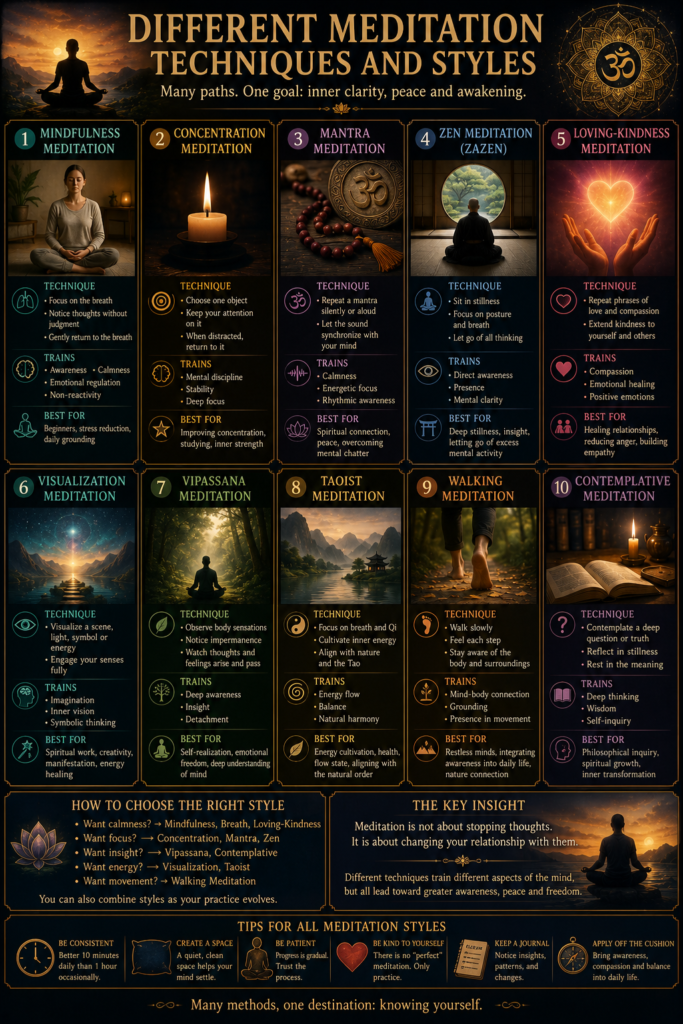
Meditation Is Not One Thing
When most people hear the word “meditation,” they imagine:
- Sitting silently
- Eyes closed
- Emptying the mind
But meditation is actually a massive category of practices developed across:
- Buddhism
- Hinduism
- Taoism
- Yogic traditions
- Mystical Christianity
- Modern psychology
Some methods focus on:
- Calmness
Others focus on:
- Awareness
- Energy
- Concentration
- Spiritual insight
- Emotional healing
The important realization is:
There is no single “correct” meditation style.
Different techniques train:
→ different aspects of consciousness.
1. Mindfulness Meditation


This is the most widely taught modern form.
The goal:
→ Observe thoughts without attachment.
Technique
- Sit comfortably
- Focus on breathing
- Notice thoughts as they arise
- Return attention gently to the breath
Trains
- Emotional regulation
- Awareness
- Focus
- Non-reactivity
Best For
- Beginners
- Stress reduction
- Daily grounding
2. Concentration Meditation (Focused Attention)


Instead of observing everything, this method narrows attention onto:
- Breath
- Candle flame
- Mantra
- Sound
- Symbol
Goal
→ Strengthen sustained attention.
Trains
- Mental discipline
- Stability
- Deep focus
Common Challenge
- Mental restlessness
3. Mantra Meditation


This style uses:
→ repeated sound or phrases
Examples:
- “Om”
- Sanskrit mantras
- Sacred names
- Repetitive prayer formulas
Why It Works
Repetition stabilizes:
- Attention
- Emotional rhythm
- Mental noise
Trains
- Calmness
- Energetic focus
- Rhythmic consciousness
4. Zen Meditation (Zazen)


A highly disciplined Buddhist form.
Focus:
→ direct awareness of the present moment.
Often emphasizes:
- Posture
- Breath
- Silence
- Non-conceptual awareness
Goal
→ Radical presence
Distinctive Feature
Zen often avoids:
- Excess symbolism
- Visualization
- Emotional interpretation
5. Loving-Kindness Meditation (Metta)


This meditation develops:
→ compassion and emotional openness
Technique
You mentally repeat phrases like:
- “May I be happy”
- “May others be safe”
- “May all beings be peaceful”
Trains
- Compassion
- Emotional healing
- Reduction of anger and resentment
6. Visualization Meditation


This style actively uses imagination.
Examples:
- Visualizing light
- Sacred geometry
- Energy movement
- Spiritual figures
Used In
- Tibetan Buddhism
- Hermetic traditions
- Energy work systems
Trains
- Imagination
- Symbolic thinking
- Internal sensory awareness
7. Vipassana Meditation
Vipassana means:
→ “insight”
This practice focuses on:
- Observing sensations
- Observing impermanence
- Seeing reality clearly
Key Principle
Everything:
- Arises
- Changes
- Passes away
Trains
- Deep awareness
- Emotional detachment
- Clarity of perception
8. Taoist Meditation


Taoist practices often focus on:
- Energy flow (Qi)
- Breath
- Harmony with nature
- Internal balance
Distinctive Feature
Less forceful than some concentration systems.
More emphasis on:
→ effortless flow and natural alignment
9. Walking Meditation
Meditation does not require sitting still.
Walking meditation involves:
- Slow movement
- Conscious steps
- Awareness of the body in motion
Excellent For
- Restless personalities
- Grounding
- Integrating awareness into daily life
10. Contemplative Meditation


This style focuses on:
→ deep reflection
Questions may include:
- “Who am I?”
- “What is consciousness?”
- “What is reality?”
Common in:
- Mystical traditions
- Advaita
- Sufi practice
- Christian contemplation
Which Meditation Style Is Best?
The answer depends on:
→ your goal
Want calmness?
- Mindfulness
- Breath meditation
Want focus?
- Concentration meditation
Want emotional healing?
- Loving-kindness
Want spiritual symbolism?
- Visualization
- Mantra systems
Want deep awareness?
- Vipassana
- Zen
The Biggest Misunderstanding
Meditation is not:
→ “stopping thoughts”
Thoughts will continue.
The real practice is:
→ changing your relationship to them.
What Usually Happens First
Beginners often notice:
- Increased calmness
- Better focus
- More emotional awareness
- Improved intuition
- Reduced reactivity
Advanced effects:
- Deep stillness
- Altered states
- Expanded awareness
come later with consistency.
The Key Insight
Meditation is less about escaping reality…
…and more about:
→ perceiving it more clearly.
Final Thought
Different meditation systems may look different externally.
But most are attempting to train some combination of:
- Awareness
- Stability
- Presence
- Insight
- Compassion
The style matters less than:
→ consistent practice
Because over time, meditation changes something subtle but profound:
Not necessarily the world around you…
…but:
→ the way your mind experiences it.