
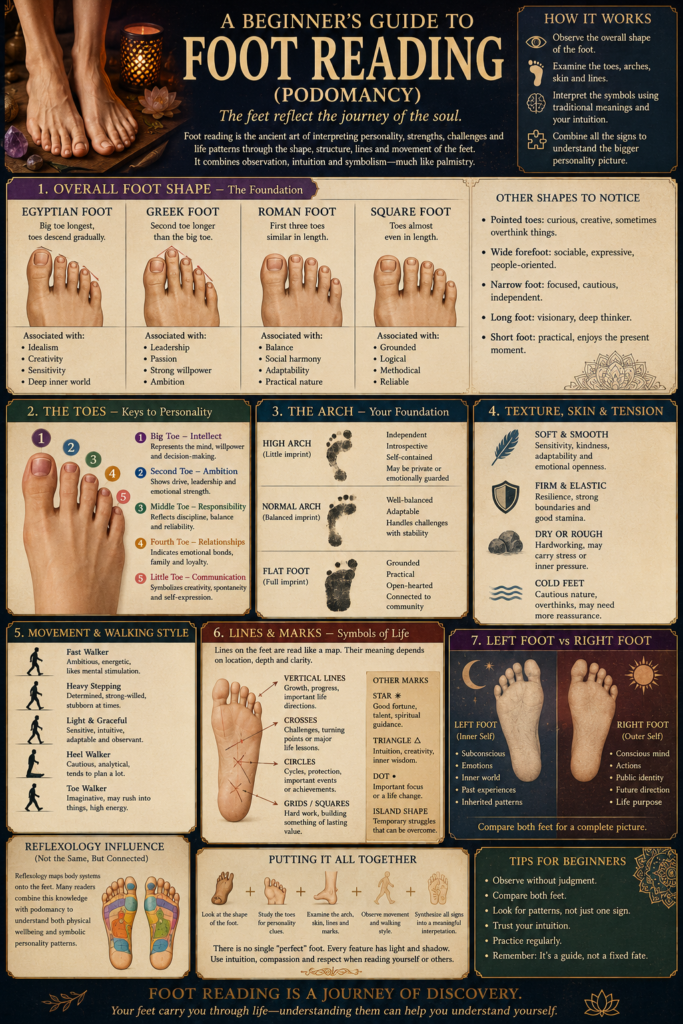
What Is Foot Reading?
Foot reading—sometimes called:
→ podomancy or foot morphology reading
is the practice of interpreting personality traits, emotional tendencies, and symbolic meaning through:
- foot shape
- toe structure
- skin texture
- arches
- movement patterns
- markings and lines
Like palmistry, foot reading exists across multiple traditions including:
- Chinese face/body reading systems
- Indian symbolic traditions
- reflexology-inspired interpretations
- folk divination practices
The idea behind foot reading is that:
the body reflects aspects of personality, energy, and life patterns.
Is Foot Reading Scientific?
Modern science does not recognize foot reading as a proven predictive system.
Most modern practitioners approach it as:
- symbolic interpretation
- intuitive analysis
- personality archetyping
- spiritual or cultural tradition
Much like:
- palmistry
- astrology
- tea leaf reading
its value often lies more in:
→ reflection and symbolism
than literal certainty.
Step 1: Observe the Overall Foot Shape


The first thing readers examine is:
→ the overall structure of the foot.
Different traditions classify feet into symbolic types.
The Egyptian Foot
- Big toe longest
- Other toes descend gradually
Traditionally associated with:
- idealism
- creativity
- emotional sensitivity
- private inner world
The Greek Foot
- Second toe longer than big toe
Often linked to:
- leadership
- passion
- charisma
- strong emotional energy
The Roman Foot
- First three toes similar length
Associated with:
- balance
- practicality
- social adaptability
The Square Foot
- Toes relatively even in length
Traditionally interpreted as:
- grounded
- logical
- methodical
- reliable
Step 2: Read the Toes Individually


In many traditions, each toe symbolizes different psychological functions.
Big Toe
Represents:
- intellect
- decision-making
- consciousness
Large big toe:
→ analytical or mentally active personality
Second Toe
Represents:
- ambition
- drive
- emotional force
Long second toe:
→ strong willpower and leadership tendencies
Middle Toe
Associated with:
- responsibility
- discipline
- structure
Fourth Toe
Linked to:
- relationships
- family
- emotional attachment
Little Toe
Connected with:
- spontaneity
- playfulness
- communication
Small or hidden little toe:
→ reserved or private tendencies
Step 3: Examine the Arch


The arch is often symbolically interpreted as reflecting:
→ emotional and energetic grounding.
High Arches
Traditionally linked to:
- independence
- introspection
- self-containment
Sometimes associated with:
- emotional distance or private inner worlds
Flat Feet
Associated with:
- groundedness
- practicality
- emotional openness
- connection to community
Step 4: Texture, Skin & Tension
Readers may also observe:
- skin texture
- tension patterns
- flexibility
- hardness or softness
Soft Feet
Traditionally interpreted as:
- sensitivity
- emotional openness
- adaptability
Rigid or Tense Feet
May symbolize:
- internal pressure
- emotional guardedness
- strong control tendencies
Step 5: Observe Movement & Walking Style


In some traditions:
→ how a person walks matters more than the static foot shape.
Fast Walkers
Associated with:
- urgency
- ambition
- mental activity
Heavy Stepping
May symbolize:
- determination
- stubbornness
- grounded energy
Light Movement
Linked to:
- adaptability
- sensitivity
- intuition
Step 6: Lines, Marks & Symbols
Like palmistry, some systems examine:
- lines
- crosses
- circles
- unusual markings
These are interpreted symbolically rather than medically.
Vertical Lines
May symbolize:
- growth
- movement
- life direction
Crosses
Often associated with:
- obstacles
- turning points
- major life lessons
Reflexology Influence


Modern foot reading is sometimes blended with:
→ reflexology
Reflexology maps body systems onto the feet.
Although distinct from podomancy, some practitioners combine:
- symbolic interpretation
with - energetic body mapping.
Left Foot vs Right Foot
Many traditions distinguish between the two feet.
Left Foot
Often symbolizes:
- inner world
- subconscious
- emotional self
- inherited tendencies
Right Foot
Associated with:
- outer life
- action
- public identity
- conscious direction
The Most Important Principle: Pattern Reading
Experienced readers do not focus on:
- one isolated feature
Instead they combine:
- foot shape
- toe structure
- posture
- movement
- symbolic consistency
into:
→ a larger personality narrative.
Foot Reading as Symbolic Reflection


Like many symbolic systems, foot reading may work best as:
- reflective insight
- intuitive observation
- self-awareness practice
rather than:
- rigid fortune telling.
A Beginner Exercise
Try observing:
- your own feet first
Ask:
- Which features stand out?
- What symbolic traits seem accurate?
- What feels exaggerated or false?
This develops:
- observation
- symbolic interpretation
- intuitive thinking
Final Thought
Foot reading survives because humans naturally search for meaning through:
- patterns
- symbols
- the body itself
Whether approached:
- spiritually
- psychologically
- culturally
or - symbolically
podomancy reflects an old human belief:
That the body quietly tells stories about the mind, personality, and life journey.
And perhaps that is why systems like palmistry and foot reading continue to fascinate people today:
Because they transform ordinary human features into mirrors of deeper identity.