
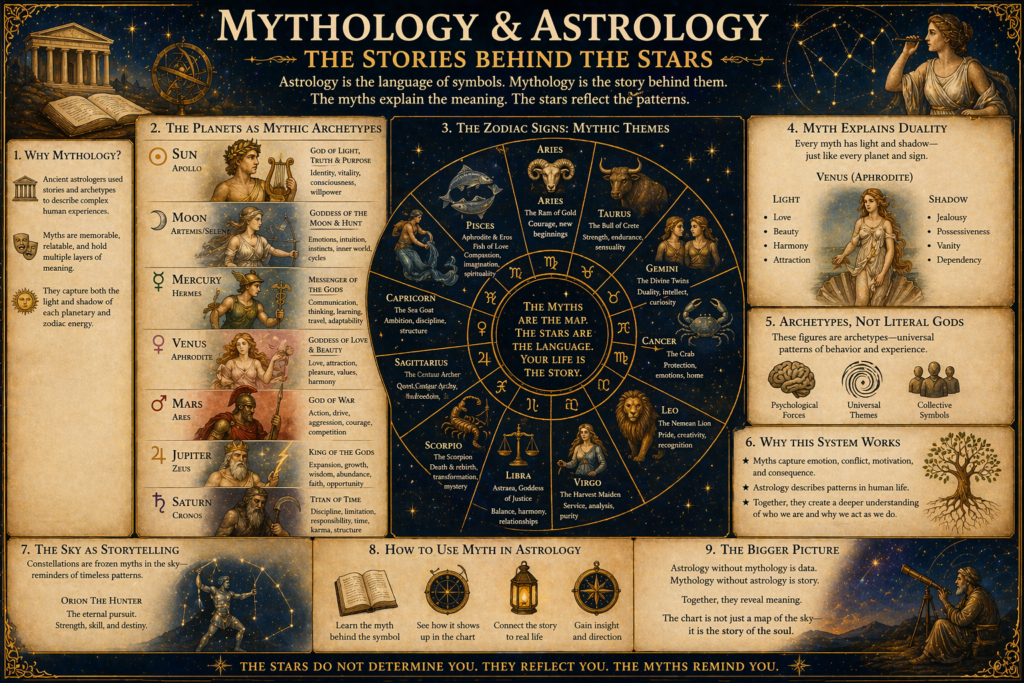
Astrology is often presented as a system of symbols—planets, signs, aspects—but behind those symbols lies something much older and more human:
Mythology.
The names of planets and zodiac signs are not random. They are drawn from ancient myths, primarily Greek and Roman, and those myths are not just decorative—they are instruction manuals for interpretation.
If you understand the mythology, you understand the astrology.
1. Why Mythology Was Used in Astrology
Ancient astrologers needed a way to describe complex patterns of human behavior and natural forces.
Instead of abstract language, they used:
- Stories
- Archetypes
- Characters
Why?
Because stories are:
- Memorable
- Relatable
- Multi-layered
A myth can hold contradictions—just like human behavior.
2. Planets as Living Archetypes
Each planet is associated with a mythological figure whose story reflects its astrological meaning.
☿ Mercury (Hermes): The Messenger
Myth:
Hermes was the messenger of the gods—quick, clever, and able to move between worlds.
Astrology:
- Communication
- Thinking
- Language
- Travel
♀ Venus (Aphrodite): Love and Desire
Myth:
Aphrodite represented beauty, attraction, and desire—but also jealousy and rivalry.
Astrology:
- Relationships
- Attraction
- Pleasure
- Aesthetic sense
♂ Mars (Ares): War and Action
Myth:
Ares was aggressive, impulsive, and driven by conflict.
Astrology:
- Drive
- Aggression
- Courage
- Competition
♄ Saturn (Cronos): Time and Limitation
Myth:
Cronos devoured his children, symbolizing fear, control, and time consuming all things.
Astrology:
- Discipline
- Restriction
- Responsibility
- Time
♃ Jupiter (Zeus): Expansion and Authority
Myth:
Zeus was king of the gods—powerful, expansive, and often excessive.
Astrology:
- Growth
- Opportunity
- Belief systems
- Expansion
3. Zodiac Signs as Mythic Environments
The zodiac signs are not just personality traits—they are settings where mythological themes play out.
Example: Scorpio
Mythic Themes:
- Death and rebirth
- Transformation
- Hidden forces
These themes appear in multiple myths involving:
- The underworld
- Trials
- Regeneration
Example: Leo
Myth:
The Nemean Lion defeated by Hercules.
Astrology:
- Pride
- Strength
- Recognition
- Personal power
Key Insight
The myths provide:
Context for how the energy behaves—not just what it is
4. Myth Explains Contradictions in Astrology
Astrology often confuses people because:
- Signs and planets have both positive and negative traits
Mythology explains why.
Example: Venus
Myth:
- Represents love and beauty
- But also jealousy and rivalry
Astrology
- Can bring harmony
- Or create attachment and conflict
Insight
The myth contains both sides—just like the astrology.
5. Archetypes, Not Literal Gods
Modern astrology does not require belief in the literal gods.
Instead, these figures are understood as:
- Archetypes (patterns of behavior)
- Psychological forces
- Universal themes
This aligns closely with ideas explored by Carl Jung, who saw myths as expressions of the collective unconscious.
6. Mythology as an Interpretive Shortcut
Experienced astrologers often use mythology intuitively.
Instead of memorizing meanings, they think:
- “What would this god do?”
Example
Mars in a chart:
- Not just “drive”
- But: conflict, assertion, impulsiveness—like Ares
Example
Saturn:
- Not just “restriction”
- But: fear, time, pressure—like Cronos
7. Why This System Works So Well
Mythology works because it captures:
- Emotion
- Conflict
- Motivation
- Consequence
All the things that define human experience.
Astrology Without Myth
Feels:
- Dry
- Mechanical
- Hard to interpret
Astrology With Myth
Becomes:
- Intuitive
- Visual
- Story-driven
8. A Deeper Pattern: The Sky as Storytelling
Ancient cultures didn’t just observe the sky—they told stories about it.
The constellations themselves:
- Are mythological scenes
- Represent narratives frozen in the sky
Example
Orion:
- The hunter
- Eternal struggle and pursuit
Insight
Astrology is not just symbolic—it is narrative-based.
9. The Real Connection
At the deepest level, astrology and mythology are doing the same thing:
They are both:
- Mapping human experience
- Describing recurring patterns
- Explaining behavior through archetypes
Final Thoughts
Mythology is not separate from astrology—it is its language.
The planets are not just objects:
- They are characters
The signs are not just categories:
- They are environments
The chart is not just data:
- It is a story
And when you read astrology through mythology, something changes:
It stops being about memorizing meanings—and starts becoming about understanding living patterns.
Because in the end, astrology doesn’t just describe your life—it tells the story of it.