
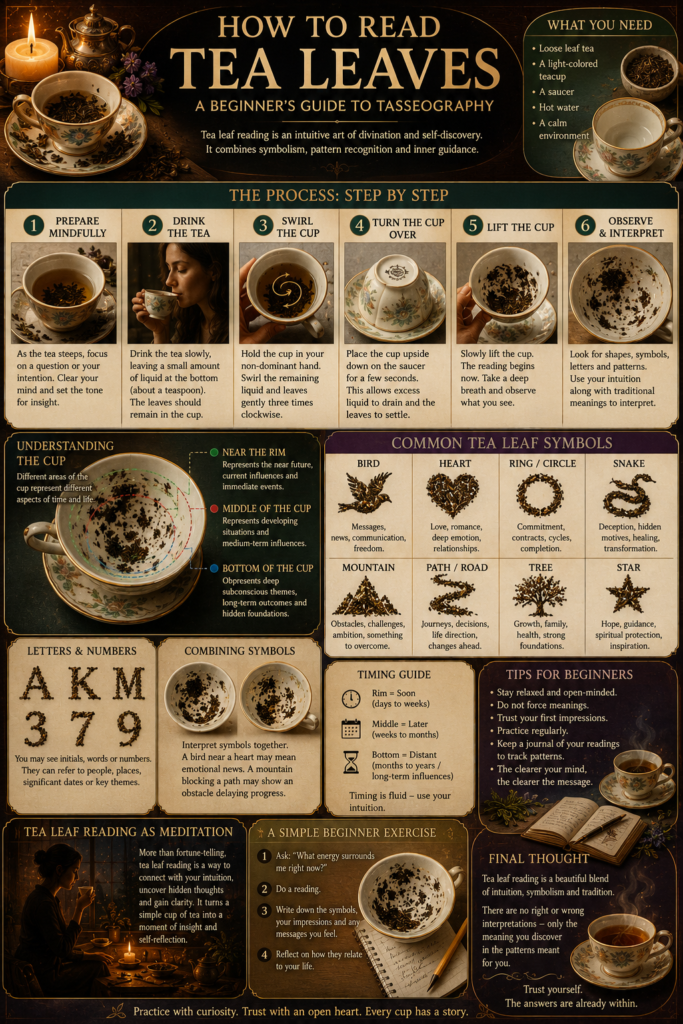
What Is Tea Leaf Reading?
Tea leaf reading—also called:
→ tasseography or tasseomancy
is a divination practice where symbols formed by loose tea leaves are interpreted for insight, guidance, or reflection.
The practice has roots in:
- China
- the Middle East
- Eastern Europe
- Victorian spiritual traditions
At its core, tea leaf reading combines:
- intuition
- symbolism
- pattern recognition
- ritual focus
It is less about “predicting the future with certainty” and more about:
interpreting symbolic patterns emerging from a focused moment.
What You Need


Tea leaf reading is simple to begin.
You’ll Need:
- Loose leaf tea
- A light-colored teacup
- A saucer
- Hot water
- A calm environment
Best Tea Types
Use teas with:
- larger leaves
- textured residue
Traditional choices include:
- black tea
- Earl Grey
- loose herbal blends
Avoid:
- tea bags with fine powder
Step 1: Prepare the Tea Mindfully
Tea leaf reading traditionally begins with:
→ intention
As the tea steeps:
- focus on a question
or - enter a reflective mental state
This helps center attention and symbolic awareness.
Step 2: Drink the Tea


Drink the tea slowly, leaving:
- a small amount of liquid at the bottom
Usually:
- about a teaspoon remains
The leaves should stay inside the cup.
Step 3: Swirl the Cup
Hold the cup in your:
- non-dominant hand (traditionally associated with intuition)
Then:
- swirl the remaining liquid and leaves gently three times clockwise
This spreads the leaves along the cup’s interior.
Step 4: Turn the Cup Over
Place the cup upside down onto the saucer for several seconds.
This allows:
- excess liquid to drain
- leaves to settle into patterns
Then slowly lift the cup.
Now the reading begins.
Understanding the Cup Layout


Different areas of the cup represent different aspects of time and life.
Near the Rim
Represents:
- near future
- current influences
- immediate events
Middle of the Cup
Represents:
- developing situations
- medium-term influences
Bottom of the Cup
Represents:
- deep subconscious themes
- long-term outcomes
- hidden foundations
How Symbols Are Interpreted
Tea leaf reading relies heavily on:
→ symbolic association
You look for:
- shapes
- lines
- animals
- letters
- objects
- patterns
The interpretation combines:
- traditional meanings
and - personal intuition.
Common Tea Leaf Symbols
Birds


Usually associated with:
- messages
- news
- communication
- freedom
Hearts
Represent:
- love
- emotional connection
- relationships
Circles or Rings
Often symbolize:
- commitments
- cycles
- contracts
- completion
Snakes
Traditionally linked to:
- deception
- transformation
- hidden motives
Mountains
Can represent:
- obstacles
- ambition
- challenges requiring effort
Paths or Roads
Symbolize:
- journeys
- decisions
- life direction changes
Letters and Numbers
Sometimes readers notice:
- initials
- dates
- symbolic numbers
These may connect to:
- people
- timing
- themes in the question.
Reading Intuitively Matters


Tea leaf reading is not purely mechanical.
Two people may see:
- different symbols
- different meanings
That’s part of the tradition.
The goal is not:
→ rigid certainty
but:
→ symbolic insight and reflection.
Combining Symbols Into a Story
Experienced readers don’t interpret symbols separately.
They look for:
- relationships between symbols
- emotional tone
- directional flow inside the cup
For example:
- Bird near a heart
→ emotional message or romantic communication - Mountain blocking a road
→ challenge delaying progress
Timing in Tea Leaf Reading
General timing rules often include:
- Rim = soon
- Middle = upcoming months
- Bottom = distant or foundational influences
But timing is usually interpreted loosely rather than literally.
Tea Leaf Reading as Meditation


Many people approach tasseography not as:
- supernatural certainty
but as:
- intuitive meditation
The symbols can reveal:
- unconscious thoughts
- emotional patterns
- inner concerns
- hidden desires
In this sense, tea leaf reading functions similarly to:
- Tarot
- dream interpretation
- symbolic reflection systems.
The Most Important Skill: Observation
Beginners often try too hard to:
- force meaning
- invent dramatic prophecies
But strong readings usually come from:
- calm observation
- symbolic association
- emotional intuition
The clearer and calmer the mind:
→ the easier patterns emerge naturally.
A Simple Beginner Exercise
Start with one question:
“What energy surrounds me right now?”
Do a reading and write down:
- symbols seen
- emotional impressions
- intuitive thoughts
Over time, patterns may become more personally meaningful.
Final Thought
Tea leaf reading has survived for centuries because it transforms an ordinary act—
drinking tea—
into a moment of:
- reflection
- symbolism
- intuition
- stillness
Whether viewed as:
- divination
- psychology
- spiritual ritual
or - artistic intuition
the practice reminds us of something timeless:
Humans naturally search for meaning in patterns.
And sometimes, in the quiet bottom of a teacup, people feel they glimpse a small reflection of their inner world.