
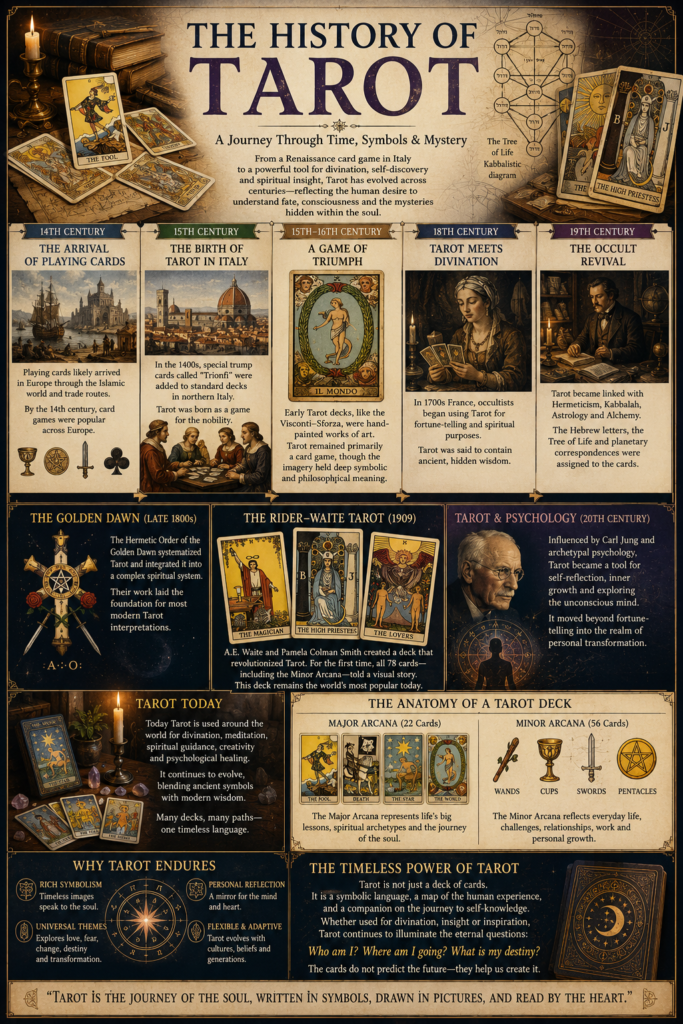
From Card Game to Mystical System
Today, Tarot is associated with:
- Divination
- Spirituality
- Psychology
- Mysticism
- Symbolic insight
But Tarot did not originally begin as an occult tool.
Its earliest history is surprisingly practical.
The Tarot started as:
a card game in Renaissance Europe
Only centuries later did it evolve into the deeply symbolic and esoteric system many people recognize today.
The Origins of Playing Cards


Playing cards likely entered Europe through:
- Islamic regions
- Trade routes connecting East and West
By the 14th century:
- Card games had spread across Europe
These early decks already contained:
- Suits
- Court cards
- Symbolic imagery
The Birth of Tarot in Italy
Most historians trace Tarot’s origins to:
→ 15th-century northern Italy
Especially cities like:
- Milan
- Ferrara
- Florence
The earliest Tarot decks were called:
- Trionfi (“triumphs”)
These decks added special illustrated trump cards to standard playing cards.
The Original Purpose: A Game


Early Tarot was primarily used for:
→ entertainment and gameplay
The cards were often luxurious:
- Hand-painted
- Commissioned by nobility
- Artistically elaborate
One famous example:
→ the Visconti-Sforza decks
These early decks already contained many recognizable images:
- The Fool
- Death
- The Magician
- The Wheel of Fortune
But they were not originally used for fortune telling.
The Major Arcana Emerges
The trump cards eventually became known as:
→ the Major Arcana
These symbolic images represented:
- Human experiences
- Virtues
- Fate
- Power
- Mortality
- Transformation
Even early on, the imagery carried:
→ psychological and philosophical depth.
Tarot and Divination Begin


Tarot gradually shifted toward divination during the:
- 18th century
This transformation happened largely in France.
Writers and occultists began claiming:
- Tarot contained hidden ancient wisdom
- Secret mystical teachings were encoded in the cards
This dramatically changed Tarot’s cultural identity.
The Egyptian Myth
One influential theory claimed Tarot originated in:
→ ancient Egypt
This idea became extremely popular among occultists.
However:
- historians generally reject this theory
There is little historical evidence connecting Tarot directly to ancient Egypt.
Still, the Egyptian myth deeply shaped:
- Tarot symbolism
- Occult interpretation
- Esoteric fascination
The Rise of Occult Tarot


During the 18th and 19th centuries, Tarot became increasingly linked to:
- Hermeticism
- Astrology
- Alchemy
- Kabbalah
Occultists began developing systems connecting Tarot to:
- Hebrew letters
- The Tree of Life
- Planetary symbolism
- Spiritual transformation
Tarot evolved from:
→ a card game
into:
→ a symbolic map of consciousness.
The Golden Dawn Revolution
A massive turning point came through:
→ Hermetic Order of the Golden Dawn
This 19th-century esoteric order heavily systematized Tarot symbolism.
They connected Tarot with:
- Astrology
- Kabbalah
- Ceremonial magic
- Mystical psychology
Many modern Tarot systems descend from Golden Dawn influence.
The Rider-Waite Tarot


One of the most influential decks ever created was:
→ the Rider-Waite Tarot
Published in 1909, it was developed by:
- Arthur Edward Waite
with artwork by: - Pamela Colman Smith
This deck transformed Tarot permanently because:
- Every card contained rich symbolic scenes
- Even minor arcana became visually narrative
Most modern decks descend directly from this structure.
Tarot and Psychology
In the 20th century, Tarot increasingly became interpreted psychologically rather than purely mystically.
Thinkers influenced by:
→ Carl Jung
saw Tarot as:
- Archetypal symbolism
- Mirrors of the unconscious mind
- Tools for self-reflection
This broadened Tarot’s appeal beyond occult circles.
Modern Tarot Today


Today Tarot exists in many forms:
- Spiritual tool
- Psychological mirror
- Artistic expression
- Divination practice
- Self-development system
Some people use Tarot:
- Mystically
Others use it:
- Symbolically or therapeutically
Its meaning varies enormously depending on the practitioner.
Why Tarot Endured
Tarot survived for centuries because it combines:
- Symbolism
- Storytelling
- Archetypes
- Mystery
- Personal reflection
The cards speak through:
→ images rather than rigid doctrine.
That flexibility allowed Tarot to evolve across:
- cultures
- religions
- philosophies
- psychological systems
The Deeper Power of Tarot
At its core, Tarot functions almost like:
→ a symbolic language of human experience.
The cards explore:
- Fear
- Desire
- Change
- Loss
- Growth
- Transformation
- Fate
- Consciousness
These themes are timeless.
Final Thought
The history of Tarot is not the story of one fixed tradition.
It is the story of:
- a card game
becoming - a mystical system
becoming - a psychological mirror
becoming - a modern spiritual language.
And perhaps that evolution explains why Tarot still fascinates people today:
Because beneath the artwork and symbolism lies something deeply human:
The desire to understand the hidden patterns shaping our lives.